

Better Call is still s’all good, man

Advertisement
Read this article for free:
or
Already have an account? Log in here »
To continue reading, please subscribe:
Monthly Digital Subscription
$1 per week for 24 weeks*
- Enjoy unlimited reading on winnipegfreepress.com
- Read the E-Edition, our digital replica newspaper
- Access News Break, our award-winning app
- Play interactive puzzles
*Billed as $4.00 plus GST every four weeks. After 24 weeks, price increases to the regular rate of $19.95 plus GST every four weeks. Offer available to new and qualified returning subscribers only. Cancel any time.
Monthly Digital Subscription
$4.99/week*
- Enjoy unlimited reading on winnipegfreepress.com
- Read the E-Edition, our digital replica newspaper
- Access News Break, our award-winning app
- Play interactive puzzles
*Billed as $19.95 plus GST every four weeks. Cancel any time.
To continue reading, please subscribe:
Add Free Press access to your Brandon Sun subscription for only an additional
$1 for the first 4 weeks*
*Your next subscription payment will increase by $1.00 and you will be charged $16.99 plus GST for four weeks. After four weeks, your payment will increase to $23.99 plus GST every four weeks.
Read unlimited articles for free today:
or
Already have an account? Log in here »
Hey there, time traveller!
This article was published 29/02/2020 (2240 days ago), so information in it may no longer be current.
Better Call Saul (Season 5 on AMC, Mondays at 8:00 p.m.; Seasons 1-4 streaming on Netflix) is back, the crime drama and human comedy that follows the moral transformation of Jimmy McGill, a small-time grifter with a good heart, into the ethically elastic underworld of lawyer Saul Goodman. Since its 2015 debut, this prequel to Breaking Bad has become that rare thing, a spin-off that surpasses its source.
For me, the very best part of a new go-round of BCS is the black-and-white sequence that kicks off the first episode of every season. These small vignettes follow the sad ongoing saga of Gene Takovic, Midwestern Cinnabon manager and the third identity of the Jimmy McGill/Saul Goodman character played with such slippery brilliance by Bob Odenkirk.
This season’s Gene installment was unusually long, clocking in at 13 minutes. Our first brief view of the character in Season 1 suggested a man always looking over his shoulder, and now those amorphous threats are coming into focus. As pressures intensifies, the “Cinnabon Gene” story is becoming a compelling little sub-narrative of its own, a tense, cinnamon-scented example of suburban-shopping-mall noir.
These flash-forwards are based on what seemed like an offhand remark in the penultimate episode of Breaking Bad, when Saul Goodman talks to crime confederate Walter White as Walt’s drug empire is imploding and the desperate survivors are preparing to disappear: “If I’m lucky, month from now, best-case scenario, I’m managing a Cinnabon in Omaha.”
As a best-case scenario, it’s pretty bleak. Gone are the big-talking bravado and loopy optimism of Saul Goodman, as we watch Gene, with a hangdog moustache and a defeated slump, go through the repetitive tasks of his workday and the dreary isolation of his Nebraska winter nights.
There are lots of close-up shots of dough machines, lots of panoramas of bland, empty shopping mall halls. So why is the Cinnabon Gene story so fascinating?
There is the complex use of time, kind of a trademark of BCS co-creators Vince Gilligan and Peter Gould. Though the Gene sequences are shown in black and white and accompanied by old-timey music – things we usually associate with nostalgia – they are set after the main narratives of both Better Call Saul and Breaking Bad. The passage of years is marked by Gene’s receding hair.
Because Better Call Saul is a reverse-engineered prequel, moving slowly and inevitably toward the known outcomes of Breaking Bad, there’s a certain dark irony in watching Jimmy/Saul wrestling with a series of small moral choices even as we know he’s heading into predetermined disaster.
The Gene sequences vault over both these narratives, offering a glimpse – just a glimpse – of an unknown future.
There’s also an emotional poignancy to this tricky timeline. Poor old Gene contains the hopes of Jimmy McGill and the regrets of Saul Goodman. Sitting on a mall bench eating his bagged lunch and reading — for some odd, unexplained reason – a paperback copy of David Niven’s 1971 autobiography The Moon’s a Balloon, Gene brings together all the bruised humanity of his previous incarnations.
The Cinnabon Gene story — with its pared down and precise look — also functions as a neat stylistic exercise. The black, white and grey palette contrasts with the lurid, bleeding colours of the show’s opening credits. The quiet, often dialogue-free scenes are nothing like Saul’s perpetual sales-pitching.
These scenes also extend the series’ fascination with mundane processes. There are sequences that could be part of a good-looking Cinnabon training film, with patient, detailed shots of Gene kneading dough, slathering icing, cleaning tables, taking out the trash, closing up and cashing out.
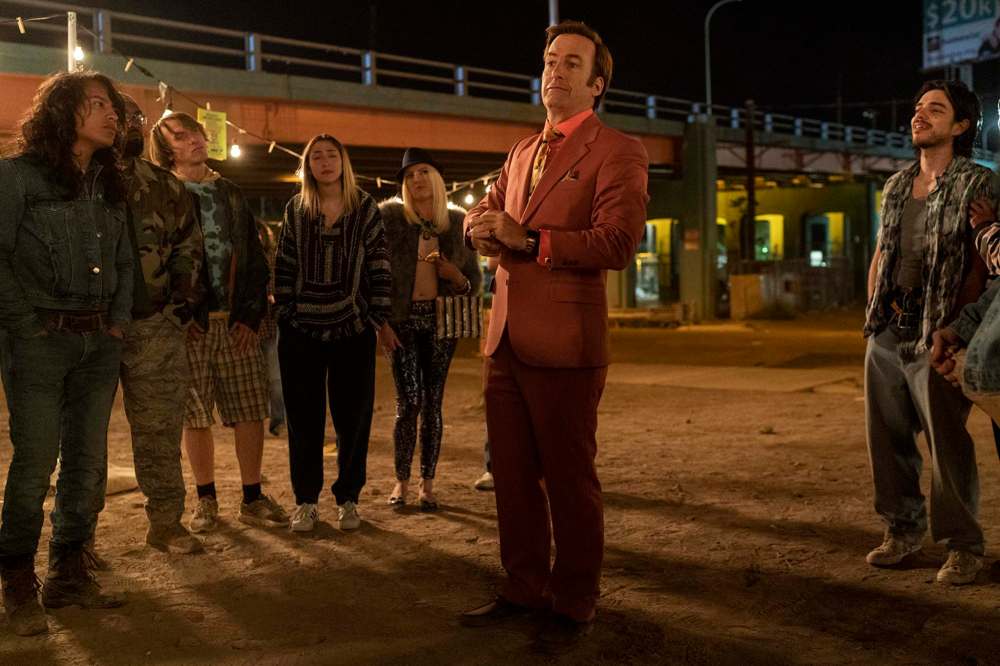

Spread out over five seasons, the juxtaposition of these ordinary tasks with a rising threat level – Gene is scared of law enforcement but maybe even more scared of old criminal associates – has been crafting a slow, steady tension.
The Season 5 opener, which picks up where the Season 4 instalment left off, sees Gene encountering a cabbie who pretends to be a Saul Goodman superfan from Albuquerque but actually seems to be shaking him down. With cheerful menace, he forces Gene to deliver Saul’s old catch phrase, “Better Call Saul.” “Say it,” he demands. “And do the point.”
A panicked Jimmy/Saul/Gene ends up calling our favourite vacuum repairman (the late, great Robert Forster, who died in 2019 and whom we get to see one last time) and requesting an adapter for a “Hoover Max Extract Pressure Pro Model 60,” code for a very expensive procedure that takes people in trouble and helps them disappear.
But Gene Takovic can’t really disappear, any more than Jimmy McGill or Saul Goodman can. They’re all here in these black-and-white openers, and they’re headed to some kind of reckoning.
alison.gillmor@freepress.mb.ca
Studying at the University of Winnipeg and later Toronto’s York University, Alison Gillmor planned to become an art historian. She ended up catching the journalism bug when she started as visual arts reviewer at the Winnipeg Free Press in 1992.
Our newsroom depends on a growing audience of readers to power our journalism. If you are not a paid reader, please consider becoming a subscriber.
Our newsroom depends on its audience of readers to power our journalism. Thank you for your support.
Studying at the University of Winnipeg and later Toronto’s York University, Alison Gillmor planned to become an art historian. She ended up catching the journalism bug when she started as visual arts reviewer at the Winnipeg Free Press in 1992.
Our newsroom depends on a growing audience of readers to power our journalism. If you are not a paid reader, please consider becoming a subscriber.
Our newsroom depends on its audience of readers to power our journalism. Thank you for your support.
Advertisement Advertise With Us
Advertisement Advertise With Us