

Bundesliga plans quick return
Germany has put up effective fight against COVID-19
Advertisement
Read this article for free:
or
Already have an account? Log in here »
To continue reading, please subscribe:

Digital Subscription
One year of digital access for only $205*
- Enjoy unlimited reading on winnipegfreepress.com
- Read the E-Edition, our digital replica newspaper
- Access News Break, our award-winning app
- Play interactive puzzles
*First annual payment billed as $205.00 + GST for one year. This annual subscription will automatically renew at $233.00 + GST every 52 weeks (10% off the regular annual price of $259.35). Offer available to new and qualified returning subscribers only. Cancel any time.
To continue reading, please subscribe:
Add Free Press access to your Brandon Sun subscription for only an additional
$1 for the first 4 weeks*
- Enjoy unlimited reading on winnipegfreepress.com
- Read the E-Edition, our digital replica newspaper
- Access News Break, our award-winning app
- Play interactive puzzles
*Your next Brandon Sun subscription payment will increase by $1.00 and you will be charged $17.95 plus GST for four weeks. After four weeks, your payment will increase to $24.95 plus GST every four weeks.
Read unlimited articles for free today:
or
Already have an account? Log in here »
Hey there, time traveller!
This article was published 11/04/2020 (2369 days ago), so information in it may no longer be current.
While much of world football, like the world at large, has been playing the coronavirus game by ear — adjusting on the fly — the Bundesliga has been meticulously planning its return. As a result, the German top flight is likely to resume more quickly than anyone would have thought as recently as earlier this week.
Late last month, after suspending both the Bundesliga and Bundesliga 2 until April 30, the Deutsche Fussball Liga (DFL) immediately began planning the resumptions of the divisions it oversees.
During the same meeting in which Germany’s professional football was postponed, the country’s football authorities also struck a “Sports Medicine/Special Match Operations Task Force” and initiated “location-specific production concepts” for TV-only matches.
The task force has since been centrally recording the COVID-19 cases at the 36 member clubs, enforcing strict measures to prevent transmission in line with public health directives, and overseeing a comprehensive testing process.
Headed by four university doctors, it has also been considering a timeline for the “medically justifiable resumption” of football activities.
Meanwhile, the DFL has been gauging the readiness of its clubs to contest the nine matchdays remaining on the schedule.
And so, as English Premier League players and teams are being turned into political footballs, and while COVID-19 cases are only starting to ebb in Italy and Spain, training has already restarted in Germany with an eye to a full slate of matches on May 9, and perhaps as early as May 2 — three weeks from today.
By the end of June, the Bundesliga could well be concluded.
It goes without saying that none of this would be possible were it not for a public health response to the global pandemic that puts much of the rest of the world, including Canada, to shame.
By and large, Germany has been testing far more people than its European neighbours and North American peers. Naturally, this means that its death rate appears lower, although a health system with a ready availability of intensive care beds and ventilators allowed its hospitals to bear the additional weight from the start. In fact, patients with even mild symptoms have been able to receive hospital treatment, boosting overall recovery.
Social-distancing measures were also being rigorously observed while, for example, Londoners were still going to the pub and the British government was openly discussing “herd immunity.”
The Premier League, consequently, will not be back anytime soon, while Serie A and La Liga similarly entertain wild aspirations of July resumptions.
Professional sports, while operating as parallel economies and alternate realities, are nevertheless mere reflections of society as a whole — a truth the coronavirus has only underlined. In that light, it makes sense that German football is in better shape than most.
By the same token, sports in Canada will almost certainly be ready to relaunch long before teams and leagues in the United States, where private, patchwork health care and incompetent administration are combining to produce the chaos of a failed state.
All that said, sports in their pre-COVID-19 version are gone until a vaccine or some other, yet unforeseen breakthrough ushers in a post-COVID-19 world.
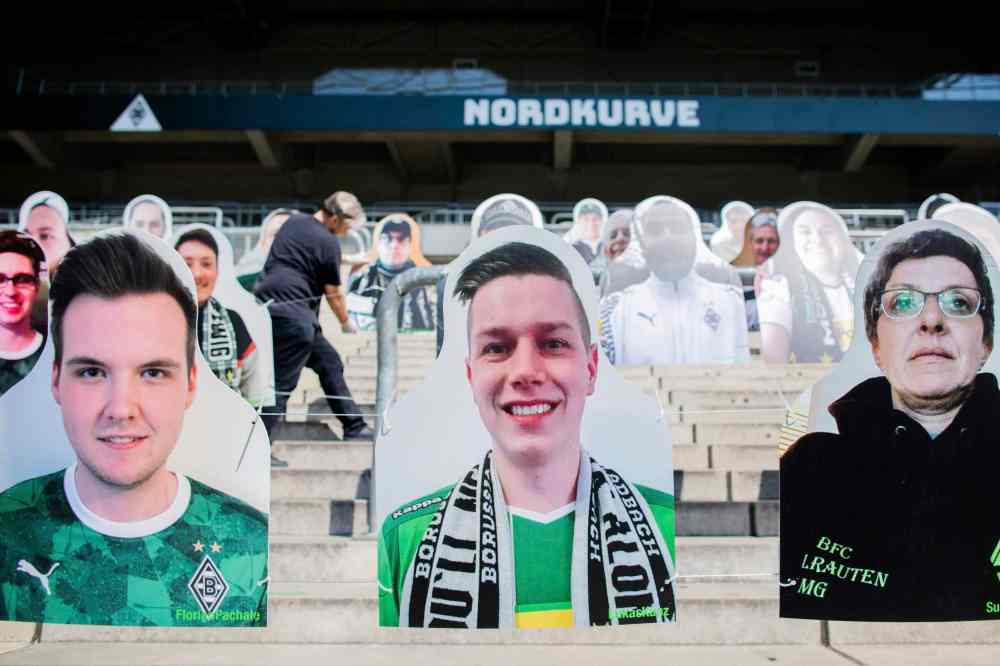
Football is no exception. In real terms, it means stadium attendance will be prohibited or, perhaps eventually, strictly limited going forward. Even broadcast production will have to be thoroughly scrutinized.
In Germany, according to the New York Times, it will take 240 people to put on a Bundesliga match for TV-specific consumption. Among them will be a sizeable team of specialists assigned to monitor the health conditions of the event.

What’s still unclear is whether the players, coaches, support staff and broadcast personnel—workers all—will be comfortable with what will shortly be proposed to them.
That’s what remains most important in all this: people, and their individual anxieties in unprecedented circumstances. No doubt the DFL will respect those concerns. But what German football has done, even if it doesn’t go ahead as planned, is plot out a way back for its industry. None of this is perfect. For now, however, theirs is the template.
jerradpeters@gmail.com
Twitter @JerradPeters
Our newsroom depends on a growing audience of readers to power our journalism. If you are not a paid reader, please consider becoming a subscriber.
Our newsroom depends on its audience of readers to power our journalism. Thank you for your support.
Our newsroom depends on a growing audience of readers to power our journalism. If you are not a paid reader, please consider becoming a subscriber.
Our newsroom depends on its audience of readers to power our journalism. Thank you for your support.
Related Articles
Former Chelsea goalkeeper Peter Bonetti dies at age 78






Advertisement Advertise With Us
Advertisement Advertise With Us