

What? Is this a dumb joke?
Barcelona's stated intention to join 'Super League' hard to handle
Advertisement
Read this article for free:
or
Already have an account? Log in here »
To continue reading, please subscribe:

Digital Subscription
One year of digital access for only $205*
- Enjoy unlimited reading on winnipegfreepress.com
- Read the E-Edition, our digital replica newspaper
- Access News Break, our award-winning app
- Play interactive puzzles
*First annual payment billed as $205.00 + GST for one year. This annual subscription will automatically renew at $233.00 + GST every 52 weeks (10% off the regular annual price of $259.35). Offer available to new and qualified returning subscribers only. Cancel any time.
To continue reading, please subscribe:
Add Free Press access to your Brandon Sun subscription for only an additional
$1 for the first 4 weeks*
- Enjoy unlimited reading on winnipegfreepress.com
- Read the E-Edition, our digital replica newspaper
- Access News Break, our award-winning app
- Play interactive puzzles
*Your next Brandon Sun subscription payment will increase by $1.00 and you will be charged $17.95 plus GST for four weeks. After four weeks, your payment will increase to $24.95 plus GST every four weeks.
Read unlimited articles for free today:
or
Already have an account? Log in here »
Hey there, time traveller!
This article was published 30/10/2020 (2165 days ago), so information in it may no longer be current.
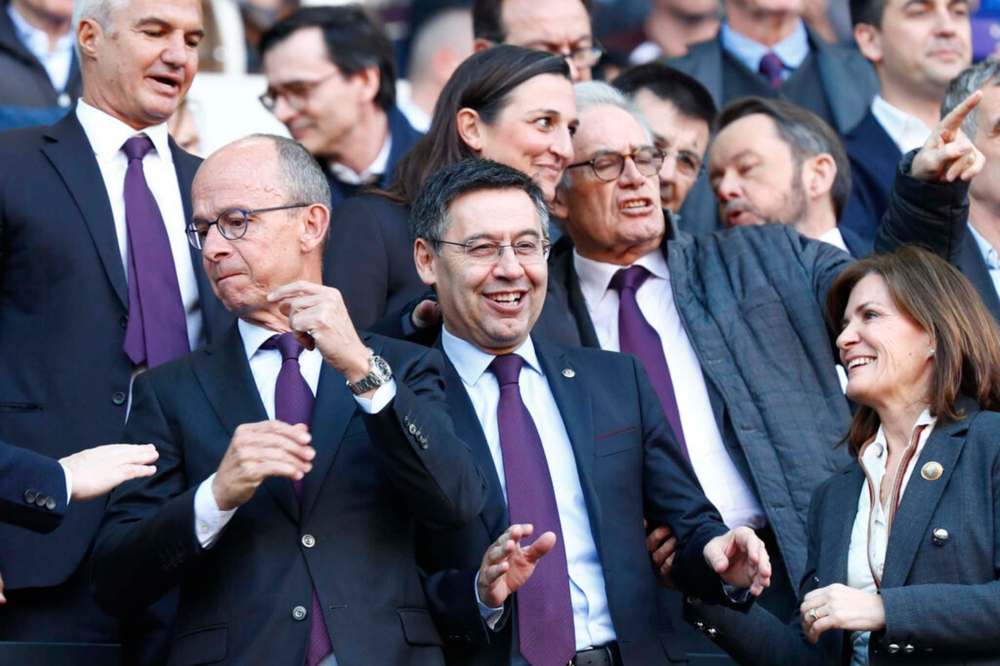
Josep Maria Bartomeu did not go quietly into the night. Facing mounting pressure following Barcelona’s 8-2 loss to Bayern Munich back in August, the club president and his entire board resigned Tuesday evening, a weighty decision that saved at least some face ahead of elections they were almost certain to lose.
Increasingly unpopular for failing to adequately rebuild the squad, and likely a precondition for Lionel Messi’s continued tenure at Camp Nou, Bartomeu and his deputies fell on their swords to appease the best player in the world, but not before they tossed a grenade at both the club and European football generally.
It was only two sentences, but Bartomeu’s explosive remarks revealed a controversial future for club football on the continent: “Barcelona have accepted a proposal to play in the European Super League,” he stated, as per Sport. “This would guarantee the financial viability of the club going forward.”
And with that, the existence of the UEFA Champions League was thrown into doubt, never mind the formats of Europe’s domestic competitions. Although the idea of a Super League, composed of the UEFA regions most famous clubs, had been bandied about previously, until Tuesday no club owner, president or director of football had addressed it so explicitly.
Until Tuesday, the European Super League was merely a notion. Bartomeu, in his final act as Blaugrana president, brought it from the hypothetical to the imminent.
Nevertheless, neither he nor any of his now-former colleagues know exactly what the tournament will look like. It may have 16 teams, or 18, and resemble Euroleague basketball, where playoffs follow a home-and-away round robin. Or, it may consist of a single table. Participants could simply add the Super League to their schedules. Or, they could scrap secondary cup competitions and pull out of the Champions League altogether.
The lack of hard details would seem to suggest that Europe’s biggest clubs might simply be applying pressure to UEFA for more control over what is now club football’s most prestigious competition. But if they’re not, if they’re serious about a break from the current continental system, then they’re essentially blowing up the bottom-to-top pyramid structure that served them well until they didn’t need it anymore.
In economic terms, they are the one per cent. They used the system to their benefit for more than a century and grew in status and stature by beating the teams in front of them. It’s important to remember that.
None of Barcelona, Bayern Munich, Juventus and Manchester United became big clubs by birthright. Rather, they emerged and grew in strength over time by winning matches. They needed to beat domestic and continental rivals to advance their reputations, to become “big clubs.” But big clubs don’t exist unless there are “small clubs,” and what the creation of a Super League suggests is that small clubs are no longer necessary. It’s football-Darwinism in the extreme, and the sport stands to suffer as a result.
Predictably, the motivating factor here is money. As lucrative as the Champions League is, television revenue is still split among dozens of teams, many of which do not hail from one of Europe’s top divisions. The Super League will do away with that, further concentrating TV and sponsorship wealth among clubs that already have no shortage of it. They’ll also be free to spend as much as they’d like on players as UEFA’s Financial Fair Play regulations — which are never meaningfully enforced — won’t apply.
Then there is the FIFA.
World football’s governing body has long been jealous of the Champions League’s profits, and it’s possible that they could sanction the Super League themselves. They’re also planning to revamp and expand the Club World Cup, and as Bartomeu seemed to suggest in his Tuesday press conference, that event comes part and parcel with the Super League.
All that said, there is an arbitrariness to the launch of a European Super League that makes it look even more ridiculous. For example, a group of 11 clubs — they call themselves the “founding clubs” — would automatically enter every year for the next 20 years. They’d be joined by five or seven qualified opponents, but never from outside the divisions of England, France, Germany, Italy and Spain.
In other words, 2020 is the gate. If a club wasn’t considered sufficiently “big” by this year, tough beans. It’ll maybe have a chance to go through to the other side in 2040. After all, the Super League is not about competitiveness; it’s about money, about cashing in on matchups that are currently considered marquee but would become run-of-the-mill after a season or two.
The Champions League, don’t forget, can attribute much of its success to date to the novelty of high-profile matches, of Liverpool vs. Paris Saint-Germain, AC Milan vs. Borussia Dortmund, Real Madrid vs. Manchester City. They’re special because they don’t happen all the time. Upsets, too, give the Champions League a certain allure.
That allure, that novelty, would wear off, and quickly, in a Super League. Beyond one or two seasons of being the shiny new thing, it would be a terrible business decision. And business, obviously, is its raison d’etre.
Incidentally, Barcelona will have a lot to say about a Super League’s feasibility. Yes, Bartomeu announced that he had accepted an invitation to the competition on behalf of the club, but it doesn’t exactly work that way.

In the coming months a plebiscite will be put to Barcelona members, or socios, asking them if they want to participate in the new league. A “yes” vote would increase the movement’s momentum; “no” would be a bellwether of what might be widespread dislike of the Super League among fans.
Here’s hoping they vote against it.
A European Super League is at best a silly idea; at worst, an insufferable gimmick.
jerradpeters@gmail.com
Twitter @JerradPeters
Our newsroom depends on a growing audience of readers to power our journalism. If you are not a paid reader, please consider becoming a subscriber.
Our newsroom depends on its audience of readers to power our journalism. Thank you for your support.
Our newsroom depends on a growing audience of readers to power our journalism. If you are not a paid reader, please consider becoming a subscriber.
Our newsroom depends on its audience of readers to power our journalism. Thank you for your support.
Related Articles
Pozuelo scores in 84th, Toronto FC beats Inter Miami 2-1






Advertisement Advertise With Us
Advertisement Advertise With Us