

Returning to normal, bit by bit
.
Advertisement
Read this article for free:
or
Already have an account? Log in here »
To continue reading, please subscribe:

Digital Subscription
One year of digital access for only $205*
- Enjoy unlimited reading on winnipegfreepress.com
- Read the E-Edition, our digital replica newspaper
- Access News Break, our award-winning app
- Play interactive puzzles
*First annual payment billed as $205.00 + GST for one year. This annual subscription will automatically renew at $233.00 + GST every 52 weeks (10% off the regular annual price of $259.35). Offer available to new and qualified returning subscribers only. Cancel any time.
To continue reading, please subscribe:
Add Free Press access to your Brandon Sun subscription for only an additional
$1 for the first 4 weeks*
- Enjoy unlimited reading on winnipegfreepress.com
- Read the E-Edition, our digital replica newspaper
- Access News Break, our award-winning app
- Play interactive puzzles
*Your next Brandon Sun subscription payment will increase by $1.00 and you will be charged $17.95 plus GST for four weeks. After four weeks, your payment will increase to $24.95 plus GST every four weeks.
Read unlimited articles for free today:
or
Already have an account? Log in here »
Hey there, time traveller!
This article was published 04/12/2020 (2134 days ago), so information in it may no longer be current.
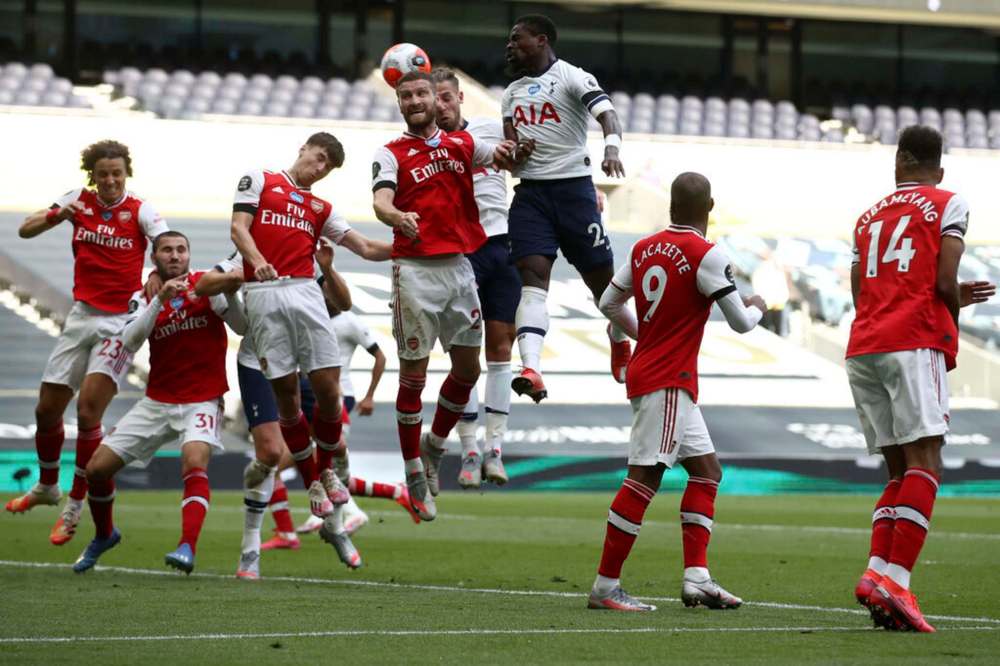
It rather jumped out at me this week as I looked ahead to the North London Derby: there will be fans inside Tottenham Hotspur Stadium for Sunday’s visit of arch rivals Arsenal (10:30 a.m., DAZN).
Not a lot of fans, it goes without saying. England was on national lockdown until Wednesday, and strict reopening rules mean only 10 Premier League grounds can reintroduce supporters, and only 2,000 per match. Ticket holders will have their temperatures checked upon arrival, and masks are mandatory.
As an advisory measure, crowds are being asked to keep singing and shouting to a minimum. We’ll see how that goes.
Back in March, when the coronavirus initially forced the complete shutdown of sports leagues around the world, I chatted with my media-scholar friend, Dr. Nicholas Greco of Providence University College (buy his U2 book for the U2 lover in your life), about the meaning of live audiences to sporting events.
I cited parts of our conversation in a Free Press column at the time — was it only nine months ago? — and we dealt mostly with the feedback loop that happens between players and fans, and how that loop impacts both the contest in the arena and the televised product for viewers at home, or in a pub. Remember those?
Dr. Greco also pointed out that as TV and streaming-service consumers, we’re watching, participating with, whatever the camera is showing us. And the actual game makes up only half or even a third of the broadcast. Personally, I need to see in-stadium fans to sense the spectacle of the event, for it to produce an element of occasion, to communicate that it’s an undertaking of some magnitude and therefore worth my attention.
I’m not alone. Following the euphoria that accompanied the returns of team sports in the summer, ratings plummeted. It’s not because we had other things to do. We didn’t. I guess we watched whatever else was on.
At various intervals over the last few months, I’ve made my opinion clear as to the playing of professional sports pre-vaccine: I don’t think it should be happening. Am I complicit? I suppose I am, given that I still watch several games each week. I’ll admit that. I’ll also admit that I’m more likely to watch a game if there are fans in the stands, even a limited number of them.
I just don’t see the point of playing in front of no one. And on a theoretical level, empty arenas tell us to consume the product in a manner we’re not at all used to, at least when it comes to professional sports.
When we go to the cinema — remember those? — we readily suspend our beliefs as demanded by the spaces and times of the film. We do it to connect with what’s playing on the screen. If we don’t, or can’t, a link is broken that leaves us at best dispassionate, at worst disoriented.
Live sports are unique in that, unlike films, they exist in real time. No suspension required. That is, until now.
For us average viewers, in-stadium supporters are the people with whom we can most identify when watching a game on television. They tell us that what we’re watching is real, and really happening now, and happening for them, for us. Without them, we’re compelled to suspend some belief, and in doing so approach the product more like a movie than a match.
We disconnect from what’s still happening live, and when disconnected we become disinterested, as the summer TV numbers bear out. Don’t forget: it’s the fans who create the notion of spectacle, not the players.
I recently shared these thoughts with Dr. Greco via text, as much to double-check that I wasn’t out to lunch as to acquire some feedback. It seems the jury is still out, although he did oblige with some comments.
“It’s true,” he replied (Win!). “That’s why for some viewers — me included — piped-in fan noise actually makes the event seem ridiculous, like a laugh-track in a drama. We need to work even harder.”
He added that a sports broadcast, of which the actual game makes up only half or a third of the presentation, already includes interstitial material such as advertisements and other mediation that further separate us from the action. We’re already working to feel a part of what’s going on. An empty stadium obliterates our efforts.
At present — and if we’ve learned anything during COVID-19, it’s that the situation is fluid — the Premier League is hoping to have up to 20,000 fans in its grounds by May. And that’s assuming the country is mostly vaccinated by then.
In other words, the road back to normal, at least as professional sports are concerned, is a long one, neither smooth nor straight. But the North London Derby, at least, will feel a bit more normal on Sunday.
Bit by bit. That’s how we get through. Bit by bit.
jerradpeters@gmail.com
Twitter @JerradPeters

Spot-kicks
· Spurs manager Jose Mourinho has yet to lose at home to Arsenal across all competitions.
· Harry Kane has scored 10 career goals for Tottenham against the Gunners, tied for first in derby history with Emmanuel Adebayor and Bobby Smith.
· Arsenal, 14th in the standings, have won just once in the Premier League in two months.
jerradpeters@gmail.com
Twitter @JerradPeters
Our newsroom depends on a growing audience of readers to power our journalism. If you are not a paid reader, please consider becoming a subscriber.
Our newsroom depends on its audience of readers to power our journalism. Thank you for your support.
Our newsroom depends on a growing audience of readers to power our journalism. If you are not a paid reader, please consider becoming a subscriber.
Our newsroom depends on its audience of readers to power our journalism. Thank you for your support.
Related Articles
Madrid on the brink in CL group stage; Messi vs Ronaldo MATCHDAY: Brighton hosts Southampton, Valencia visits Eibar Crew downs Revolution 1-0 to reach MLS Cup final Spurs beat Arsenal to stay top, fans return to Anfield Liverpool charges to 4-0 win over Wolves in EPL AP Interview: Qatar plans 'normal' World Cup after vaccines

Advertisement Advertise With Us
Advertisement Advertise With Us