

Italy finds balance
Mancini builds contender around players' strengths
Advertisement
Read this article for free:
or
Already have an account? Log in here »
To continue reading, please subscribe:

Digital Subscription
One year of digital access for only $205*
- Enjoy unlimited reading on winnipegfreepress.com
- Read the E-Edition, our digital replica newspaper
- Access News Break, our award-winning app
- Play interactive puzzles
*First annual payment billed as $205.00 + GST for one year. This annual subscription will automatically renew at $233.00 + GST every 52 weeks (10% off the regular annual price of $259.35). Offer available to new and qualified returning subscribers only. Cancel any time.
To continue reading, please subscribe:
Add Free Press access to your Brandon Sun subscription for only an additional
$1 for the first 4 weeks*
- Enjoy unlimited reading on winnipegfreepress.com
- Read the E-Edition, our digital replica newspaper
- Access News Break, our award-winning app
- Play interactive puzzles
*Your next Brandon Sun subscription payment will increase by $1.00 and you will be charged $17.95 plus GST for four weeks. After four weeks, your payment will increase to $24.95 plus GST every four weeks.
Read unlimited articles for free today:
or
Already have an account? Log in here »
Hey there, time traveller!
This article was published 15/06/2021 (1936 days ago), so information in it may no longer be current.
It was, declared La Stampa, the “Apocalypse.”
“A national shame,” sulked Il Messaggero; Corriere dello Sport demanded “Everyone out.”
A lot went. And so too, along with Italy’s 2018 World Cup qualifying campaign, did an entire mindset.
Now, it’s important to point out that the country’s relationship with catenaccio — the “door-bolt” tactical system emphasizing defense in both formation and directive — tends to be rather overblown. It reached its height with Helenio Herrera’s Grande Inter of the 1960s, and those teams borrowed heavily from Nereo Rocco’s Milan, and before that, Triestina.
It may be that English-speaking commentators simply enjoy saying “catenaccio,” as the majority of them weren’t even alive when the scheme was in use, nevermind working the games. Then there’s the temptation to attach stereotypes to national teams—a practice that makes for easier punditry but rarely bores deep enough to deliver meaningful, fair analysis. (So in sport as in life.)
That said, there’s no denying that recent iterations of the Azzurri have been stale, uncreative, even clunky. And that’s where this one is different.
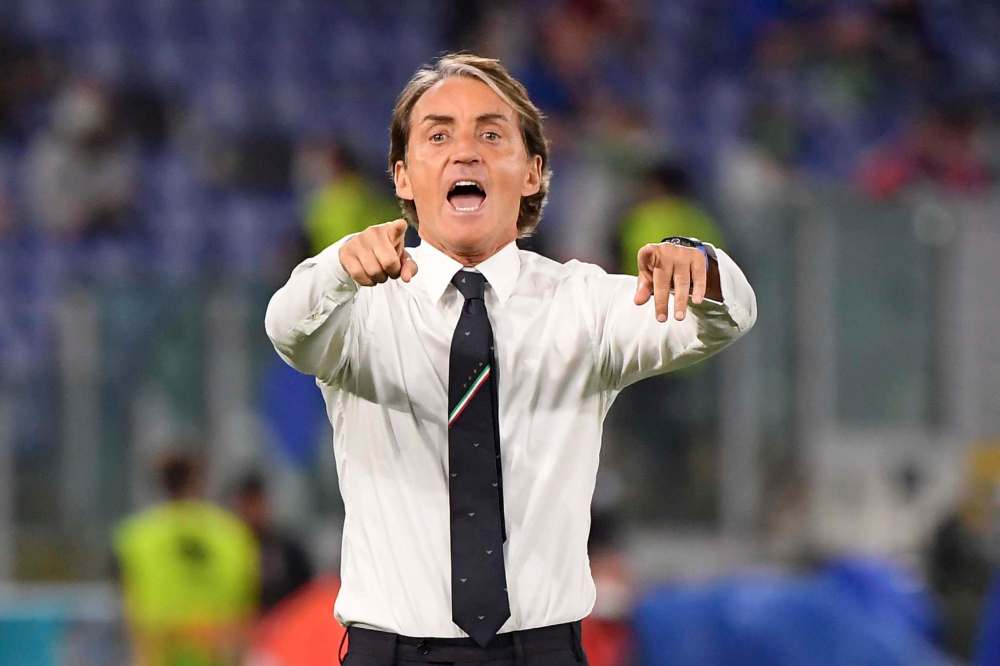
Ever the pragmatist, manager Roberto Mancini has not imposed a way of playing on his group of Italy players. Instead, he has identified the key contributors and designed his tactics to accommodate their strengths.
Jorginho, for example, is a crisp-passing midfield engine. The Chelsea man is untouchable in the centre of the park, and given his bevy of runners and playmakers, Mancini is able to surround the 29-year-old with one of each in what immediately becomes an actionable midfield — perhaps the best at EURO 2020.
Up top, the attack is fronted by Italy’s top goal-scorer from the past Serie A season: Lazio’s Ciro Immobile. It just so happens that the next-highest scorer, Napoli’s Lorenzo Insigne, prefers to play from the left and the next-highest after that, Sassuolo’s Domenico Berardi, likes to operate on the right.
Presto! You have a front three.
Back it all up with Juventus defenders Leonardo Bonucci and Giorgio Chiellini and this Italy XI is a natural 4-3-3.
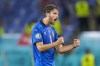
And if that weren’t balanced enough, Mancini has offset his more veteran players with selections from the 2019 European Under-21 champions, including Nicolo Barella and Manuel Locatelli, both of whom started Friday’s tournament opener against Turkey.
It is a team built wisely, if not easily, around the abilities of form players, and the result is a genuine contender that may well generate some wildly different headlines next month.
Italy’s next match is this afternoon at 2:00 p.m. (TSN) against Switzerland in Rome.
Spot-kicks
-Christian Eriksen is stable in hospital — alive, thankfully, due to the heroics of paramedics who revived the Denmark international after he’d gone into cardiac arrest during Saturday’s Group B match against Finland.
But should television viewers have been privy to what might have been his final moments, to the agonies of his family members?
I interviewed Dr. Nicholas Greco, Professor of Communications and Media at Providence University College, regarding the ethics of the broadcast while the incident was ongoing. He underlined the importance of exercising caution where a subject is “unable to give consent.”
“Avoid pandering to lurid curiosity,” he said. “We have a right to know what happened, but we don’t have to see it. And if death is involved, there are others who have that right before we do.”
– UEFA is investigating Austria’s Marco Arnautovic, who made xenophobic remarks directed at ethnic Albanians after scoring his side’s third goal of a 3-1 win over North Macedonia.
Arnautovic, who has previously spit at Kenny Tete, a black footballer, and is alleged to have used the “n-word” in a match while playing in the Netherlands, also flashed a symbol interpreted by some as a “white power” gesture before Austria captain David Alaba grabbed him by the mouth and physically stopped him from speaking.

The Austrian Football Association have already accepted Arnautovic’s “apology,” in which he remarked that he has “friends in many countries.” How tokenish.
– A personal note: Many readers will no doubt be familiar with my experience with major depressive disorder. My new book, So Old a Pain: Depression in Fragments, tries to chronicle the mindset of that experience and is available for pre-order wherever you buy your books. I hope you’ll do me the honour.
jerradpeters@gmail.com Twitter @JerradPeters
Our newsroom depends on a growing audience of readers to power our journalism. If you are not a paid reader, please consider becoming a subscriber.
Our newsroom depends on its audience of readers to power our journalism. Thank you for your support.
Our newsroom depends on a growing audience of readers to power our journalism. If you are not a paid reader, please consider becoming a subscriber.
Our newsroom depends on its audience of readers to power our journalism. Thank you for your support.
Related Articles
Belgium tops Denmark 2-1 at Euro 2020, players honor Eriksen





Advertisement Advertise With Us
Advertisement Advertise With Us