

Football needs to talk about Hungary
Oppressive government under spotlight as Budapest hosts Euro matches
Advertisement
Read this article for free:
or
Already have an account? Log in here »
To continue reading, please subscribe:
Digital Subscription
One year of digital access for only $75*
- Enjoy unlimited reading on winnipegfreepress.com
- Read the E-Edition, our digital replica newspaper
- Access News Break, our award-winning app
- Play interactive puzzles
*Billed as $5.77 plus GST every four weeks. After 52 weeks, price increases to the regular rate of $19.95 plus GST every four weeks. Offer available to new and qualified returning subscribers only. Cancel any time.
Monthly Digital Subscription
$4.99/week*
- Enjoy unlimited reading on winnipegfreepress.com
- Read the E-Edition, our digital replica newspaper
- Access News Break, our award-winning app
- Play interactive puzzles
*Billed as $19.95 plus GST every four weeks. Cancel any time.
To continue reading, please subscribe:
Add Free Press access to your Brandon Sun subscription for only an additional
$1 for the first 4 weeks*
- Enjoy unlimited reading on winnipegfreepress.com
- Read the E-Edition, our digital replica newspaper
- Access News Break, our award-winning app
- Play interactive puzzles
*Your next Brandon Sun subscription payment will increase by $1.00 and you will be charged $17.95 plus GST for four weeks. After four weeks, your payment will increase to $24.95 plus GST every four weeks.
Read unlimited articles for free today:
or
Already have an account? Log in here »
Hey there, time traveller!
This article was published 18/06/2021 (1797 days ago), so information in it may no longer be current.
We need to talk about Hungary.
And no, not just about the country’s entry at EURO 2020, although it does merit mention.
The Magyars quite admirably kept Portugal at bay for 84 minutes on Tuesday, only for their defence to finally be breached by Raphael Guerreiro and then Cristiano Ronaldo, and then Ronaldo again. Szabolcs Schon even thought he had given the hosts a late second-half lead in Budapest, only for his goal to be rightfully disallowed for offside.
Saturday, Hungary will welcome France to Puskas Arena (8 a.m., TSN). They’ll have to get a result in order retain any hope of advancing to the round of 16, and given that Les Bleus have already beaten Germany — and looked comfortable doing it — it’s a dream unlikely to last more than the 90 minutes.
Unfortunately, there will be more to watch than the game itself, which is why more than the team itself is being examined here. And, to be clear, none of it is about pointing fingers. Goodness knows we in Canada barely have enough of those to aim at ourselves.
But when people’s basic rights are attacked, the oppressor is fair game for criticism, no matter the geography — especially when it has chosen to be in the spotlight.
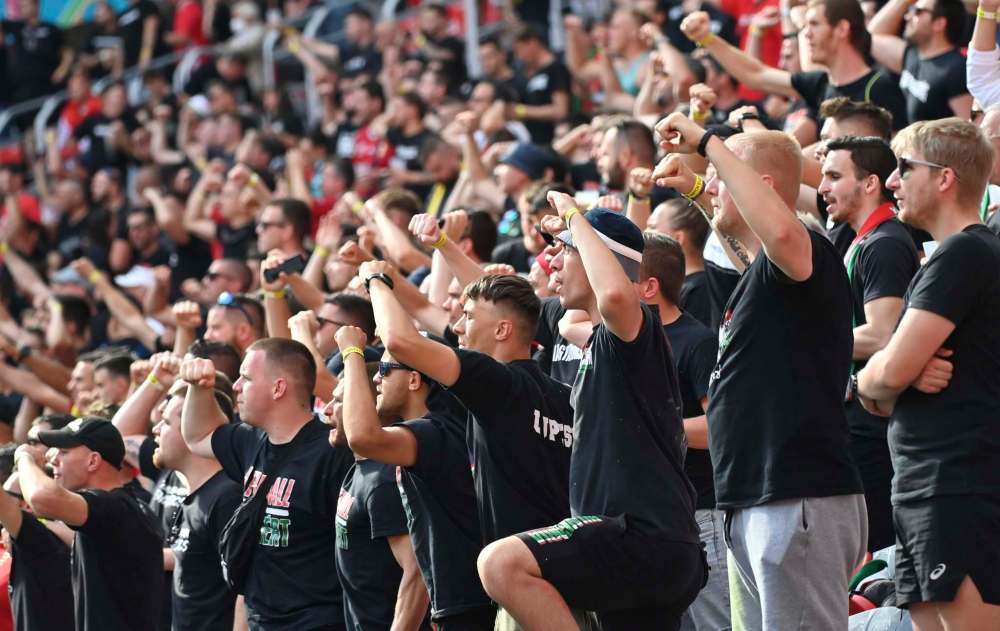
Present at the Portugal game, as even a casual observer will have noticed, was a section of far-right ultras behind one of the goals, to the left of the screen for those watching on television. It was the Carpathian Brigade, and several of its black-clad members celebrated the Schon non-goal with Nazi salutes.
They also unfurled a banner with a homophobic message — emboldened, no doubt, by legislation passed the same day prohibiting LGBTTQ+ content in schools and programming on television targeted to audiences under the age of 18.
“This is a blanket approval to treat LGBT people with discrimination, with hatred,” analyzed Andras Lederer of the Hungarian Helsinki Committee Europe, according to The Guardian. “The idea that being gay poses a risk in itself to people under 18 is such a horrible, vicious concept… It will have tragic effects on the mental well being of young LGBT people.”
Homophobia has been central to Viktor Orban’s fascist ideology since he was elected to a second stint as prime minister of Hungary in 2010. Additional planks have included the curbing of press freedoms, attacks on women’s rights, interference with academia and refusal of safe entry for asylum-seekers.
Moreover, “the government continued to undermine judicial independence and public confidence in the judiciary,” stated Amnesty International in its annual report for 2020.
Not surprisingly, Orban has also politicized his COVID-19 response, using the pandemic “as a pretext to continue its attacks on the rule of law and democratic institutions,” according to Human Rights Watch. “The government declared a state of emergency in March (2020), seizing unlimited power to rule by decree without parliamentary and judicial review.”
This is why, as the other EURO 2020 hosts prudently cap their stadium limits at anywhere between 25 and 50 per cent, the Budapest ground operates at a full capacity of more than 67,000 — a personal statement from Orban that COVID is conquered, that he has already guided his nation to a post-pandemic future.
The question is, should Hungary have been awarded EURO 2020 matches in the first place?
“We do need a better and more firm approach to respect for universal rights being conditional for hosting matches at major tournaments,” remarked Piara Powar, executive director of the anti-discrimination group FARE, in an interview with Eurosport.
It needn’t be a slippery slope.
As Powar pointed out, the Hungarian football association, ahead of a pre-tournament friendly against Ireland, issued a statement referring to the Irish players’ take-a-knee demonstration as a political gesture.
“Then, a week later,” said Powar, “in the same stadium a prominent banner has appeared that is homophobic. These are political acts in support and endorsement of the policies of the government which has just passed a law that is widely considered to marginalize the LGBTQ community.”
In other words, the Hungarian FA, at the very least, is running interference for Orban; more likely, the organization itself is a far-right entity functioning as an instrument of soft power on behalf of the government.

When that happens, as per UEFA’s and FIFA’s own statutes, the football association risks, first, a warning and, ultimately, suspension.
So far, however, Hungary has avoided censure. Somehow. And Puskas Arena will once again be the scene of discriminatory displays when the world watches the match against France.
The football authorities need to talk about Hungary.
jerradpeters@gmail.com Twitter @JerradPeters
Our newsroom depends on a growing audience of readers to power our journalism. If you are not a paid reader, please consider becoming a subscriber.
Our newsroom depends on its audience of readers to power our journalism. Thank you for your support.