

Goosebumps for a nation
Steph Labbé's brilliance in goal gives Canada its first major soccer title
Advertisement
Read this article for free:
or
Already have an account? Log in here »
To continue reading, please subscribe:

Digital Subscription
One year of digital access for only $205*
- Enjoy unlimited reading on winnipegfreepress.com
- Read the E-Edition, our digital replica newspaper
- Access News Break, our award-winning app
- Play interactive puzzles
*First annual payment billed as $205.00 + GST for one year. This annual subscription will automatically renew at $233.00 + GST every 52 weeks (10% off the regular annual price of $259.35). Offer available to new and qualified returning subscribers only. Cancel any time.
To continue reading, please subscribe:
Add Free Press access to your Brandon Sun subscription for only an additional
$1 for the first 4 weeks*
- Enjoy unlimited reading on winnipegfreepress.com
- Read the E-Edition, our digital replica newspaper
- Access News Break, our award-winning app
- Play interactive puzzles
*Your next Brandon Sun subscription payment will increase by $1.00 and you will be charged $17.95 plus GST for four weeks. After four weeks, your payment will increase to $24.95 plus GST every four weeks.
Read unlimited articles for free today:
or
Already have an account? Log in here »
Hey there, time traveller!
This article was published 06/08/2021 (1845 days ago), so information in it may no longer be current.
How long are goosebumps supposed to last? Asking for a country.
Yes, this country. Canada. Gold medallists in women’s soccer. Olympic champions. After all that.
All that.
How far back should we go? Clear through to the women’s national team’s first international just over 35 years ago? That squad departed from here, by the way, from Winnipeg, and took a bus to Minneapolis, equipped with men’s jerseys.
Or perhaps to the 2001 Algarve Cup, when Canada upset the United States 3-0? Christine Sinclair, 17 at the time, scored in that game. She wouldn’t be part of a winning side against the U.S. for another 20 years — not until Jessie Fleming’s penalty in Kashima ended a 37-match winless run against our southern neighbours and set up Friday’s Gold Medal showdown with Sweden.
There was no shortage of disappointment through those two decades, including a quarterfinal exit at a home World Cup in 2015. The Bronze Medals in London and Rio de Janeiro were meaningful achievements, sure, but until this Olympics they had yet to contest a major final.
This Olympics — in which the U.S., Great Britain, the Netherlands, Brazil and, yes, Sweden, were each of them, on paper and in pedigree, expected to outmatch a Canadian outfit that would struggle for goals and do well to just be among the semifinalists once again.
Well, they certainly struggled for goals, but it didn’t much matter. Not when everyone took turns at playing the hero, and certainly not when goalkeeper Steph Labbé donned her cape and made spectacular save after spectacular save and, crucially, penalty stop after penalty stop.
Labbé, don’t forget, had to leave the opening match against Japan through injury. Her Olympics was one played in pain, but also with a smile on her face. Against Brazil in the quarterfinal she grinned down Andressa and Rafaelle. Against Sweden it was Anvegard, Seger and Andersson.
Caroline Seger, the Swedish captain and, at 36 years of age her country’s own Sinclair figure, could have won the gold medal with her spot-kick. She missed. A reminder that for every feel-good story there is also disappointment — emotions that sports tend to carefully negotiate.
But on Friday it was Canada’s turn to feel good — and nervous. It was, after all, the biggest soccer match in our history. The empty stadium might have done its best to reduce the atmosphere, but it failed. We could sense we were all watching together, an entire country up early, pulses racing, participating in every kick, pass and, mostly, block. It was the loudest game we’ve ever played.
And it took an entire team to win it.
Territorially, there’s no denying that Sweden carried much of the play. And when Stina Blackstenius beat Labbé in the 34th minute, they even took the lead. But there was no panic. Zero.
Defenders Kadeisha Buchanan and Vanessa Giles — the latter of whom was one of the tournament’s revelations — locked things down at the back, and just in front of them Winnipeg’s Desiree Scott lived up to her “Destroyer” nickname, breaking up Sweden’s best attempts at attacking play.
Out wide, Allysha Chapman and Ashley Lawrence did their best to spring attackers Nichelle Prince and Deanne Rose, but it was Sinclair — who else? — who earned the penalty that sent Fleming back to the spot in the 68th minute. The 23-year-old, whose veins must run with ice, made no mistake from 12 yards, and in extra time she may well have saved a goal when her diving, reverse-head block recalled Dominik Hasek’s best acrobatics.
It was an anxious ride through extra time to the penalty shoot-out, but once there Labbé took control. Most teams that miss three straight attempts — as Canada did — are doomed to defeat, but even fewer have a ‘keeper who can regain momentum on her own.
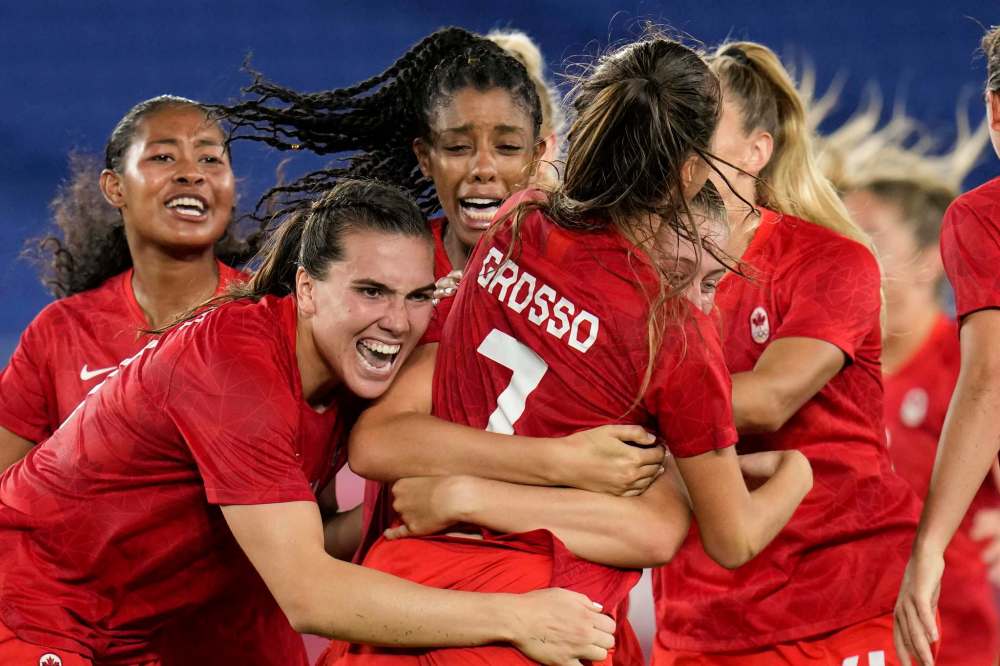
Labbe, composed as ever, did exactly that, and suddenly it was 20-year-old midfielder Julia Grosso stepping up to make history.
She made it.
They all made it. And Sinclair, lying on the field when it was all said and done, was the picture of the entire journey of Canadian women’s soccer — tested, doubted, relentless, triumphant. A Canadian Heritage Moment meme in the making.

For the players, gold medals well-earned.
For the rest of us, goosebumps that just won’t go away.
jerradpeters@gmail.com
Twitter@JerradPeters
Our newsroom depends on a growing audience of readers to power our journalism. If you are not a paid reader, please consider becoming a subscriber.
Our newsroom depends on its audience of readers to power our journalism. Thank you for your support.
Our newsroom depends on a growing audience of readers to power our journalism. If you are not a paid reader, please consider becoming a subscriber.
Our newsroom depends on its audience of readers to power our journalism. Thank you for your support.
Related Articles
Whitecaps settle for 1-1 draw with L.A. Galaxy






Advertisement Advertise With Us
Advertisement Advertise With Us