

Nostalgia doesn’t win football matches
Manchester United won’t return to relevance by trading on past glories
Advertisement
Read this article for free:
or
Already have an account? Log in here »
To continue reading, please subscribe:

Digital Subscription
One year of digital access for only $205*
- Enjoy unlimited reading on winnipegfreepress.com
- Read the E-Edition, our digital replica newspaper
- Access News Break, our award-winning app
- Play interactive puzzles
*First annual payment billed as $205.00 + GST for one year. This annual subscription will automatically renew at $233.00 + GST every 52 weeks (10% off the regular annual price of $259.35). Offer available to new and qualified returning subscribers only. Cancel any time.
To continue reading, please subscribe:
Add Free Press access to your Brandon Sun subscription for only an additional
$1 for the first 4 weeks*
- Enjoy unlimited reading on winnipegfreepress.com
- Read the E-Edition, our digital replica newspaper
- Access News Break, our award-winning app
- Play interactive puzzles
*Your next Brandon Sun subscription payment will increase by $1.00 and you will be charged $17.95 plus GST for four weeks. After four weeks, your payment will increase to $24.95 plus GST every four weeks.
Read unlimited articles for free today:
or
Already have an account? Log in here »
Hey there, time traveller!
This article was published 12/08/2022 (1500 days ago), so information in it may no longer be current.
We need to change the way we talk about Manchester United.
Not forever, but for now, in this moment — this moment which is either despairing or hilarious depending on one’s specific allegiance or particular bent.
And that’s a credit to the club, really — one of the few they can claim amidst their worst period of the Premier League era. Because, as they say, United are hated or adored, but never ignored.
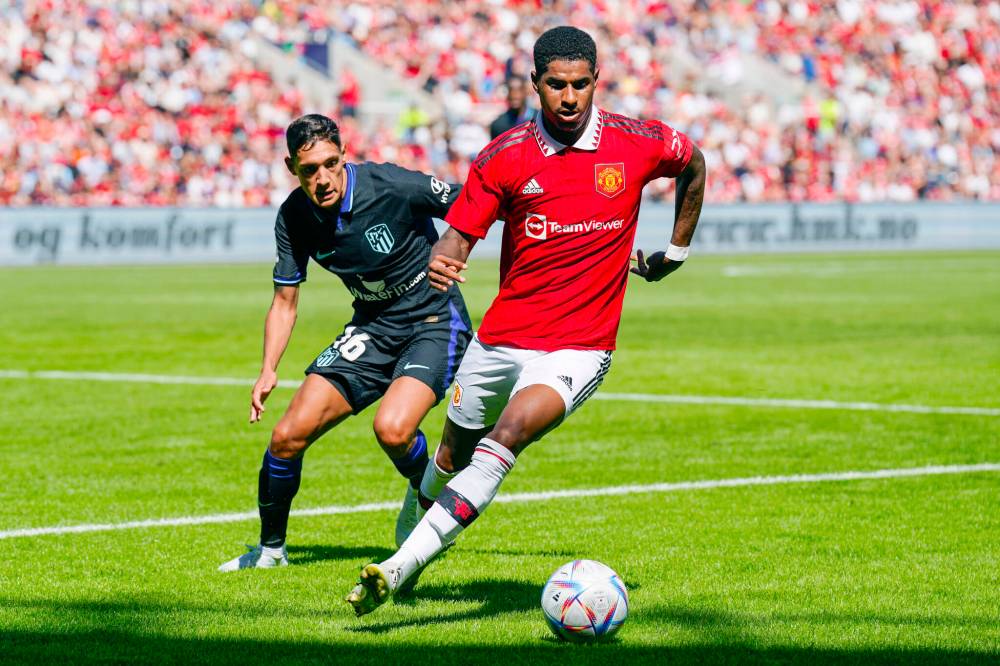
Stian Lysberg Solum / The Associated Press
Manchester United striker Marcus Rashford is rumoured to be mulling a transfer to Paris Saint-Germain.
Not even for an instant.
Friday’s front page of L’Equipe, for example, was emblazoned by the single figure of Red Devils striker Marcus Rashford, whom the French daily have claimed is mulling a transfer to Paris Saint-Germain.
In Spain, the cover of Sport featured Netherlands midfielder and United transfer target Frenkie de Jong, shown clapping to Barcelona supporters in a sort of farewell. It’s a misleading image, of course, as the 25-year-old’s gesture is common enough for a late substitution or post-match tribute to cheering fans. But the Blaugrana need rid of him for financial reasons, and such is their influence in the tabloids.
Meanwhile, Italian outlet Tuttosport heralded the arrival of United representatives in Turin — their presence presumably intended to convince Adrien Rabiot of Juventus to don the red shirt, although it’s the player’s mother whose arm will need twisting.
Thing is, not only are Manchester United a wholly unattractive prospect right now, but they’re also a club where hopes go to die. The Theatre of Dreams has become a players’ graveyard, which is why Rashford is considering a change of scenery, why de Jong won’t contemplate the switch, and why Veronique Rabiot is even more prickly than normal.
When juxtaposed with the glory days of Sir Alex Ferguson, the contemporary enterprise is unrecognizable. But in staring back at the Fergie years as a sort of justification for prominence, as their guarantor of identity, United are looking at precisely the wrong thing.
That’s their past, their history, and it’s a proud one. No one can take it away. And yes, it can even serve to inspire players, managers and staff who care about that sort of thing.
But nostalgia doesn’t win football matches. What it can do, however, is depress a culture that will only feel a sense of failure when measured against those long-ago triumphs.
Which is why the manner in which we’re accustomed to discussing the club no longer makes sense, and why United, themselves, need to adjust their narrative.
Instead of looking to a world-class player like Frenkie de Jong, who is understandably more willing to suffer Barcelona’s insults than move to Old Trafford, United should look to repairing the stadium roof. The toilet facilities could use some work as well, and there’s always a job for exterminators, what with the numerous and embarrassingly public rodent infestations.
There hasn’t been meaningful investment in the ground since the Glazer family bought the club in 2005 (development of the quadrants had been approved by the previous owners), and the old South Stand is also in need of a revamp.
If United are keen to set new standards, never mind equalling previous ones, the crumbling-stadium-as-metaphor-for-decaying-club is as good a place as any to start.
In fairness, new manager Erik ten Hag is trying mightily to impose fresh standards — any standards, really — within the first team squad. Some of his more talked-about alterations: regular weigh-ins and tests of body mass index, fish and vegetables on the menu at the Carrington training complex, no alcohol during match weeks, and meals taken together as a team — without mobile devices.
In other words, welcome to 10 years ago. Absolutely nothing about the Dutchman’s approach is revolutionary, and he, more than anyone, will have been flabbergasted to find a squad accustomed to anything less.
If his methods have made headlines it’s because even tea-time at Carrington is newsworthy. Never ignored, don’t forget.
All that said, United’s present condition and, in all likelihood, a difficult road ahead, is hardly unprecedented.
AC Milan, another giant of a club, went 11 seasons without a Scudetto before winning it last spring and in that time finished higher than fifth on only three occasions. Between 2014 and 2018 they came 8th, 10th, 7th, 6th and 6th again. Local rivals Inter Milan failed to win Serie A between 1989 and 2006, and before regaining the title in 2021 they sustained another 11-year drought.
The impetus behind the Milan clubs’ resurgences? New ownership.
Even mighty Juventus — with a push from Calciopoli — went eight seasons between Scudetti of 2003 and 2012. Central to their revitalization? A new stadium.
Closer to home, Arsenal haven’t won the Premier League since 2004 but seem to finally be on the upswing. Liverpool spent three decades in the wilderness before winning the title in 2020. The Gunners are 15 years in their new stadium; the Reds underwent an ugly ownership change in 2010.
The commonalities are obvious, and should be instructive to Manchester United.
They can have a modern manager — someone who is rightfully the most important person at the club — and toss money hither and thither in attempts to lure top players to Old Trafford, but without fundamental transformation they’ll merely be spinning their wheels in the mud, trying desperately to drive back to a past that’s no longer who they are.

The Glazers, quite clearly, have got to go, and with them a tired, clunky administration routinely left behind by sleeker, more modern operations. Given that their indebted ownership is leveraged against the club’s assets, they’re unlikely to leave until their position becomes untenable. A planned walkout of this month’s match against Liverpool should help with that.
In the short term, little if anything will improve on the pitch. Which brings us back to where we started: we need to change the way we talk about Manchester United.
This is not a club in a struggle to recapture an illustrious history. Rather, it’s one in a battle to be relevant.
Twitter @JerradPeters
Our newsroom depends on a growing audience of readers to power our journalism. If you are not a paid reader, please consider becoming a subscriber.
Our newsroom depends on its audience of readers to power our journalism. Thank you for your support.
Our newsroom depends on a growing audience of readers to power our journalism. If you are not a paid reader, please consider becoming a subscriber.
Our newsroom depends on its audience of readers to power our journalism. Thank you for your support.
Related Articles
Sanchez makes debut for Marseille in a 1-1 draw at Brest Villarreal seals return of Argentina midfielder Lo Celso








Advertisement Advertise With Us
Advertisement Advertise With Us