

Hate, lies, heroes and kindness

Advertisement
Read this article for free:
or
Already have an account? Log in here »
To continue reading, please subscribe:

Digital Subscription
One year of digital access for only $205*
- Enjoy unlimited reading on winnipegfreepress.com
- Read the E-Edition, our digital replica newspaper
- Access News Break, our award-winning app
- Play interactive puzzles
*First annual payment billed as $205.00 + GST for one year. This annual subscription will automatically renew at $233.00 + GST every 52 weeks (10% off the regular annual price of $259.35). Offer available to new and qualified returning subscribers only. Cancel any time.
To continue reading, please subscribe:
Add Free Press access to your Brandon Sun subscription for only an additional
$1 for the first 4 weeks*
- Enjoy unlimited reading on winnipegfreepress.com
- Read the E-Edition, our digital replica newspaper
- Access News Break, our award-winning app
- Play interactive puzzles
*Your next Brandon Sun subscription payment will increase by $1.00 and you will be charged $17.95 plus GST for four weeks. After four weeks, your payment will increase to $24.95 plus GST every four weeks.
Read unlimited articles for free today:
or
Already have an account? Log in here »
Hey there, time traveller!
This article was published 19/12/2025 (251 days ago), so information in it may no longer be current.
The terror struck as it so often does, where people had gathered to share joy: this time, at a community Chanukah celebration at Australia’s famous Bondi Beach on Sunday. Two gunmen, a father and son, opened fire on the crowd, injuring dozens and killing at least 15.
The scenes that emerged from the attack were unbearable. It was a brazen act of antisemitic terrorism, the worst such attack in Australian history. In the lists of the victims, it was also a reminder that the world can be a very small place: among the dead were citizens of Britain and France, and people who had once sought safety in Australia from all over the world.
One, Alexander Kleytman, was an 87-year-old from Ukraine, who survived the Holocaust as a child when his family fled to Siberia; he died shielding his wife from the storm of bullets. She survived. Another victim, 10-year-old Matilda, was the child of Ukrainian immigrants, so named because she was the first in her family to be born in Australia.
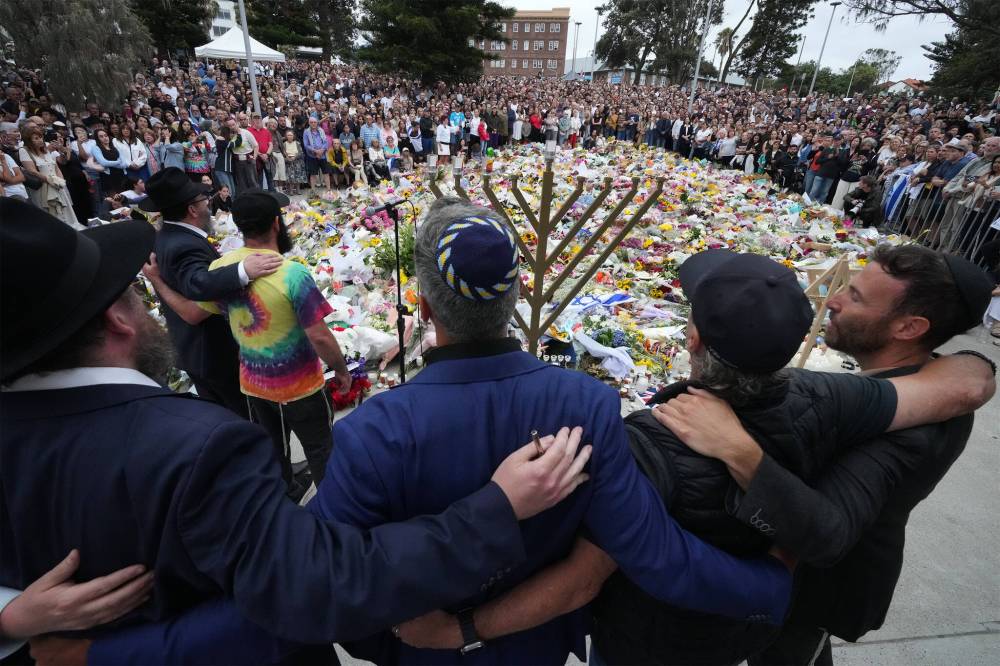
Mark Baker / the Associated Press
Mourners gather at a menorah lighting ceremony at a floral memorial for victims of the Bondi Beach shooting.
And at least one victim, Adam Smyth, was not attending the Chanukah event, but was killed as he happened to be walking by with his wife. It shouldn’t need to be said, but perhaps the state of the world means it does: hate never stays contained. It may target one group the most, but always threatens us all. If some of us are not safe, then none of us are.
Hate never stays contained. It may target one group the most, but always threatens us all. If some of us are not safe, then none of us are.
Yet even in this nightmare, this darkness, a glow of human light. There were multiple heroes that day, who showed acts of incredible bravery, at the cost of their own life: Reuven Morrison was killed after throwing a brick at the terrorists. Boris and Sofia Gurman, married 34 years, died when they rushed the gunmen just as the killers emerged from their vehicle; Boris even managed to seize one attacker’s gun, before he was thrown to the ground.
But one of these heroes survived and, thanks to a bystander taking video on their phone, his story can be known, and his sacrifice properly honoured.
In the video, which went public within hours of the attack, we can see one of the attackers poised behind a tree, raising his weapon to pump off shots. As he does, a civilian in a white t-shirt rushes up from behind, tackles the shooter around the neck, and manages to wrest his weapon away.
The man then points the weapon at the disarmed attacker, and begins calling others to come help. (Some have criticized him for not shooting the terrorist then; such critics deserve little reply. Few of us know with certainty how we would react in such intense situations, and it is no small thing to take a life, assuming one even knows how to operate the weapon.)
In the end, the shooter was able to get away, obtain another weapon and resume firing. But the man’s intervention slowed the pace of the massacre and undoubtedly saved lives, nearly at the cost of his own: he was shot twice, suffering grievous wounds to his left arm.
Before long, relatives and friends had identified the man as Ahmed al-Ahmed, a 43-year-old Muslim immigrant from Syria, who ran a fruit stand in Sydney. He acted, they said, out of pure conscience, later telling one of his relatives that he’d just prayed to God to give him strength before rushing the actively shooting attacker.
This is exactly the kind of story we need to hold close, in times such as these. Hate is explosive. Hope is quiet. One killer with a weapon can do damage so immense, it terrifies the world and obscures the everyday goodness of millions.
But there is yet more good in us than evil. Far more who would save lives, rather than take them. And when an act of terrorism would seek to inflame hate and reaction along religious or ethnic lines, we need to cherish all the more those who, without hesitation, throw their own bodies on the flames, to quench them.
Hate is explosive. Hope is quiet.
Not all, it seemed, would agree. Within hours of the massacre, a new fiction had started circulating online, falsifying the hero’s identity. The man, some claimed, was not Ahmed al-Ahmed from Idlib, not a Muslim fruit-seller, but an IT professional from Sydney named Edward Crabtree.
This lie was not propagated by mere idle chatter. Someone created an entire website to host and spread this fiction, registering it on the day of the shooting and making it appear like a real Australian news site. The site even hosted an AI-generated article, complete with an entire backstory for the fictional Crabtree and fake interviews with him and his non-existent friends.
For a flicker of time, this lie spread like wildfire online, driven first by a flood of accounts with murky origins, and then by real people who had been exposed to those posts through social media algorithms.
Before long, X’s resident AI fact-checker, Grok, was repeating the lie as fact to countless thousands more people — because Grok, unlike humans, cannot actually apply critical thinking to verify claims, but simply generates plausible answers based on circulating information. In other words, it just chews up and spits out common content it sees.
The good news is that truth won this time, albeit in a qualified victory, still denied and attacked in some quarters. But its spread was hampered when real Australian media quickly spoke to al-Ahmed’s family and shared a video of him in hospital, where he had endured multiple surgeries and faced possible amputation of his shot-shredded arm.
Soon, Australia’s prime minister visited him in hospital, cementing his status as a hero. An Australian car club launched a GoFundMe for al-Ahmed, which by Thursday had skyrocketed past US$2.5 million. All of this managed to halt the fake website’s momentum; by Tuesday, few were still repeating the Crabtree lie.
The truth is more hopeful than the lie; the truth is the more beautiful, the more uniting, the more human.
But who made that website in the first place, and why? What were their motives? Was it simply to scrape a bit of income out of clicks on the world’s most high-traffic news item or was it something more nefarious?

It will be illuminating if someone can uncover who launched the site, though it will take a far better digital detective than me.
And so, even as the world turns to mourning the dead and honouring the heroes such as al-Ahmed, this strange episode of disinformation ought not be entirely forgotten. Because the truth will not always win; we can no longer count on that. Every year, it becomes easier to obscure it, easier to put the lie before more people than the truth can reach, and faster.
What one can’t help but notice is that in this case, and so many others, the truth is more hopeful than the lie; the truth is the more beautiful, the more uniting, the more human.
Every day, we should question why some would have us believe something worse — and what lengths they will go to in order to spread it.
melissa.martin@freepress.mb.ca
Melissa Martin
Reporter-at-large
Melissa Martin reports and opines for the Winnipeg Free Press.
Every piece of reporting Melissa produces is reviewed by an editing team before it is posted online or published in print — part of the Free Press‘s tradition, since 1872, of producing reliable independent journalism. Read more about Free Press’s history and mandate, and learn how our newsroom operates.
Our newsroom depends on a growing audience of readers to power our journalism. If you are not a paid reader, please consider becoming a subscriber.
Our newsroom depends on its audience of readers to power our journalism. Thank you for your support.
Melissa Martin
Reporter-at-large
Melissa Martin reports and opines for the Winnipeg Free Press.
Every piece of reporting Melissa produces is reviewed by an editing team before it is posted online or published in print — part of the Free Press‘s tradition, since 1872, of producing reliable independent journalism. Read more about Free Press’s history and mandate, and learn how our newsroom operates.
Our newsroom depends on a growing audience of readers to power our journalism. If you are not a paid reader, please consider becoming a subscriber.
Our newsroom depends on its audience of readers to power our journalism. Thank you for your support.
Related Articles
A sunrise crowd gathers at Bondi Beach in solace and defiance after a massacre


Advertisement Advertise With Us
Advertisement Advertise With Us