

It’s time for us to imagine the unimaginable

Advertisement
Read this article for free:
or
Already have an account? Log in here »
To continue reading, please subscribe:

Digital Subscription
One year of digital access for only $205*
- Enjoy unlimited reading on winnipegfreepress.com
- Read the E-Edition, our digital replica newspaper
- Access News Break, our award-winning app
- Play interactive puzzles
*First annual payment billed as $205.00 + GST for one year. This annual subscription will automatically renew at $233.00 + GST every 52 weeks (10% off the regular annual price of $259.35). Offer available to new and qualified returning subscribers only. Cancel any time.
To continue reading, please subscribe:
Add Free Press access to your Brandon Sun subscription for only an additional
$1 for the first 4 weeks*
- Enjoy unlimited reading on winnipegfreepress.com
- Read the E-Edition, our digital replica newspaper
- Access News Break, our award-winning app
- Play interactive puzzles
*Your next Brandon Sun subscription payment will increase by $1.00 and you will be charged $17.95 plus GST for four weeks. After four weeks, your payment will increase to $24.95 plus GST every four weeks.
Read unlimited articles for free today:
or
Already have an account? Log in here »
Hey there, time traveller!
This article was published 24/01/2026 (227 days ago), so information in it may no longer be current.
On a pleasant spring evening in April 2025, a Russian ballistic missile shrieked into the blue-collar Ukrainian city of Kryvyi Rih. It exploded directly over top of a playground, blasting shrapnel across a quiet residential neighbourhood and killing 23 people, including nine children.
Five days after the strike, I drove to Kryvyi Rih to report on a city in the midst of what has become, in Ukraine, the all-too-familiar rituals of public mourning. There was the playground, heaped with memorial stuffed animals and flowers. Beside that was a shallow crater surrounded by tattered police tape, where the air-burst warhead exploded.
It was near that crater where I interviewed a member of the Ukrainian parliament from Kryvyi Rih. I was the first foreign journalist he’d interviewed with, and for much of our discussion, his answers drifted back to disputes he had with local officials. This was not what I needed; I moved to wrap up the conversation in my usual way.
“Is there anything we haven’t talked about, that you think is important?”
The man paused, gazing at the crater, the playground, the flowers. Then the words started spilling out.
“In the past, since Soviet times, we were all mixed up, everything was united,” he said. “So many Ukrainians would go to Russia and study there. Even in my mind, I couldn’t believe (the full-scale invasion would happen) in the beginning, and then when it really happened, I realized that there was a huge difference between us.”
He shook his head. “Even up to today, I cannot believe every missile attack, and we were just attacked like this,” he added, speaking in Russian through a translator. “We knew they could do anything, but even now you still keep catching yourself (thinking) ‘why would they do that?’”
I couldn’t believe it. Why would they do that? I never imagined this would happen.
In my nearly three years in Ukraine I heard some version of that sentiment dozens of times, from every part of society. I heard it from politicians and volunteers; soldiers and doctors; bartenders and village grandmas. I heard it from eastern Ukrainians, western Ukrainians and 30-something Kyiv hipsters who’d rallied in the 2014 Euromaidan Revolution.
Of course, many Ukrainians believed the full-scale war would happen. Many braced for it, waiting, expecting. But even as Russian troops massed on the border in early 2022, even as American officials warned the most catastrophic phase of war was imminent, many Ukrainians thought it was “just politics” or posturing, that little would change.
There’s a term in Ukraine for a person who, as they say, “changed their shoes.” It means someone — usually a politician or prominent businessman — who was known to be pro-Russian, but suddenly became a flag-waving Ukrainian patriot after the full-scale invasion in February 2022.
Many who changed their shoes were, quite transparently, securing their best interests. But for at least some, the abrupt reversal reflected true horror and revulsion; until the full-scale invasion, they genuinely couldn’t believe that a country they’d grown up seeing as a “brother nation” would enact such massive violence on them.
Yes, even after Russia annexed Crimea. Even after it armed and fomented a separatist uprising in Eastern Ukraine in 2014. Even then, that the war could morph into something far more massive and destructive was a possibility some couldn’t envision; it was too strange, too surreal, too much a violation of settled order.
This is understandable. The headlines talk of war; but you walk outside, and the birds are chirping.
I’ve thought about that a lot lately. I thought about it this week, when U.S. President Donald Trump shared an image showing a map of North America on which the silhouettes of both Greenland and Canada were covered over by an American flag; I thought about it as Europe scrambled to send a symbolic handful of troops to Greenland.
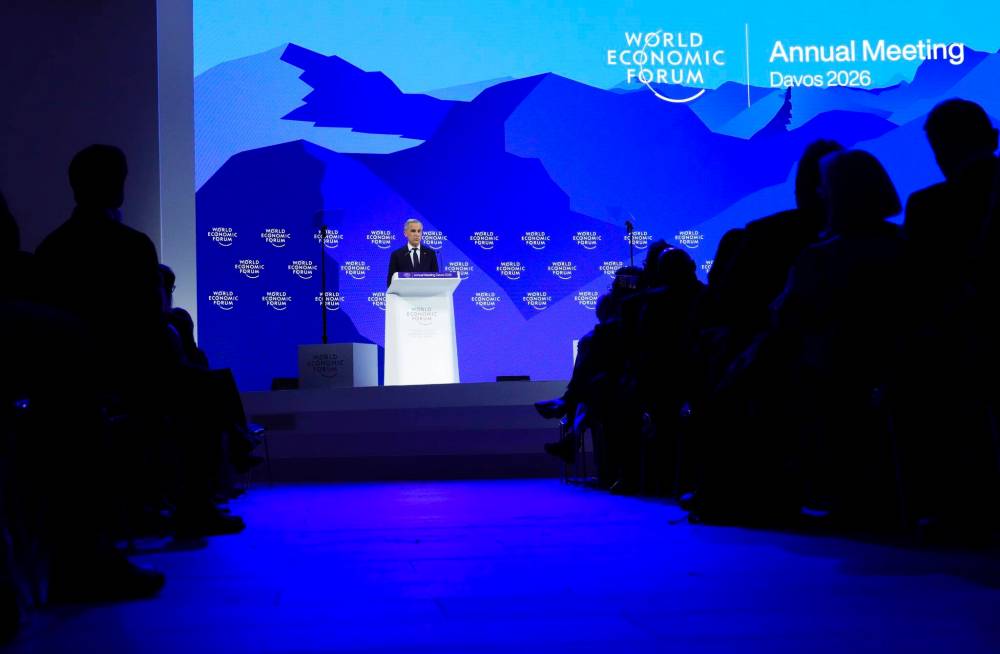
And I thought about it when Prime Minister Mark Carney gave a searing speech at the World Economic Forum in Davos. There was much in that speech to analyze and critique, which I’ll leave to others better equipped to do so; but some lines stood out for bluntly naming a truth in a way other leaders have, to this point, been hesitant to do.
“Let me be direct,” Carney said. “We are in the midst of a rupture, not a transition.”
This much, I think, cannot be argued. The rupture is upon us. It is sudden, it is sharp, and nobody really knows where it is going. Carney’s speech in Davos may have been intended as a wake-up call for Europe and the global powerbrokers who attend such events; but the truth of there being a rupture should also jolt the majority of us far removed.
For as long as it’s existed, in a global security sense, Canada has been a lucky place. We fought in the two great wars of the 20th century, contributing our share to the battles that would give rise to the concept of a rules-based international order; but those wars didn’t touch us directly. We were stable, safe, effectively shielded by oceans and ice and the aegis of American power.
It is unimaginable to us that this could change. And because it is unimaginable, we must imagine it.
Everything we know about the world can change. This is something Ukrainians taught me. It can change more abruptly than those of us eking out ordinary lives in our homes can imagine. It can change in ways that shatter everything we’ve believed to be true about our security, our allies and our neighbours.
In Davos, Trump gave a rambling speech in which he declared that, should he decide to use “excessive strength and force” to seize Greenland, the U.S. “would be, frankly, unstoppable.” But he added that he “won’t do that,” that he does “not want to use force. I won’t use force.”

News reports generally took this statement as Trump backing off further escalation of this bizarre and completely avoidable crisis. It could also be interpreted as a continued veiled threat. Either way, it seemed to slightly cool the temperature in the geopolitical room, for now.
Is the map Trump showed off, alluding to an American annexation of Greenland and Canada, likely to come true? No, it’s not likely. Quite probably not in our lifetimes, and maybe not ever. But is it possible? Yes, it’s possible. The worst thing we can do is under-react to that possibility, to ignore it, to write it off as posturing or politics as unusual.
If the possibility is still too hard to imagine, that’s understandable. Just know that even as hundreds of thousands of Russian troops massed on their border, many Ukrainians went to sleep on the night of Feb. 23, 2022, never imagining they’d wake to the shriek and explosion of missiles, never dreaming the peaceful life they knew would be ruptured, ruined and over.
It’s been almost four years since then. In Ukraine, the war is everyday life now. It is terrible and terrifying, and it is normal; they have no more doubts about what can happen. Canadians have been immensely lucky; we should not allow that luck to become a blindfold. We can’t afford to carry on without seeing the rupture, and the worst it can do.
melissa.martin@freepress.mb.ca
Melissa Martin
Reporter-at-large
Melissa Martin reports and opines for the Winnipeg Free Press.
Every piece of reporting Melissa produces is reviewed by an editing team before it is posted online or published in print — part of the Free Press‘s tradition, since 1872, of producing reliable independent journalism. Read more about Free Press’s history and mandate, and learn how our newsroom operates.
Our newsroom depends on a growing audience of readers to power our journalism. If you are not a paid reader, please consider becoming a subscriber.
Our newsroom depends on its audience of readers to power our journalism. Thank you for your support.
Melissa Martin
Reporter-at-large
Melissa Martin reports and opines for the Winnipeg Free Press.
Every piece of reporting Melissa produces is reviewed by an editing team before it is posted online or published in print — part of the Free Press‘s tradition, since 1872, of producing reliable independent journalism. Read more about Free Press’s history and mandate, and learn how our newsroom operates.
Our newsroom depends on a growing audience of readers to power our journalism. If you are not a paid reader, please consider becoming a subscriber.
Our newsroom depends on its audience of readers to power our journalism. Thank you for your support.

Advertisement Advertise With Us
Advertisement Advertise With Us