

Resistance, hear them roar
In the face of state-sanctioned thuggery, defiant Minneapolis citizenry delivers aspirational message

Advertisement
Read this article for free:
or
Already have an account? Log in here »
To continue reading, please subscribe:
Digital Subscription
One year of digital access for only $1.44 a week*
- Enjoy unlimited reading on winnipegfreepress.com
- Read the E-Edition, our digital replica newspaper
- Access News Break, our award-winning app
- Play interactive puzzles
*Billed as $5.77 plus GST every four weeks. After 52 weeks, price increases to the regular rate of $19.95 plus GST every four weeks. Offer available to new and qualified returning subscribers only. Cancel any time.
To continue reading, please subscribe:
Add Free Press access to your Brandon Sun subscription for only an additional
$1 for the first 4 weeks*
- Enjoy unlimited reading on winnipegfreepress.com
- Read the E-Edition, our digital replica newspaper
- Access News Break, our award-winning app
- Play interactive puzzles
*Your next Brandon Sun subscription payment will increase by $1.00 and you will be charged $17.95 plus GST for four weeks. After four weeks, your payment will increase to $24.95 plus GST every four weeks.
Read unlimited articles for free today:
or
Already have an account? Log in here »
Hey there, time traveller!
This article was published 31/01/2026 (265 days ago), so information in it may no longer be current.
There have been many times over the last several years where I’ve felt myself losing hope. War, turmoil, disinformation, rising authoritarianism; so much suffering with no clear road out. It’s a dangerous position. Despair is a killer; hope is an antidote. Yet it can be so hard to find, when the state of the world seems so dark.
If you’re looking for hope right now, turn your gaze south. Because right now, it shines bright in Minneapolis.
What’s happening on the ground in Minneapolis could be one of the most inspiring stories of our generation; an incredible grassroots response to a brutal and unwanted federal occupation, organized and led by ordinary residents. And it lays out a framework from which people in all cities could draw beautiful lessons.
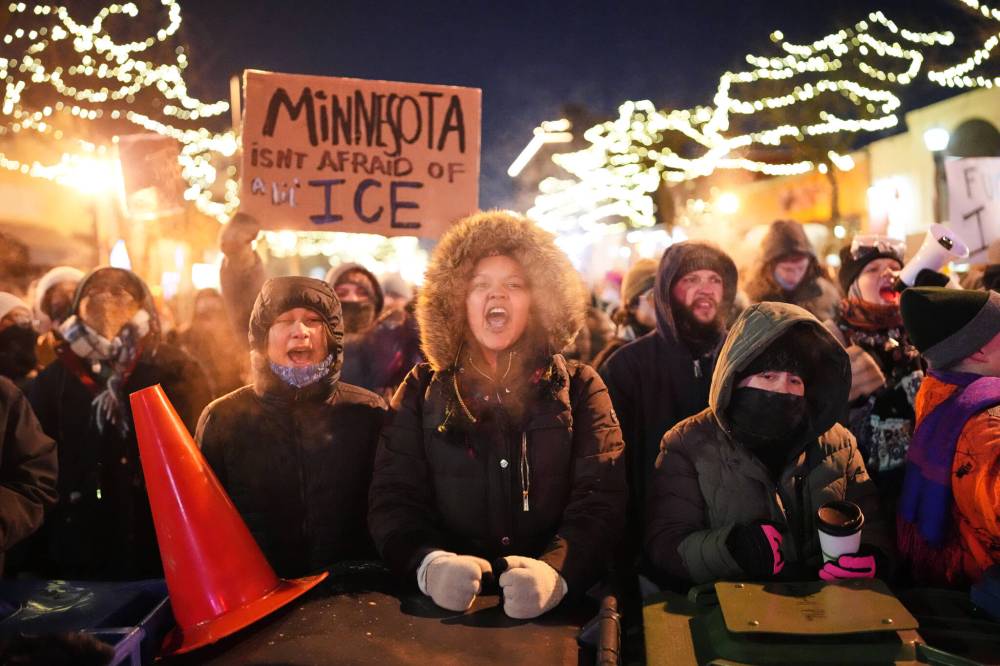
ADAM GRAY / THE ASSOCIATED PRESS
People demonstrate outside the Graduate by Hilton Minneapolis hotel, where it’s believed ICE agents are staying.
Since December, when a surge of 3,000 heavily armed and armoured Immigrations and Customs Enforcement (ICE) agents began in the city, the citizens of Minneapolis have held their streets, united to comfort those affected, and remained undaunted by the frigid -25 C weather which Winnipeggers know well.
The work of this response is multifaceted. In a stunning article this week for The Atlantic, journalist Adam Serwer painted a vivid picture of a city where tens of thousands of people have come together, chipping in how they can. Some are observers, filming ICE raids; there are group text chats to track their movements and alert residents to their locations.
That’s the most visible part of the response, but it’s only the beginning. Churches and secular groups have organized to deliver groceries and fundraise rent for immigrant families — including many with valid legal documentation — who are scared to leave their homes to work or shop, justifiably fearing they’ll be stopped and seized by ICE.
Some of the folks in these networks have been active in protest before. But many have not. In interviews, many say they were driven to help simply because they were horrified by what they saw in their own neighbourhoods; one mom Serwer met said she started delivering groceries after more than 100 of her kids’ classmates stopped coming to school.
That example is instructive. In general, abuses against a minority endure best when the majority are convinced the people affected are, in some essential way, unlike themselves. Humans have an unavoidable tendency towards the tribal; once we believe any given group is different, separate from ourselves, “other,” it’s a short step to seeing them as a threat.
For this reason, the Trump administration is fond of emphasizing the ICE raids are clearing the country of “criminals, rapists and murderers.” In reality, thousands who have been seized and sent to detention camps are peaceful residents and workers; many were, to the best of their knowledge, following legal immigration procedures.
In Minneapolis, that rhetorical battering ram couldn’t work. People watched their neighbours — people they knew, worked with, cared about, whose kids played with their kids — being taken by armed officers, often with weapons drawn. They saw clearly how their fates were intertwined: when armed federal agents swarm a street, all are in danger.
So residents are protecting their neighbours, both undocumented and documented: there are multiple cases of ICE agents seizing American citizens, including a 17-year-old Latino youth who was arrested at his Target job; an elderly Hmong man who was dragged out of his home at gunpoint while in his underwear; and four members of the Oglala Sioux Nation.
(Here, it’s worth emphasizing that by law, U.S. citizens do not have to prove their citizenship to police, or carry documents that do. The fact that in Minnesota, ICE has shown a predilection for grabbing non-white people off the street, taking them to detention, and forcing them to prove their status in custody is in glaring conflict with that right.)
Trump administration officials have, predictably, characterized the Minnesotans taking the streets as “domestic terrorists” and “professional agitators.” The reality, of course, is quite different. The folks organizing to resist ICE’s presence in their neighbourhoods are just moms and dads; students and retirees; friends, neighbours, clergy and business owners.
In an affidavit, a woman who witnessed ICU nurse Alex Pretti being shot and killed by federal agents described herself as “a children’s entertainer, specializing in face painting” who’d stopped to observe an ICE raid on her way to work: “Connecting to your local community and knowing who your neighbours are is something I profoundly value,” she stated.
Not terrorists. Not agitators. Just normal people. Which makes how they’ve been treated all the more alarming.
The brutality of ICE’s actions in Minnesota is shocking. There’s a video of agents driving past a line of people on a sidewalk — simply filming, not engaging the vehicles or blocking a road — and dousing them in pepper spray; a video of an agent at a gas station who asks a man to back up and, when the man immediately does, the agent lunges to assault him.
The intensity of this aggression has led many to wonder if the Trump administration hoped to provoke a more chaotic and violent reaction, something to justify deeper crackdowns. Authoritarians can thrive on the appearance of instability; when people are frightened, they look to those who rule with a firmer hand.
Well, if the administration wanted a war in Minneapolis, they didn’t get it. Instead, they met a community full of people who declared, in words and actions, that they will take care of each other; people who prioritize the safety of their neighbours and neighbourhoods over their own comfort; people who refuse to look away.
Minneapolis is the model to which all cities should aspire, not just when under extreme pressure. The lesson of the city’s resistance is that with connection, co-operation and communication, we can do incredible things to keep our community safe, and find in each other the hope to go on.
The lesson of Minneapolis is love.
● ● ●

With that in mind, we have something kicking off soon that I’m excited to share with readers.
In next weekend’s 49.8, we’re launching a new feature. It’s called One Day, and the concept is simple: we’ll simply document one day in the life of the people, places and organizations that keep Manitoba going. These will come from every segment of our community: social agencies, faith groups, private businesses, utility workers, everything.
It’s an idea I’ve nursed for a long time, and I’m excited to share it. There’s an immense amount of unseen work that goes on to tend the community we have, and to build the one we want; often, media only covers that work when there’s something relevant in the news.
But Manitobans, I think, are interested in each other. I think we, like most people, want to know our neighbours, and want to know more about the community around us. By giving a behind-the-scenes glimpse of an average day in the life of these people and places, my hope is that we can feel a little bit more connected.
melissa.martin@freepress.mb.ca
Melissa Martin
Reporter-at-large
Melissa Martin reports and opines for the Winnipeg Free Press.
Every piece of reporting Melissa produces is reviewed by an editing team before it is posted online or published in print — part of the Free Press‘s tradition, since 1872, of producing reliable independent journalism. Read more about Free Press’s history and mandate, and learn how our newsroom operates.
Our newsroom depends on a growing audience of readers to power our journalism. If you are not a paid reader, please consider becoming a subscriber.
Our newsroom depends on its audience of readers to power our journalism. Thank you for your support.
Melissa Martin
Reporter-at-large
Melissa Martin reports and opines for the Winnipeg Free Press.
Every piece of reporting Melissa produces is reviewed by an editing team before it is posted online or published in print — part of the Free Press‘s tradition, since 1872, of producing reliable independent journalism. Read more about Free Press’s history and mandate, and learn how our newsroom operates.
Our newsroom depends on a growing audience of readers to power our journalism. If you are not a paid reader, please consider becoming a subscriber.
Our newsroom depends on its audience of readers to power our journalism. Thank you for your support.
Advertisement Advertise With Us
Advertisement Advertise With Us