

Washington Post just a plaything for pandering billionaire Bezos

Advertisement
Read this article for free:
or
Already have an account? Log in here »
To continue reading, please subscribe:

Digital Subscription
One year of digital access for only $205*
- Enjoy unlimited reading on winnipegfreepress.com
- Read the E-Edition, our digital replica newspaper
- Access News Break, our award-winning app
- Play interactive puzzles
*First annual payment billed as $205.00 + GST for one year. This annual subscription will automatically renew at $233.00 + GST every 52 weeks (10% off the regular annual price of $259.35). Offer available to new and qualified returning subscribers only. Cancel any time.
To continue reading, please subscribe:
Add Free Press access to your Brandon Sun subscription for only an additional
$1 for the first 4 weeks*
- Enjoy unlimited reading on winnipegfreepress.com
- Read the E-Edition, our digital replica newspaper
- Access News Break, our award-winning app
- Play interactive puzzles
*Your next Brandon Sun subscription payment will increase by $1.00 and you will be charged $17.95 plus GST for four weeks. After four weeks, your payment will increase to $24.95 plus GST every four weeks.
Read unlimited articles for free today:
or
Already have an account? Log in here »
Hey there, time traveller!
This article was published 05/02/2026 (241 days ago), so information in it may no longer be current.
Two of the most talented journalists I’ve ever met lost their jobs on Wednesday, though “lost” seems like the wrong verb for this occasion. The jobs were not lost; we know exactly where they are, and who took them. It’s the “why” that deserves more scrutiny now, and also what it portends for the future of quality journalism.
Spoiler alert: that future isn’t looking too bright.
Of course, that fact alone isn’t breaking news. We are now entering the fourth decade of the digital media revolution, which upended the old revenue models on which legacy media once depended. Since the late 2000s, every year has brought more layoffs, more closures and more dates described as “dark days in journalism.”
Yet even against that bleak backdrop, this week brought one of the darkest. On Wednesday, the Washington Post cut 30 per cent of its staff, a bloodbath that signalled a massive restructuring of the once-mighty paper. It axed its sports desk and books section and eviscerated its international coverage, laying off its entire bureaus in China, the Middle East and Ukraine.
For me, the latter cuts were especially heartbreaking. While living in Ukraine I had the chance to get to know some of the Post staff there, including bureau chief Siobhan O’Grady and Lizzie Johnson. From the moment I met both, it was clear they were journalists of a rare calibre: brilliant, determined, meticulous, but also curious and compassionate.
Johnson had just accepted the Ukraine posting last summer and moved there in the fall, eager to dedicate herself full-time to the country she would be covering; the Post cut her loose just months later, in the middle of this Kyiv winter with little heat, power or running water.
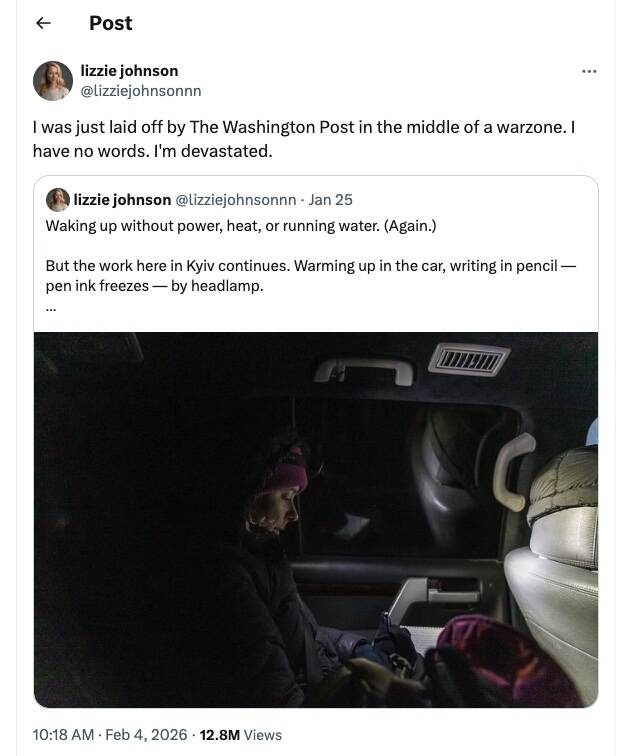
The optimist in me believes both will be snapped up by some smarter outlet. The pessimist in me worries that what the Post threw away will never be fully replaced. Given what’s going on in the world geopolitically, and Washington’s involvement, it seems ominous that the paper bearing the capital’s name just eliminated all that reporting capacity.
Why these particular cuts, at a once highly esteemed paper? Why so deep, why so sudden? On these questions, most who have observed the Post’s struggles and sharp decline over the last few years point a finger squarely at the newspaper’s owner, Amazon billionaire Jeff Bezos.
On Wednesday, in a statement decrying the cuts, former Post executive editor Marty Baron made an observation. During Baron’s tenure between 2013 and 2021, he wrote, Bezos offered “steadfast support and confidence” in the paper’s mission, even as he “came under brutal pressure from (U.S. President Donald) Trump.”
This lines up with what other staff have stated. When Bezos bought the paper in 2013, scooping it up for US$250 million, some reactions to the sale, including among Post staff, were cautiously — and naively, in hindsight — optimistic.
One thing the public often doesn’t understand is that the crisis journalism is facing is only minimally about readership, or trust, which often remain strong.
The issue is that the digital age broke the original revenue models on which that journalism depended; people still turned to the same outlets for news, but that support no longer translated into sufficient funding.
I won’t get into those problems here; suffice to say they have been intensely difficult to fix. By the 2010s, almost no legacy media had really figured out how to build more-sustainable new revenue models.
At the time, many thought having a billionaire with extraordinarily deep pockets who was invested in journalism was as good a solution as any.
Related Articles
Washington Post cuts a third of its staff in a blow to a legendary news brand
And Bezos, at that time, seemed invested in the journalism. The New Yorker ran a piece this week, bluntly titled How Jeff Bezos Brought Down the Washington Post. In it, former Post editor Ruth Marcus recalled staff’s first meeting with Bezos in 2013, where the billionaire described why he decided to buy the paper.
In that meeting, Marcus writes, Bezos pledged he could provide “financial runway” to the Post, “because I don’t think you can keep shrinking the business.” To keep cutting back, Bezos assured them, might keep the paper profitable as a survival strategy, but “it ultimately leads to irrelevance, at best. And, at worst, it leads to extinction.”
Now, it appears, Bezos has done a complete flip on that opinion — and it coincides with his about-face on Trump.
In recent years, Bezos has unabashedly cosied up to the president. Most recently, Amazon invested a whopping US$75 million in an eponymous documentary film on Melania Trump, including US$40 million to the first lady’s own production company for the rights; The Wall Street Journal reported she will pocket up to 70 per cent of that payout.
(The WSJ also reported Trump proposed the idea to Bezos over dinner at Mar-a-Lago in December 2024; while Disney had also bid on the rights for the documentary, Amazon’s offer blasted past it by US$26 million, according to the New York Times. It’s hard to interpret those sums, the highest ever paid for a documentary, as anything other than graft.)
Meanwhile, over the last several years, beginning in the lead-up to the 2024 U.S. presidential election, Bezos began to take a more hands-on approach to the Post’s operations, interfering in ways that were often transparently in Trump’s favour. (The paper planned to endorse Kamala Harris for president in 2024; Bezos killed it.)

This, former executive editor Baron points out, has been the paper’s undoing, more than the longstanding revenue problems all large media outlets must navigate. As Bezos outright abandoned his touted support for the Post’s journalism, both its readership and its staff lost confidence; many of its best reporters and editors departed in recent years.
“Bezos’s sickening efforts to curry favour with President Trump have left an especially ugly stain of their own,” Baron wrote. “This is a case study in near-instant, self-inflicted brand destruction.”
This is true, and it’s sad, and it didn’t need to happen. The Washington Post has long produced some of the world’s most outstanding journalism; it’s published countless stories that have changed history, stories that diligently uncovered the worst wrongdoings of their generations. It’s why so many of the most-talented journalists ended up there.
Now, with Bezos ready to jettison that talent as he moves to bend the paper more to his interests, what’s left?
On Bluesky, the social media site that looks like old Twitter but without the infestation of white supremacist bots and child pornography-generating AI that define Elon Musk’s current X version, someone suggested the Post’s famous slogan should be updated with different punctuation: “Democracy? Dies in Darkness!”
The silver lining, if there is any, is that perhaps this latest darkest day in journalism emphasizes for all of us just how critical it is to keep believing in good journalism, keep supporting it, keep finding new ways to keep it afloat, and to do so in ways that shield it from the whims of the Bezos class.
It’s hard to see how the Post’s trajectory can be reversed; but the outcry this week tells us the public still keeps faith that journalism can be, and should be, supported better.
melissa.martin@freepress.mb.ca
Melissa Martin
Reporter-at-large
Melissa Martin reports and opines for the Winnipeg Free Press.
Every piece of reporting Melissa produces is reviewed by an editing team before it is posted online or published in print — part of the Free Press‘s tradition, since 1872, of producing reliable independent journalism. Read more about Free Press’s history and mandate, and learn how our newsroom operates.
Our newsroom depends on a growing audience of readers to power our journalism. If you are not a paid reader, please consider becoming a subscriber.
Our newsroom depends on its audience of readers to power our journalism. Thank you for your support.
Melissa Martin
Reporter-at-large
Melissa Martin reports and opines for the Winnipeg Free Press.
Every piece of reporting Melissa produces is reviewed by an editing team before it is posted online or published in print — part of the Free Press‘s tradition, since 1872, of producing reliable independent journalism. Read more about Free Press’s history and mandate, and learn how our newsroom operates.
Our newsroom depends on a growing audience of readers to power our journalism. If you are not a paid reader, please consider becoming a subscriber.
Our newsroom depends on its audience of readers to power our journalism. Thank you for your support.
Advertisement Advertise With Us
Advertisement Advertise With Us