

Kusama embraced dots which crowded her vision

Advertisement
Read this article for free:
or
Already have an account? Log in here »
To continue reading, please subscribe:
Digital Subscription
One year of digital access for only $1.44 a week*
- Enjoy unlimited reading on winnipegfreepress.com
- Read the E-Edition, our digital replica newspaper
- Access News Break, our award-winning app
- Play interactive puzzles
*Billed as $5.77 plus GST every four weeks. After 52 weeks, price increases to the regular rate of $19.95 plus GST every four weeks. Offer available to new and qualified returning subscribers only. Cancel any time.
To continue reading, please subscribe:
Add Free Press access to your Brandon Sun subscription for only an additional
$1 for the first 4 weeks*
- Enjoy unlimited reading on winnipegfreepress.com
- Read the E-Edition, our digital replica newspaper
- Access News Break, our award-winning app
- Play interactive puzzles
*Your next Brandon Sun subscription payment will increase by $1.00 and you will be charged $17.95 plus GST for four weeks. After four weeks, your payment will increase to $24.95 plus GST every four weeks.
Read unlimited articles for free today:
or
Already have an account? Log in here »
In 2012, just as I was leaving the Tate Modern in London, I noticed an exhibition that I had nearly missed: The Obliteration Room by Yayoi Kusama, the famed Japanese artist with the bright-red bob known for her use of repetition and polka dots.
I had read about this exhibition but had no idea it was on while I was in the U.K. Conceived as an interactive exhibition for children and first put up at the Queensland Art Gallery in 2002, it begins as a monochromatic white room, furnished with all-white furniture and objects that visitors are then encouraged to cover with the multi-coloured dot stickers they are given on entry.
The idea is that, over weeks, the pristine room becomes “obliterated” by dots of colour.
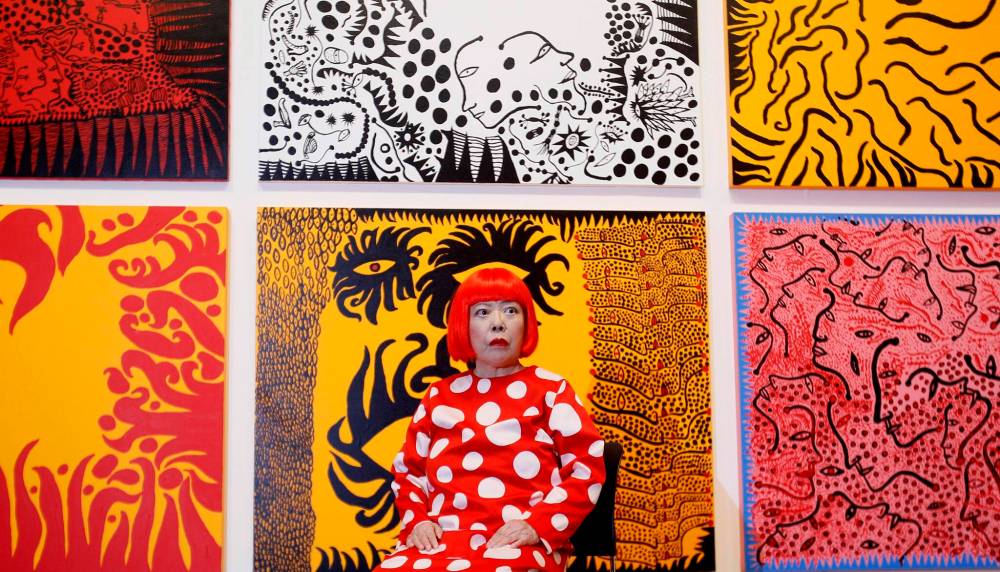
Obviously, I beelined for it. I was handed my sheet of stickers, all different sizes of circles, and sent to add to a work that hundreds of people had already contributed to.
I had the place to myself, oddly, I guess owing to the fact I was there during a midweek afternoon. There are no rules, obviously, in a place called The Obliteration Room, and anyway, no one was watching me. You can stick your dots wherever you want, in whatever pattern you want.
And yet, it felt slightly deviant to stick a sticker to something in an art gallery, doubly so because it also felt like you were defacing the Ikea Kallax cabinet in someone’s home. I got a little rush every time I affixed a red dot here and a blue dot there. The sheet of stickers felt like a permission slip, or maybe a dare.
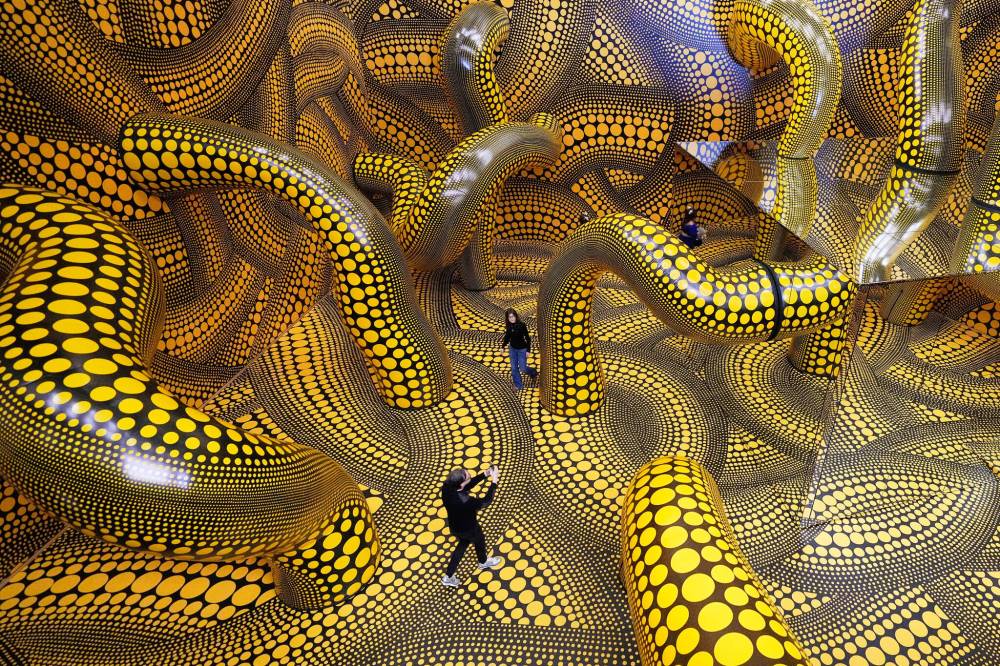
Yayoi Kusama died earlier this month at the age 97, though it was only announced this week. She saw renewed popularity in the smartphone era and, while works such as her polka-dotted pumpkin sculptures and her popular Infinity Mirror Rooms are certainly very Instagram-friendly, it’s a great disservice to her work to say that’s the only reason people flock to them.
Polka dots are often considered to be childlike and whimsical and, as they did for such disparate figures as Minnie Mouse and designer Kate Spade, became a brand for Kusama.
But in the artist’s hands, polka dots are not always playful. They are often disorienting and disturbing in the way that the idea of infinity — the idea she was always looking to capture — is disorienting and disturbing. There’s a sense of dread in the repetition of the dots she was so obsessed with — and perhaps tormented by.
Kusama’s use of dots comes from vivid hallucinations she’d started seeing as a child, obliterating her sense of vision.
“I still see hallucinations even now,” she said in 2017. “Dots come flying everywhere — on my dress, the floor, things I’m carrying, throughout the house, the ceiling. And I paint them.”
In the 1970s, after leaving a hugely influential mark in New York City’s avant-garde art scene, Kusama returned to Japan and voluntarily checked herself into a psychiatric hospital in Tokyo, where she lived until her death, creating art every day in a small studio close by. She was always open about her mental-health struggles.

“I fight pain, anxiety and fear every day, and the only method I have found that relieved my illness is to keep creating art. I followed the thread of art and somehow discovered a path that would allow me to live,” she said in a 2012 interview.
In recent years, her installations — those “Instagrammable” ones — have made for blockbuster museum exhibitions that attract massive lines of people all over the world.
And while I’m sure some of them are just there for selfies, it’s hard to believe that Kusama herself was “doing it for the ’gram,” as it were. Her immersive installations are also about as close one can get to physically wandering around inside her singular brain.
If you ever get the chance, brave the queues and take it.
jen.zoratti@winnipegfreepress.com
Jen Zoratti is a columnist and feature writer working in the Arts & Life department, as well as the author of the weekly newsletter NEXT. A National Newspaper Award finalist for arts and entertainment writing, Jen is a graduate of the Creative Communications program at RRC Polytech and was a music writer before joining the Free Press in 2013. Read more about Jen.
Every piece of reporting Jen produces is reviewed by an editing team before it is posted online or published in print – part of the Free Press‘s tradition, since 1872, of producing reliable independent journalism. Read more about Free Press’s history and mandate, and learn how our newsroom operates.
Our newsroom depends on a growing audience of readers to power our journalism. If you are not a paid reader, please consider becoming a subscriber.
Our newsroom depends on its audience of readers to power our journalism. Thank you for your support.
Jen Zoratti is a columnist and feature writer working in the Arts & Life department, as well as the author of the weekly newsletter NEXT. A National Newspaper Award finalist for arts and entertainment writing, Jen is a graduate of the Creative Communications program at RRC Polytech and was a music writer before joining the Free Press in 2013. Read more about Jen.
Every piece of reporting Jen produces is reviewed by an editing team before it is posted online or published in print – part of the Free Press‘s tradition, since 1872, of producing reliable independent journalism. Read more about Free Press’s history and mandate, and learn how our newsroom operates.
Our newsroom depends on a growing audience of readers to power our journalism. If you are not a paid reader, please consider becoming a subscriber.
Our newsroom depends on its audience of readers to power our journalism. Thank you for your support.
Advertisement Advertise With Us
Advertisement Advertise With Us