

Down from the hills to triage the wounded
Advertisement
Read this article for free:
or
Already have an account? Log in here »
To continue reading, please subscribe:
Monthly Digital Subscription
$1 per week for 24 weeks*
- Enjoy unlimited reading on winnipegfreepress.com
- Read the E-Edition, our digital replica newspaper
- Access News Break, our award-winning app
- Play interactive puzzles
*Billed as $4.00 plus GST every four weeks. After 24 weeks, price increases to the regular rate of $19.95 plus GST every four weeks. Offer available to new and qualified returning subscribers only. Cancel any time.
Monthly Digital Subscription
$4.99/week*
- Enjoy unlimited reading on winnipegfreepress.com
- Read the E-Edition, our digital replica newspaper
- Access News Break, our award-winning app
- Play interactive puzzles
*Billed as $19.95 plus GST every four weeks. Cancel any time.
To continue reading, please subscribe:
Add Free Press access to your Brandon Sun subscription for only an additional
$1 for the first 4 weeks*
*Your next subscription payment will increase by $1.00 and you will be charged $16.99 plus GST for four weeks. After four weeks, your payment will increase to $23.99 plus GST every four weeks.
Read unlimited articles for free today:
or
Already have an account? Log in here »
Hey there, time traveller!
This article was published 14/05/2011 (5453 days ago), so information in it may no longer be current.
It is said that editorial writers are the folks who come down from the hills after a battle to kill the wounded. In that spirit, I come down from the hills 12 days after the election, not to kill the wounded but simply to identify some of them for triage and to survey the battlefield.
First, and most obvious, is a moaning, groaning heap of bodies at the base of a shredded and bloodied banner on which it is just possible to see inscribed in Roman numerals LX:XL, or 60:40 to modern eyes.
For several years now, Canadian opposition politicians, who did not want to engage in electoral battle for fear that they would lose, instead have claimed that the Conservative government could be replaced by a coalition of opposition parties because they represented a majority of Canadians (that would be the LX) while the Conservatives were elected by a minority (the XL).
The reasoning was that 60 per cent had “voted against the Harper Conservatives.” But in truth, 100 per cent of Canadians who vote always vote “for” something — there is no “against” place on the ballot to mark an X.
It makes just as much nonsense to say that 96 per cent of Canadians who voted 12 days ago voted against the against the Greens, that 69 per cent voted against the NDP, and that 81 per cent voted against the Liberals.
But, in fact, 40 per cent voted for the Tories, 31 per cent voted for the NDP, 19 per cent voted for the Liberals and four per cent voted for the Greens.
So attractive was the LX:XL idea that it was twisted into a Frankenstein monster of parliamentary democracy, especially so after the Speaker of the House correctly but narrowly ruled that the will of the majority of MPs is superior to the will of the minority, even if the minority is governing.
I have no problem with the bare facts of that ruling, the strength of the people represented by their MPs should always be greater than the power of government, even elected government.
But the idea of Parliament is greater than majority rules. If it is only a numbers game it reduces a splendid idea into little more than a tranny of the majority.
Ideally, there should be no whipped votes in a Parliament. That might not be practical, but it would be a Parliament in the finest meaning of the word — where the will of the people is expressed through the majority of MPs guided by their consciences not by whips or partisan ambitions.
But to reduce the idea to merely a numbers game as the LX:XLers did, first by contriving contempt rulings and then by using their numbers to bring down the government, offends the idea of Parliament, making it a place where just because you can do, you do.
And, like Sampson, the Liberals and the Bloc found that when you use your muscle to bring down the House, you risk being crushed in the rubble.
I see Elizabeth May, Green party leader. She came out of the election personally unscathed, but boy, she lost a lot of troopers. She remains an LX:XLer, claiming the Conservative majority is “phony” because it wasn’t the result of a proportional vote. But then she has to say that — proportional representation is the only way the Greens are going to grow beyond a one-woman band, as the election 12 days ago confirmed.
It’s hard to feel sympathy for Gilles Duceppe, who truly suffered a crushing defeat. But as grievously injured as he is, it’s likely the $147,000 pension we will pay him for his failed efforts to breach the walls of Confederation will prove a soothing balm.
Poor Michael Ignatieff, our modern day Cincinnatus. Like the patrician Roman of long ago, he was dazzled by the backroom boys into leaving the farm, or at least the bucolic confines of Harvard, to become leader. Unlike Cincinnatus, he did not emerge victorious from battle, but he did survive and like the famous Roman saw that life on the farm field was better than on the battle field, even for a general.
Ignatieff leaves his army pretty much in ruin, so much so that defections started even before the smoke cleared. Anita Neville, for example, was urging her comrades to defect to enemy ranks within hours of failing to hold her own riding, an apparent lapse in courage of conviction.
Her comrades, however, held and it would appear the Liberals live to fight another day under their own flag.
And besides, it turned out that one-time LX:XLer Jack Layton, experienced one of those battlefield epiphanies that warriors sometimes experience when they succeed beyond all expectations. He now sees no need to make common cause with the rag-tag remnants of the once mighty Liberals.

Then, too, his victory was not so much a battlefield victory but one that came on an eastern flank. That surprise more than doubled his forces but the loyalty of the new troops in not entirely clear and his immediate concern will be to try to enforce discipline.
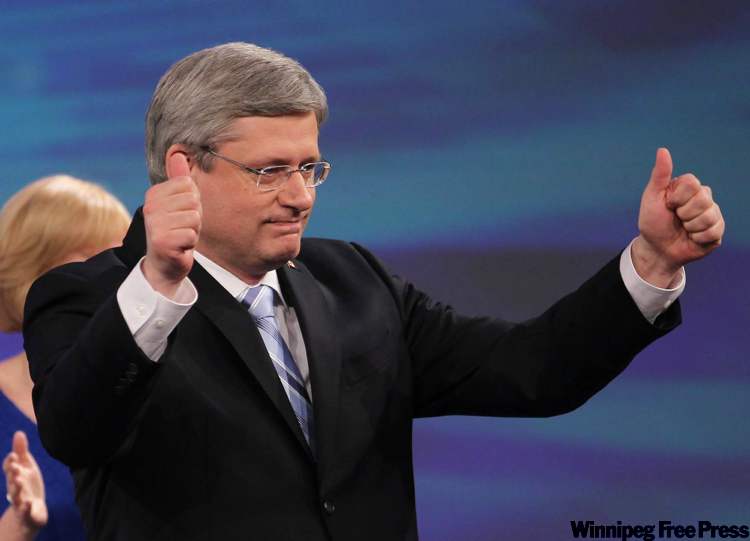
As for Steven Harper, he convincingly won the entire campaign and his forces emerged stronger on all but one front where he lost a few lieutenants in skirmishes.
The real winners, of course, are Canadians who got what they wanted, a stable government that will be able to keep the peace for four years.
That’s the way our parliamentary democracy works best.
gerald.flood@freepress.mb.ca