
Tories’ mass texting is Scheer mischief
Read this article for free:
or
Already have an account? Log in here »
To continue reading, please subscribe:

Digital Subscription
One year of digital access for only $205*
- Enjoy unlimited reading on winnipegfreepress.com
- Read the E-Edition, our digital replica newspaper
- Access News Break, our award-winning app
- Play interactive puzzles
*First annual payment billed as $205.00 + GST for one year. This annual subscription will automatically renew at $233.00 + GST every 52 weeks (10% off the regular annual price of $259.35). Offer available to new and qualified returning subscribers only. Cancel any time.
To continue reading, please subscribe:
Add Free Press access to your Brandon Sun subscription for only an additional
$1 for the first 4 weeks*
- Enjoy unlimited reading on winnipegfreepress.com
- Read the E-Edition, our digital replica newspaper
- Access News Break, our award-winning app
- Play interactive puzzles
*Your next Brandon Sun subscription payment will increase by $1.00 and you will be charged $17.95 plus GST for four weeks. After four weeks, your payment will increase to $24.95 plus GST every four weeks.
Read unlimited articles for free today:
or
Already have an account? Log in here »
Hey there, time traveller!
This article was published 04/04/2019 (2742 days ago), so information in it may no longer be current.
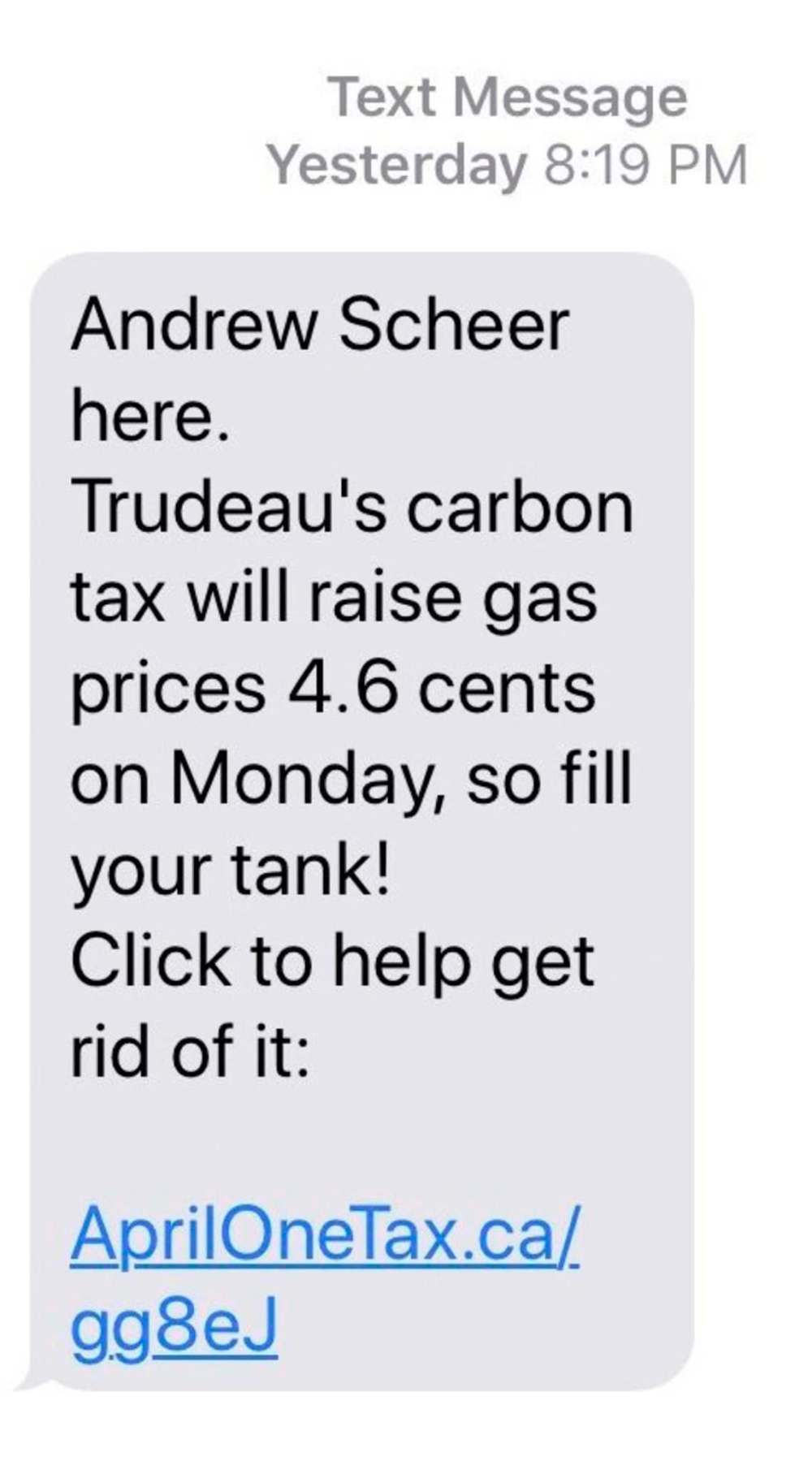
Last Sunday, thousands of people in Manitoba, Saskatchewan, New Brunswick and Ontario — the four provinces that have not agreed to implement their own carbon-pricing plans — received an unsolicited text message warning them to fill up their gas tanks before prices at the pumps jumped 4.6 cents a litre.
In some cases, the text purported to be from Conservative party Leader Andrew Scheer. Some were sent anonymously, while others claimed to be from someone named Lisa.
In all cases, the texts informed recipients that “Trudeau’s carbon tax” would raise gas prices on Monday, and invited them to click on a link if they wished to sign a petition against the tax.Those who did click on the link also divulged their name, address, phone number and email address, and tacitly agreed to be added to the party’s mailing list
Of course, those who did so also divulged their name, address, phone number and email address, and tacitly agreed to be added to the party’s mailing list. The website’s privacy policy states: “As a national organization with a riding-based membership system, your personal information may also be disclosed to our local riding associations, candidates, nomination contestants and leadership contestants who may also communicate with you.”
In addition, the random letters at the end of the web link were unique to each recipient, thereby allowing them to be tracked if they clicked on it. Even if recipients merely replied back, they would have been confirming their location and that the phone number reached was a legitimate one.
Though this kind of indiscriminate mass communication seems as if it should be illegal under anti-spam laws, political parties and candidates running for office are exempt, as their messages are “non-commercial.” While so-called “robocall” telephone messages have had restrictions placed upon them — they cannot be anonymous and must include a way for the person being called to opt out of such communications — no such rules exist for mass texting.
This regulatory grey area is worrisome for several reasons, among them the fact that randomly generated phone numbers necessarily include people who have not reached the age of majority, and that unsolicited communications are the primary delivery method for malware.
Of greater concern, however, is the fear-mongering, avoidance of facts and lack of alternative policy provided by the Conservatives.
If you drive a giant, gas-guzzling SUV, you might have saved $4 by filling your tank on the weekend — but only if prices actually went up (gas prices are inherently volatile, and already subject to fluctuations in the market and multiple taxes; tracking website GasBuddy showed some pumps in Ontario dropped prices from Sunday to Monday). That $4 saving, by the way, would only be fully realized if you coasted into the station on fumes, didn’t make an extra trip and didn’t idle in line for 10 minutes.
Neither Mr. Scheer nor “Lisa” made mention of the carbon-tax rebate Manitobans will be eligible for — $336 for the average family, which outstrips the estimated $232 expended annually on the tax.Though the petition claims Mr. Scheer would scrap the carbon tax if elected prime minister, it contains no information about what his party’s plan entails
Also, though the petition claims Mr. Scheer would scrap the carbon tax if elected prime minister, it contains no information about what his party’s plan entails; he gave no further details when speaking to the press on Monday in New Brunswick at an anti-carbon-tax rally.
There’s an argument to be made that the federally imposed carbon tax is likely to be ineffective in changing behaviour — one doesn’t imagine Canadians will be buying bus passes en masse to avoid paying $2 more for gas — but in the absence of a better idea, recipients of the Conservatives’ text could be forgiven for responding with an emphatic thumbs-down emoji.


