

Transit service must be dependable
Advertisement
Read this article for free:
or
Already have an account? Log in here »
To continue reading, please subscribe:

Digital Subscription
One year of digital access for only $205*
- Enjoy unlimited reading on winnipegfreepress.com
- Read the E-Edition, our digital replica newspaper
- Access News Break, our award-winning app
- Play interactive puzzles
*First annual payment billed as $205.00 + GST for one year. This annual subscription will automatically renew at $233.00 + GST every 52 weeks (10% off the regular annual price of $259.35). Offer available to new and qualified returning subscribers only. Cancel any time.
To continue reading, please subscribe:
Add Free Press access to your Brandon Sun subscription for only an additional
$1 for the first 4 weeks*
- Enjoy unlimited reading on winnipegfreepress.com
- Read the E-Edition, our digital replica newspaper
- Access News Break, our award-winning app
- Play interactive puzzles
*Your next Brandon Sun subscription payment will increase by $1.00 and you will be charged $17.95 plus GST for four weeks. After four weeks, your payment will increase to $24.95 plus GST every four weeks.
Read unlimited articles for free today:
or
Already have an account? Log in here »
Hey there, time traveller!
This article was published 08/01/2026 (255 days ago), so information in it may no longer be current.
If there’s anything worse for a public-transportation user than waiting in the winter cold for a Winnipeg Transit bus that never arrives, it surely must be waiting for a bus that does arrive but, being already overpacked with a standing-room complement of riders, passes by without stopping or opening its doors.
That, however, is the reality currently faced by too many users of Winnipeg’s transit system, which last year underwent a massive reorganization of its routes and schedules in an effort to make the service more efficient, more reliable and — perhaps most important — more appealing to this city’s car-dependent population as a viable option for getting from one place to another.
According to data released in December by Winnipeg Transit, the number of pass-ups — defined as when a bus is too full to allow more passengers to board, or is unable to accommodate a wheelchair either because the bus is too full or both wheelchair positions are already in use — experienced by the service last September (3,375) was the second-highest on record, eclipsed only by the 3,414 that occurred in September 2019.
MIKAELA MACKENZIE / FREE PRESS FILES
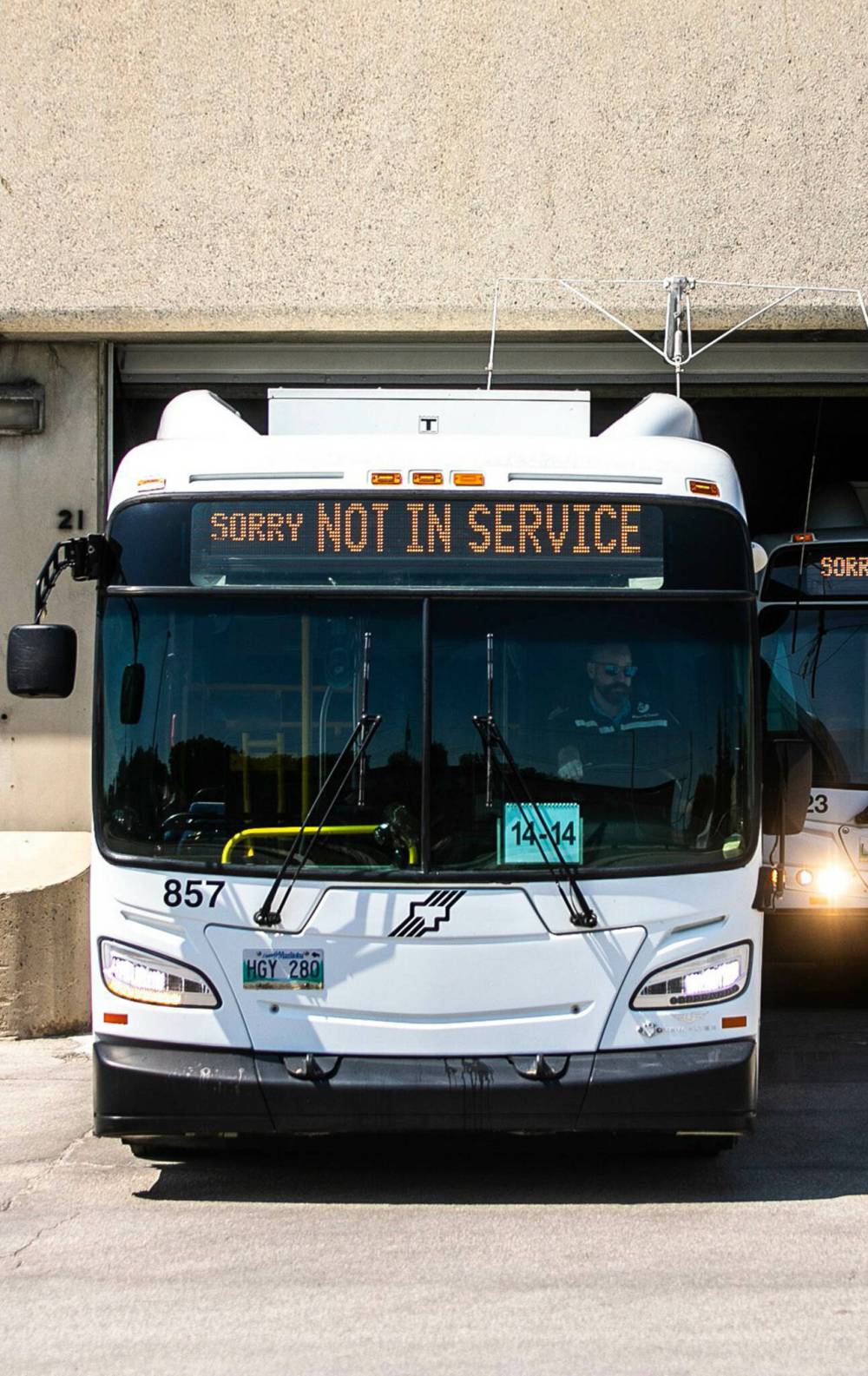
A Winnipeg Transit bus at the Fort Rouge garage.
Between September and November last year, 6,971 pass-ups were recorded (bus operators have access to a button which is pressed when a pass-up occurs), compared to 5,779 in the same period the previous year. In 2019, 8,297 were recorded.
“Defeating” is how one frequent rider characterized his recent pass-up experiences after waiting for scheduled buses but being unable to catch a ride home from work, adding “when it happens so frequently, it feels like no one cares and they’re not trying to fix it.”
That is definitely not a description befitting a transit service that has become more efficient, reliable and/or appealing to its users.
In fairness, Winnipeg Transit has been, and still is, attempting to address the deficiencies in its reconfigured system.
Major overhauls such as the one the service enacted last year are bound to experience setbacks, hiccups, frustrations or whatever other term one might use to describe a failure for performance to match promise.
Since the June 29 imposition of the new primary transit network — replacing the long-established model with a more streamlined configuration in which “feeder” buses connect riders with a smaller number of primary “spine” routes — Transit has made numerous adjustments, based in large part on feedback from (mostly dissatisfied) customers.

But the system remains very much a work in progress, as evidenced by the recently released pass-up figures, and the reasons offered by Transit officials — including a return to full service levels on all routes (many had been reduced during the pandemic) and the fact some transit users are having difficulty adjusting to the route reorganization — will provide little comfort to those enduring the frozen frustration of being passed up by yet another overburdened bus.
It also must be noted that the unacceptable pass-up rate is not the only critical issue with which the public-transit enterprise is grappling. Fare evasion and the on-board safety of both operators and passengers remain serious concerns that also affect public perception of the service and discourage ridership on buses.
But nothing is more fundamental to the viability of public transport than it being readily available to those who have chosen to use it.
For a full-time transit user, transit is their route to work, school or home — it isn’t optional.
Leaving would-be passengers stranded at stops thousands of times per month — particularly during a winter city’s most inhospitable season — while overcrowded buses pass them by is a failure that must be addressed before Winnipeg can expect the public to get on board, both literally and figuratively, with public transportation.
Related Articles
Eight of 10 people using bus to get downtown unhappy after system overhaul, BIZ survey reveals

Advertisement Advertise With Us
Advertisement Advertise With Us