

Eight of 10 people using bus to get downtown unhappy after system overhaul, BIZ survey reveals

Advertisement
Read this article for free:
or
Already have an account? Log in here »
To continue reading, please subscribe:

Digital Subscription
One year of digital access for only $205*
- Enjoy unlimited reading on winnipegfreepress.com
- Read the E-Edition, our digital replica newspaper
- Access News Break, our award-winning app
- Play interactive puzzles
*First annual payment billed as $205.00 + GST for one year. This annual subscription will automatically renew at $233.00 + GST every 52 weeks (10% off the regular annual price of $259.35). Offer available to new and qualified returning subscribers only. Cancel any time.
To continue reading, please subscribe:
Add Free Press access to your Brandon Sun subscription for only an additional
$1 for the first 4 weeks*
- Enjoy unlimited reading on winnipegfreepress.com
- Read the E-Edition, our digital replica newspaper
- Access News Break, our award-winning app
- Play interactive puzzles
*Your next Brandon Sun subscription payment will increase by $1.00 and you will be charged $17.95 plus GST for four weeks. After four weeks, your payment will increase to $24.95 plus GST every four weeks.
Read unlimited articles for free today:
or
Already have an account? Log in here »
Hey there, time traveller!
This article was published 25/02/2026 (228 days ago), so information in it may no longer be current.
Tefere Kahsay has few options: downsize, move his store to another location or close the business.
He rang through a couple of customers at an otherwise-empty Graham Convenience Store. One man, perhaps ironically, asked for a bus ticket.
The city took buses off Graham Avenue during last year’s Winnipeg Transit overhaul. Kahsay’s store at the corner of Graham and Vaughan Street, busy from Monday to Friday, suddenly looked like Sunday morning all week long.
“I’m dying,” said Kahsay.
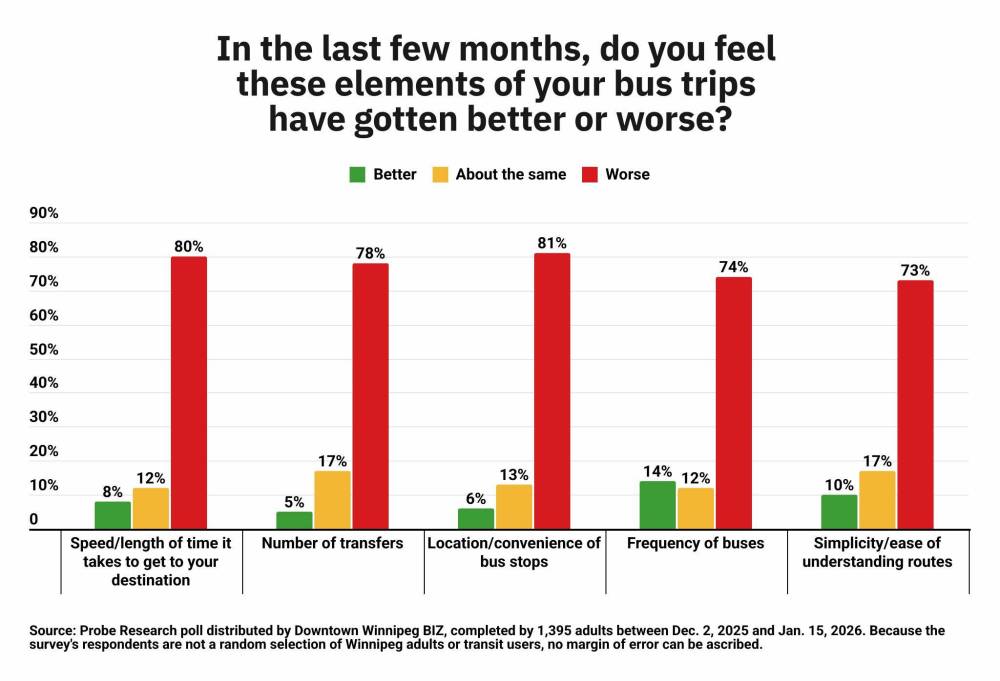
The people using transit to get downtown don’t like it, either. More than eight in 10 of them are unhappy with the new system, a Probe Research survey commissioned by the Downtown Winnipeg BIZ found.

The survey — which compiled data from 1,395 bus users over six weeks — says commute times downtown have increased by an average 22 minutes.
One-third of respondents said their trip downtown takes at least an hour — 10 times more riders with an hour-plus bus commute than under the old system.
Seventy per cent said they visit downtown less now, and half said when they do, they often seek other ways to reach the city’s core, such as booking an Uber.
“The level of dissatisfaction — that is dire,” said Coun. Sherri Rollins. “Winnipeggers are… voting with their feet. They’re not taking transit anymore. We’re losing revenue.”
Survey findings show the length of time to get downtown, the number of transfers required and the location of new bus stops are top complaints for commuters.
It’s the case for Maruna Litvinova: what was once a one-bus trip from the Corydon area to Red River College Polytechnic has become a two-bus endeavour with a 20-minute wait in between.
“When it’s (minus) 34 C, it’s not OK,” Litvinova said with a laugh.
The Downtown Winnipeg BIZ released its survey findings Wednesday. Simultaneously, the City of Winnipeg announced its spring transit schedule, which includes more buses on the road and later bus services, beginning April 12.
Winnipeg Transit will propose route changes to city council next week that affect downtown routes; changes would take effect in June.
Extending the D19-Corydon line — so buses will end their routes on Vaughan Street between Graham and St. Mary avenues, instead of further north across Portage Avenue at Webb Place — is on the agenda. The proposed change was suggested by a Graham Avenue business owner, said Kate Fenske, chief executive of the Downtown Winnipeg BIZ.
The D16 Academy-Notre Dame line may be split into two. A revised D16 and new D18 would reach downtown via different routes, from Polo Park and RRC Polytech’s Notre Dame campus, respectively.
“It’s not about looking (at), ‘How do we go backwards,’ but ‘How do we move forward?’” Fenske said.
“We’re hoping that the city is making changes as quickly as they can, because it is having an impact on downtown businesses and people that want to get here.”

The BIZ has had “productive conversations” with Winnipeg Transit and city officials regarding the new network, Fenske added.
Manitobans took the Probe survey between Dec. 2 and Jan. 15. It was a self-selecting survey, meaning people could enter via social media and the BIZ’s website, among other channels.
The data may skew towards people with negative views of the transit system, Mayor Scott Gillingham said.
“Nonetheless, we value the feedback,” he said, pointing to the proposed network changes.
He called last year’s overhaul the “right decision” but said he’s not pleased with how it’s been rolled out.
“We’re having to make a lot of adjustments, but we will make the adjustments,” Gillingham said. “We’ll keep… retooling the transit system until we get it right.”
Winnipeg Transit will use survey feedback, ridership and “pass-up” data — when a bus is too crowded and bypasses stops — as it tweaks its network, said Adam Budowski, senior transit planner for the city. Winnipeg Transit can now use GPS data; its system faltered over a period of months ending earlier this year, wreaking havoc on bus schedules.
“We’ll keep… retooling the transit system until we get it right.”
Rollins (Fort Rouge–East Fort Garry) said she’d like more publicly available data showing Transit’s performance, strategies to reduce transfer and commute times, a plan for greater reliability and an equity assessment focused on vulnerable people taking the bus.
People with disabilities were most likely, in the Probe survey, to believe nearly every aspect of the transit system is worse. And approximately three-quarters of riders aged 55 and older expressed dissatisfaction.
“Transit in Canada is still typically for people who need it as an alternative to driving,” said Aaron Moore, a University of Winnipeg political science professor.
“The most important aspect, to me, of a transit system is to provide services for those people — the people who need it the most.”
Older Manitobans may be less comfortable using digital applications to plan bus routes; distributing paper copies of new routes might be worthwhile, Moore suggested.
The city will launch weekly information sessions, starting mid-March, covering topics such as using the network and on-request buses.
gabrielle.piche@winnipegfreepress.com
Gabrielle Piché reports on business for the Free Press. She interned at the Free Press and worked for its sister outlet, Canstar Community News, before entering the business beat in 2021. Read more about Gabrielle.
Every piece of reporting Gabrielle produces is reviewed by an editing team before it is posted online or published in print — part of the Free Press‘s tradition, since 1872, of producing reliable independent journalism. Read more about Free Press’s history and mandate, and learn how our newsroom operates.
Our newsroom depends on a growing audience of readers to power our journalism. If you are not a paid reader, please consider becoming a subscriber.
Our newsroom depends on its audience of readers to power our journalism. Thank you for your support.
Spring schedule route changes
Winnipeg Transit will launch its spring schedule April 12.
It’s adding trips to the F5 line, which services Notre Dame Avenue and McPhillips Street, and the F8 line, which reaches Pembina and Henderson highways.
Buses will be added between CF Polo Park and the Old Commonwealth Path on Route 74. They’ll be added from St. Vital Centre to Bridgwater Centre, and from St. Vital Centre to Creek Bend Road, on Route 676.
Route 557, which serves South Osborne, Southdale, Island Lakes and Sage Creek, will also see more trips.
The D10, D14, D16, D17, 28, 38, 43, 70, 74 and 680 lines will have service extended until after midnight.
The number of buses travelling on Victoria Avenue East will decrease as Transit adjusts the service of the FX3 east of Kildonan Place. Adjusted service on the FX3 and the FX4, north of McLeod Avenue, reflects lower ridership.
— City of Winnipeg
Gabrielle Piché reports on business for the Free Press. She interned at the Free Press and worked for its sister outlet, Canstar Community News, before entering the business beat in 2021. Read more about Gabrielle.
Every piece of reporting Gabrielle produces is reviewed by an editing team before it is posted online or published in print — part of the Free Press‘s tradition, since 1872, of producing reliable independent journalism. Read more about Free Press’s history and mandate, and learn how our newsroom operates.
Our newsroom depends on a growing audience of readers to power our journalism. If you are not a paid reader, please consider becoming a subscriber.
Our newsroom depends on its audience of readers to power our journalism. Thank you for your support.
Related Articles
Without key GPS data, transit plan lacked direction











Advertisement Advertise With Us
Advertisement Advertise With Us