

Stalin’s skyscraper rules and clogs heart of Warsaw
Advertisement
Read this article for free:
or
Already have an account? Log in here »
To continue reading, please subscribe:

Digital Subscription
One year of digital access for only $205*
- Enjoy unlimited reading on winnipegfreepress.com
- Read the E-Edition, our digital replica newspaper
- Access News Break, our award-winning app
- Play interactive puzzles
*First annual payment billed as $205.00 + GST for one year. This annual subscription will automatically renew at $233.00 + GST every 52 weeks (10% off the regular annual price of $259.35). Offer available to new and qualified returning subscribers only. Cancel any time.
To continue reading, please subscribe:
Add Free Press access to your Brandon Sun subscription for only an additional
$1 for the first 4 weeks*
- Enjoy unlimited reading on winnipegfreepress.com
- Read the E-Edition, our digital replica newspaper
- Access News Break, our award-winning app
- Play interactive puzzles
*Your next Brandon Sun subscription payment will increase by $1.00 and you will be charged $17.95 plus GST for four weeks. After four weeks, your payment will increase to $24.95 plus GST every four weeks.
Read unlimited articles for free today:
or
Already have an account? Log in here »
Hey there, time traveller!
This article was published 10/04/2010 (5978 days ago), so information in it may no longer be current.
WARSAW, Poland — The din of traffic at the intersection of Marszalkoska and Jerozolimskie in downtown Warsaw rises and falls with the rhythms of the morning and evening rush hours, but it never stops.
Honking horns, wailing sirens, roaring trucks, grinding double-long buses, the clatter and clang of trams and squeals of tires made it impossible to use the balcony of my room on the eighth floor of the Metropol Hotel, which directly overlooked the four-lane roundabout where 16 lanes of traffic sorted themselves out in a maelstrom of chrome and metal.
It’s perhaps notable that in all the time I watched that intersection I never saw a single accident.
More notable, perhaps, is that in all the time I watched that intersection I rarely saw a single person out for a stroll — in the heart of a city of 1.8 million.
There are two reasons for that.
One reason is the street-level environment is designed to serve traffic and is hostile to pedestrians.
The other reason is all the pedestrians have been forced underground. Below the pinwheeling traffic of the roundabout, tens of thousands of commuters swirl like a river of humanity through a ring of tunnels connecting the subway with the trams and buses on the streets above. The crush at times is so great it is all but impossible to simply stand in one place and watch the world go by.
But seldom does any of that humanity emerge to create street life in the heart of the city.
In that, Warsaw is much like Winnipeg, which has pretty much killed street life at its most famous intersection by turning it over to the exclusive use of cars and herding those few pedestrians who venture there underground.
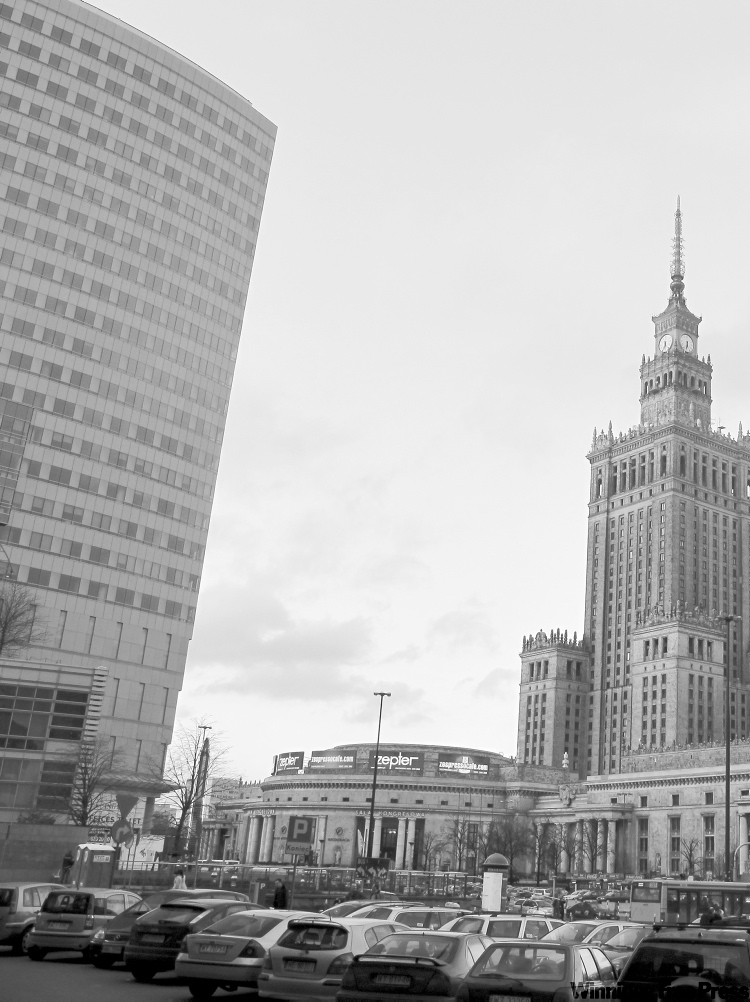
Warsaw, however, has a second major obstacle to the establishment of vibrant centre — the Palace of Culture and Science.
Erected in the early ’50s, the Palace is a monument to Joseph Stalin’s "edifice complex."
After "winning" the Second World War, Stalin became concerned his allies might think the Soviet Union backward because it lacked skyscrapers. And so he ordered some be built in a style that has since become known as "Stalinist."
While a dozen such skyscrapers were designed for construction in Moscow, only seven were actually built — the Seven Sisters, as they have come to be known — all massively imposing but larded with kitschy touches, statues and gargoyles and fussy stonework that make them appear to be "wedding cakes."
Not satisfied with the Seven Sisters, however, Stalin decided to make a gift of an Eighth Sister to Warsaw.
And so, after four years of construction by some 6,000 workers, the 231-metre-tall, 42-storey Palace was opened in 1955 at the corner of Marszalkoska and Jerozolimskie, and there it looms to this day.
The building has conflicted Poles from the beginning. They never asked for it, and for the most part have found its imposition on the city to be a symbol of Moscow’s domination of them and their country.
An old joke about the building reflects public opinion.
"Why is view from the observation deck on 30th floor of the Palace of Culture and Science the best in Warsaw? Because it is the only view that excludes the Palace."
After Stalin’s death, Poles did manage to remove his name from the structure, but they can’t seem to part with it, although they did toy with the idea of razing it in the heady days after the fall of the Berlin Wall.
It seems that they just can’t come to grips with the idea of wasting 1.3 million square feet of floor space, or finding substitutes for theatres, conference halls and museums that are part of the complex and its 43-metre "spire" from which radio and television signals are broadcast.
Which outrages many, like my friend Kamila Cronberg, whom I first met 20 years ago when she was a history of art student

Kamila simply hates the building, which she dismisses simply as "ugly."
But more importantly, the Palace, even more than the nearby traffic roundabout, is antithetical to street life. It squats at the centre of vast property, about a half-kilometre square, most of it dedicated to surface parking, with the result that pedestrians are inhibited by the structure on the one hand, and have nothing to relate to from sidewalks other than parking lots.
In addition, the Palace displaced 6,000 people who had lived in the centre and who made it a people place.
"It was done deliberately to destroy the ‘bourgeois’ centre of the city," Kamila explained. "And it worked."
Related Articles
Warsaw: Never say die
Advertisement Advertise With Us
Advertisement Advertise With Us