

Warsaw: Never say die
Free from Moscow, the Poles surge ahead
Advertisement
Read this article for free:
or
Already have an account? Log in here »
To continue reading, please subscribe:

Digital Subscription
One year of digital access for only $205*
- Enjoy unlimited reading on winnipegfreepress.com
- Read the E-Edition, our digital replica newspaper
- Access News Break, our award-winning app
- Play interactive puzzles
*First annual payment billed as $205.00 + GST for one year. This annual subscription will automatically renew at $233.00 + GST every 52 weeks (10% off the regular annual price of $259.35). Offer available to new and qualified returning subscribers only. Cancel any time.
To continue reading, please subscribe:
Add Free Press access to your Brandon Sun subscription for only an additional
$1 for the first 4 weeks*
- Enjoy unlimited reading on winnipegfreepress.com
- Read the E-Edition, our digital replica newspaper
- Access News Break, our award-winning app
- Play interactive puzzles
*Your next Brandon Sun subscription payment will increase by $1.00 and you will be charged $17.95 plus GST for four weeks. After four weeks, your payment will increase to $24.95 plus GST every four weeks.
Read unlimited articles for free today:
or
Already have an account? Log in here »
Hey there, time traveller!
This article was published 10/04/2010 (5969 days ago), so information in it may no longer be current.
WARSAW, Poland — To understand Poland’s remarkable post-Communist success, it is instructive to examine the success of Aleksander Nawrocki, who left a good life in Winnipeg to return to Warsaw as the Soviet Union was collapsing in 1989.
I first met Nawrocki, 57, a tall, infectiously genial man, at my hotel in the Praga district on the east bank of the Vistula River in Warsaw. It was in Praga that the Red Army waited and mostly watched as the Nazis razed the historic west bank in retaliation for the Warsaw uprising, which cost more than 200,000 ever-defiant Poles their lives, and most of their city — "The Paris of Eastern Europe" — in 1944.
The scars of those terrible times are still visible on shrapnel-pocked buildings in Praga. It nevertheless survived the war pretty much intact, which proved a mixed blessing in that it missed out on the post-war rebuilding boom and remains a poorer district of the rebuilt city — even the recently recreated "Old City" — on the west bank. It is home to the Warsaw Zoo, and the massive 60,000-seat stadium under construction to co-host the Euro Cup soccer championships with Ukraine in 2012.
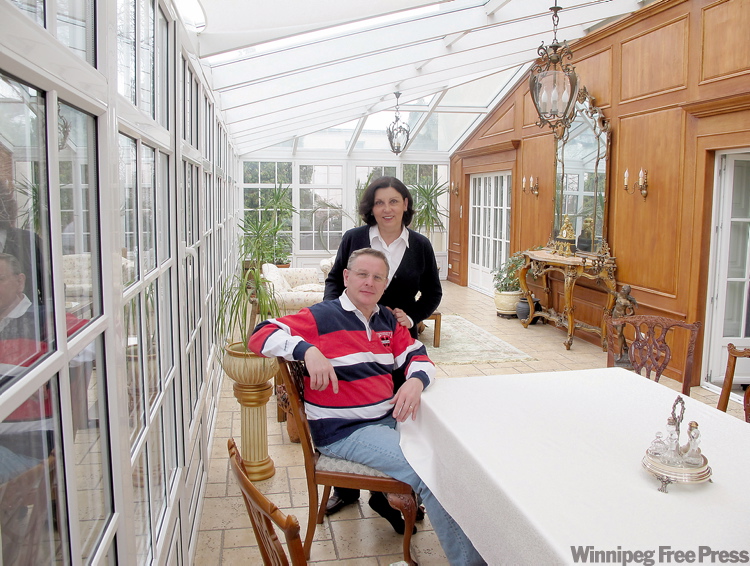
Although Praga today is starting to gentrify, it is a world away from the affluent south side where Nawrocki took me to his splendid, three-storey, 4,000-square-foot home for lunch with his wife Halina, also a former Winnipegger.
Aleks — everyone calls him Aleks — arrived to pick me up in a $130,000 BMW 740 Li (one of four vehicles he owns, including a vintage Mercedes convertible). He wore a good black suit, crisp white shirt and a red tie. He immediately removed his sunglasses to introduce himself.
He is the owner of an insurance and investment company, the start-up of which marked the most recent evolution in his business career, and which also marks the most recent development in Poland’s evolution — it is now a country with a growing market for investments, retirement plans and security, a far cry from the carpet-bagger economy that Aleks returned to only 20 years ago.
But I get ahead of myself.
Aleks was born in Soviet-Warsaw in 1952 and first "escaped the cage" in 1974, travelling to Ontario — "Everyone knew that Canada was synonymous with richness" — where he worked illegally in tobacco country before returning home starry-eyed with hope.
In that, he was like so many Poles, then and now. The entrepreneurial spirit of Poles, often compared to that of Americans, could not be stamped out by Communism, as Polish farmers proved by refusing to surrender their private lands and submit to collectivization, which explains why agriculture was an early success after the Communists quit in 1989, leading to Lech Walesa’s election as president and the establishment of a Solidarity government one year later.
The desire to make their own way in the world explains why the first Poles I met 20 years ago after the "Fall of Wall" were carpet-baggers in temporary but teeming outdoor markets in Berlin, to which they would travel by train with huge bags bulging with cheap Polish goods that they would sell, use the money to purchase TVs and VCRs that they would take back, resell and start the cycle over again.
The desire to get ahead remains strong, so much so that it is estimated that three million Poles today work outside of the country, contributing to a demographic imbalance — there are one million more Polish women today than men in the country of 45 million.
The willingness to seek opportunity elsewhere had an unintended but positive consequence — a stream of remittance money that helped relieve poverty and spur economy in the early days of independence, and which helped buffer it during the recent economic crisis, from which Poland was the only one of 27 European Union members to escape without falling into recession, Janusz Grobiki, an economist with the Adam Smith Institute, explained to me.
On his return to Poland from his first foray abroad, Aleks met Halina, who had immigrated to Winnipeg with her parents in 1962, and where she then was studying commerce at the University of Manitoba.
The next year, 1975, he found his way to Winnipeg, where he was a "garbageman" at the Westin Hotel, eventually working his way up to valet.
"Room service was to me at that time the best job on Earth," Aleks recalls. "I struck gold."
Alex and Halina married, and Alex followed her into the faculty of commerce, graduating in 1981.
For the next eight years, the couple built a good life in Winnipeg, acquiring a first home and then a second in St. Vital. Halina worked for the Toronto Dominion bank, Aleks for two farm machinery companies. He was writing business plans for an aboriginal investment group when he was surprised to learn that Johnson and Johnson, the soap makers, were interested in hiring him to work in Poland.
It turned out Aleks’ mother, a doctor, had submitted his cv to Johnson and Johnson after seeing an ad in a Warsaw newspaper seeking a Polish-speaking accountant to be its first financial director in Poland.
Aleks got the job for more than he asked (and less than he could have asked), and Halina agreed to the move back "for three years, long enough for the children to learn Polish."
When they arrived in Warsaw, however, Halina wept.
It was a dirty, backward city with few amenities. "In the market they chopped off the heads of chickens," Aleks said. "We had bars on the windows of our apartment and still we were robbed twice. It was those times."
But those times were also times of incredible opportunity, which was why Aleks had been recruited to set up shop "for an international company, can you imagine, in one room, the copier was in the toilet."
Over the next several years, the business rapidly expanded in response to Poland’s pent-up demand for consumer goods, even basics, like soap.
But it wasn’t just commerce that Aleks and thousands of other returnees were imparting in that first wave of private initiative. The business of doing business had to be made reliable, secure and transparent; annual reports had to reflect annual activities.
One of Alek’s major responsibilities was to make accounts reflect western standards — General Accounting Principles — the piecemeal application of which everywhere at once laid down an accounting foundation on which further economic expansion could more easily follow.
Alex found that he was unsatisfied, however. He wanted more responsibility, and he wanted to plunge, along with most everyone, it seemed, into the entrepreneurial vortex that Poland became in the 1990s.
"At that time, there was no government regulation, everything was possible and nothing was forbidden," economist Grobiki said. "The people created six million jobs, and when the people started to get richer, the government woke up" and started to tax and regulate, neither of which was welcome, but both of which were necessary for Poland’s future.
The government brought in tough measures to eliminate unsustainable entitlements, leading sometimes to riots but forcing Poles to fend for themselves, something that was not happening in many less-courageous or far-sighted former satellites, all of which are doing less well today.
Aleks refers to that time as "Oklahoma when they discovered oil." Others call it simply "the wild west."
But whatever it’s called, just about anyone with an idea could make money. One of Alexs’ friends started selling VCR tapes, and then machines, filling a home entertainment void that seemed unlimited. Today he owns a television station, a huge glass and chrome edifice that stands across the street from the office building in which he started. Another imported lawn mowers from Canada — not a top of mind idea — but eventually he became the lawn mower and snow blower czar of Poland as prosperity made lawns attractive and automobile ownership led to the need to shovel the driveway.
Aleks was approached to head up a cosmetics distribution company that first sent him to Harvard to get an MBA, the certificate of which hangs in his study, along with his diploma from the University of Manitoba, his certificate as a Certified Management Accountant and his certificate of Canadian citizenship, which he, Halina and their three children all continue to possess. (Halina and the children spent summers in Winnipeg for their first 10 years, until her father died and her mother moved to Calgary.)
Back from Harvard, Aleks formed a team that quickly exceeded sales expectations in a territory that included all of Eastern Europe. He stayed 10 years during which he watched as market "for fast moving consumer goods" expanded to the point of saturation, and the ability to make easy money in distribution and retail sales gave way to cut-throat competition and the big box merchandizing so familiar to Canadians.
It was good for consumers and workers, but the writing was on the wall for anyone who expected the recent and well-trod paths to success were still easy streets.
Aleks moved with the increasingly prosperous times into their corollary – a desire to protect gains. He became president of Prudential Life and ministered to the desire of the upwardly-mobile population to secure its prosperity through safe investments and insurance. The upward mobility was spurred by tax reforms, reduced flat income and corporate tax rates that had the effect of increasing government revenue as a result of declines in cheating, and which helped Poland weather the recent financial crisis.
Three years ago, Aleks started his own company, Premium Financial Prestige, which employed 120 agents until the financial crisis caused everyone to pause.
"People stopped buying," he said. "The usual answer was; ‘I think I will wait’."
Which is where, Aleks, and Poland, are today — waiting to see what will happen next.
The economy still has a pulse, but it has slowed — growth is less than one per cent down from six and seven per cent, even 17 per cent in heady times.
Construction has slowed. In the city centre, a new tower remains a concrete skeleton and everywhere can be found naked tenements, stripped of their exteriors to expose their brick structures and awaiting the return of good times and the application of new stucco.
But growth continues apace in the sprawling "small city" in south Warsaw where apartment complexes have exploded into a community of 100,000 in less than a decade, the result of ever expanding credit and mortgage financing, both of which were slow to develop but which arrived in time and with sufficient prudence to help Poland through the recent storm without creating a real-estate bubble.
And, of course, construction continues unabated at the European Union financed soccer stadium, where 13 building cranes swing 24-7 to meet the 2012 deadline.
In fact, for all the remarkable efforts Poles have made in pulling their economy into sixth place in the European Union, they would not be where they are without the incredible investments the EU has made in the country, which became an EU member in 2004.
Rick Lada, a Canadian-born Californian who has made Poland home since 1990, said that by some estimates, the EU has poured 750 billion euros — almost $1 trillion — into Poland.
It’s not charity, of course, but an investment. The biggest supermarket chain, for example, Beidronka, which has an estimated 1,400 outlets in Poland, is German. Volkswagen, BMW and Porsche all build and sell cars here. Locomotives are German. The French sell cars, furniture and wines. The Scandinavians sell mobile phones … and on and on and on.
Investments in roads and other infrastructure are a boon to Poles, but they also facilitate trade. While Warsaw inexplicably is not yet connected to the rest of the country with freeways, its new international air terminal contributes to the growing pride of the city. But it also is the departure point for millions of Poles travelling to other EU countries, in particular Britain, and it is the arrival point for Europeans seeking getaways in a European-friendly and relatively-cheap environment.
Lada, a partner in a Polish firm that builds innovative fire and dust suppression systems, and who is vice-president of the American Chamber of Commerce in Poland, said EU assistance to Poland is so pervasive that the United States should sit up and take notice.
Poland has always been one of America’s greatest admirers and allies, but that relationship in recent times has not been sufficiently reciprocated.
"So many EU countries have student exchanges but not so much the United States," he said. "Poles need a visa to get into the U.S., but they are not required anywhere in Europe.

"The U.S. can’t assume it will always have such a strong partner."
Aleks, meanwhile, believes the worst has passed and that his company will regain lost ground.
But he is not worried. He has enough to support his children in good schools, and he expects to continue to spend his summers sailing in Croatia and skiing in Italy in winter.
"I am not a rich man, but we are comfortable and I do not live in hope of having a big company and being rich," he said, adding for perhaps the 10th time. "I love Canada. Everything good that has happened to me has happened because of Canada."
BACKEAST
GERALD FLOOD — has revisited Eastern Europe, a much different world from the one he encountered on his first trip 20 years ago, just after the collapse of the Iron Curtain. He filed these stories from Warsaw, where Polish creativity has blossomed, freed from the dead hand of Moscow.
Related Articles
Stalin's skyscraper rules and clogs heart of Warsaw
Advertisement Advertise With Us
Advertisement Advertise With Us