

A lot of hot air, but little action
With mounting evidence COVID-19 could be spread through aerosols, experts question school ventilation

Advertisement
Read this article for free:
or
Already have an account? Log in here »
To continue reading, please subscribe:
Monthly Digital Subscription
$1 per week for 24 weeks*
- Enjoy unlimited reading on winnipegfreepress.com
- Read the E-Edition, our digital replica newspaper
- Access News Break, our award-winning app
- Play interactive puzzles
*Billed as $4.00 plus GST every four weeks. After 24 weeks, price increases to the regular rate of $19.95 plus GST every four weeks. Offer available to new and qualified returning subscribers only. Cancel any time.
Monthly Digital Subscription
$4.99/week*
- Enjoy unlimited reading on winnipegfreepress.com
- Read the E-Edition, our digital replica newspaper
- Access News Break, our award-winning app
- Play interactive puzzles
*Billed as $19.95 plus GST every four weeks. Cancel any time.
To continue reading, please subscribe:
Add Free Press access to your Brandon Sun subscription for only an additional
$1 for the first 4 weeks*
*Your next subscription payment will increase by $1.00 and you will be charged $16.99 plus GST for four weeks. After four weeks, your payment will increase to $23.99 plus GST every four weeks.
Read unlimited articles for free today:
or
Already have an account? Log in here »
Hey there, time traveller!
This article was published 12/08/2020 (2052 days ago), so information in it may no longer be current.
Consider a school building: its dusty chalkboards in crowded classrooms, gymnasiums packed with sweaty bodies, and lockers with forgotten lunches left behind.
There is a reason “public school classroom” is not a signature air freshener scent.
One Winnipeg educator, drawing on her experience teaching teenagers in a portable classroom, told the Free Press her workplace can get “smelly” after a few classes; “so you know the air’s not moving.”
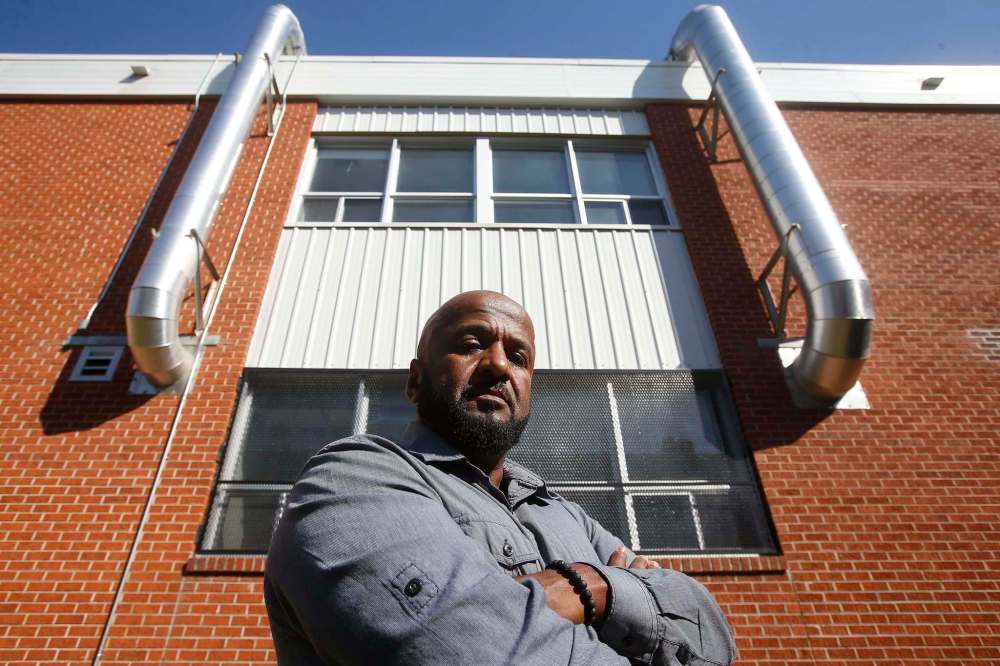
Thousands of students are expected to return to classrooms across the province in a month’s time to start the 2020-21 school year during the pandemic. Schools are expected to follow a laundry list of new protocols, from physical distancing to rigorous cleaning — but despite mounting evidence the novel coronavirus can be spread through aerosols, as well as droplets, there has been little discussion about ventilation.
The province’s back-to-school plan recommends teachers spend as much time as possible outside in the fall, while public health experts have suggested classroom windows be left open, weather permitting, to better circulate fresh air.
For father Abe Araya, who worked in Winnipeg School Division schools for 20 years in various maintenance roles, these suggestions will not be enough.
Araya has visited all of the schools in the province’s largest division, some of which he said house classrooms that do not have operable windows. He said most hallways, gymnasiums and locker-rooms do not have windows.
“In some schools (in the division), the air movement is horrible,” said Araya, who took over the post of president of the Canadian Union of Public Employees Manitoba late last year. The union represents 6,000 K-12 education support staff who work in two dozen divisions across Manitoba.
“They’re not up to par, as far as I’m concerned… and it should be a concern in regards to COVID.”
According to the WSD’s latest building systems assessment from 2018, the division has 310 air-handling units, which take outside air, filter and either heat or cool it, and supply fresh air throughout a building via a ductwork ventilation system. The mechanical equipment is in “poor to fair condition,” based on service age, with many of the units in buildings being the original ones installed when schools were built, the report states. However, it notes a maintenance program has maintained units in “good operating condition.”
The report adds that, “WSD can expect to see increasing unplanned failures of the units in the future.”
Doug Wylie, an occupational hygienist, said Wednesday air quality relies on the per cent of fresh air brought into a space, the number of air exchanges that happen per hour, filtration and occupancy. These variables can be altered in schools, at a cost.
“People in general give out and breathe a cocktail of volatile organic compounds,” said Wylie, principal investigator at Winnipeg Air Testing. That’s why he said it’s important to “purge and dilute” — especially when there may be potentially infectious aerosols.

Schools may be able to increase the percentage of fresh air they bring into the building, Wylie said, adding buildings often bring in new air and re-circulate air on a 50-50 scale because heating or cooling fresh air can be costly. Buying HEPA filters, which can filter particles, is another option for classrooms, he added.
“You can’t just put a bunch of fans in the hallway and move the air around. That’s maybe a bad thing to do, if you have a contaminated building,” said Andrew Halayko, a professor of physiology and pathophysiology at the University of Manitoba, and a Canada Research Chair in Lung Disease and Treatment.
Halayko said air exchange is critical and while it’s unlikely schools will overhaul ventilation systems, they can reset and re-calibrate them. It may be costly, he said, but such change is important.
maggie.macintosh@freepress.mb.ca
Twitter: @macintoshmaggie
Maggie Macintosh
Education reporter
Maggie Macintosh reports on education for the Free Press. Originally from Hamilton, Ont., she first reported for the Free Press in 2017. Read more about Maggie.
Funding for the Free Press education reporter comes from the Government of Canada through the Local Journalism Initiative.
Every piece of reporting Maggie produces is reviewed by an editing team before it is posted online or published in print — part of the Free Press‘s tradition, since 1872, of producing reliable independent journalism. Read more about Free Press’s history and mandate, and learn how our newsroom operates.
Our newsroom depends on a growing audience of readers to power our journalism. If you are not a paid reader, please consider becoming a subscriber.
Our newsroom depends on its audience of readers to power our journalism. Thank you for your support.
Maggie Macintosh
Education reporter
Maggie Macintosh reports on education for the Free Press. Originally from Hamilton, Ont., she first reported for the Free Press in 2017. Read more about Maggie.
Funding for the Free Press education reporter comes from the Government of Canada through the Local Journalism Initiative.
Every piece of reporting Maggie produces is reviewed by an editing team before it is posted online or published in print — part of the Free Press‘s tradition, since 1872, of producing reliable independent journalism. Read more about Free Press’s history and mandate, and learn how our newsroom operates.
Our newsroom depends on a growing audience of readers to power our journalism. If you are not a paid reader, please consider becoming a subscriber.
Our newsroom depends on its audience of readers to power our journalism. Thank you for your support.
Advertisement Advertise With Us
Advertisement Advertise With Us