

Dad of Down syndrome teen files complaint over vaccine

Advertisement
Read this article for free:
or
Already have an account? Log in here »
To continue reading, please subscribe:

Digital Subscription
One year of digital access for only $205*
- Enjoy unlimited reading on winnipegfreepress.com
- Read the E-Edition, our digital replica newspaper
- Access News Break, our award-winning app
- Play interactive puzzles
*First annual payment billed as $205.00 + GST for one year. This annual subscription will automatically renew at $233.00 + GST every 52 weeks (10% off the regular annual price of $259.35). Offer available to new and qualified returning subscribers only. Cancel any time.
To continue reading, please subscribe:
Add Free Press access to your Brandon Sun subscription for only an additional
$1 for the first 4 weeks*
- Enjoy unlimited reading on winnipegfreepress.com
- Read the E-Edition, our digital replica newspaper
- Access News Break, our award-winning app
- Play interactive puzzles
*Your next Brandon Sun subscription payment will increase by $1.00 and you will be charged $17.95 plus GST for four weeks. After four weeks, your payment will increase to $24.95 plus GST every four weeks.
Read unlimited articles for free today:
or
Already have an account? Log in here »
Hey there, time traveller!
This article was published 04/03/2021 (1980 days ago), so information in it may no longer be current.
A Brandon father is accusing the provincial government of “blatant discrimination” against his teenage son, who has Down syndrome, because Manitobans with disabilities have been left off the COVID-19 immunization priority list.
Bruce Strang said he filed a formal complaint with the Manitoba Human Rights Commission this week to pressure the province to edit its vaccination plan.
“Disability rights shouldn’t be the first thing to go in a time of crisis,” Strang, a father of two, told the Free Press. “It’s unethical in my view. It’s unconscionable in my view and I can’t see how a medical professional can advocate for a plan that discriminates actively against people with disabilities.”
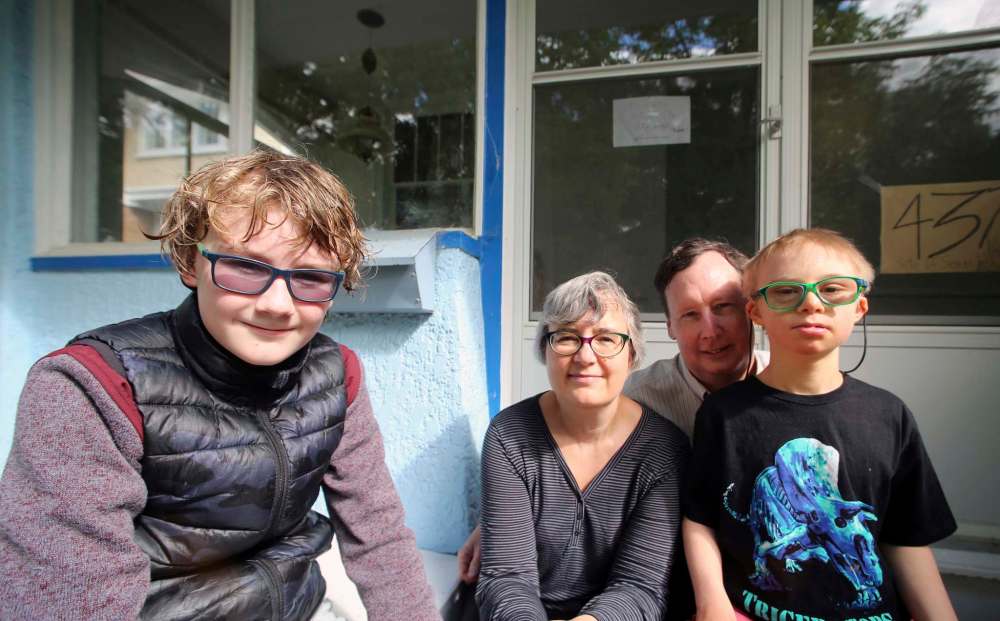
Strang’s oldest son, Sean, 16, hasn’t been in a classroom — let alone, left his family home for any other reason — for nearly a year because of his immunocompromised status.
(While Health Canada has approved Moderna and AstraZeneca COVID-19 vaccines for anyone 18 and older, Pfizer-BioNTech doses can be given to patients as young as 16.)
Health-care workers, seniors and staff in long-term care facilities, adults who are 80 or older and the elderly in remote and isolated Indigenous communities make up the priority population in Manitoba.
The province has started to vaccinate the general population, based solely on age.
Strang said his son should not get priority over an 85-year-old who lives in a nursing home, but it doesn’t make sense that Sean can expect a vaccine at the same time a healthy teenager can.
People with Down syndrome are nearly five times more at risk of COVID-19-related hospitalization and 10 times more likely to die after contracting the virus in comparison to the general population, according to a U.K. study published in the Annals of Internal Medicine in autumn.
The population’s unique genetics and predisposition to respiratory illnesses are believed to be contributing factors.
Ready for My Shot, a Canadawide campaign, is calling on all jurisdictions to clearly identify adults with Down syndrome and other developmental disabilities as high priority patients, citing that research.
Only the Northwest Territories has explicitly opened up vaccine appointments to adults with disabilities.
“I would love to be able to offer vaccine to everybody — everyone in Manitoba, but, certainly, everybody who’s at any level of higher risk. We just don’t have that luxury until we have more supply,” said Joss Reimer, medical lead for Manitoba’s vaccine implementation task force, when pressed on the subject during a press conference Wednesday.
Reimer said all health conditions that put people at a higher risk, including Down syndrome, will be considered as more doses become available.

Mike Waddingham, an organizer with Ready for My Shot, called that reasoning — that this is a supply-linked issue — “a red herring.”
“You either accept that people with Down syndrome are at higher risks and therefore should be prioritized with other people who are high risk, like elderly people or Indigenous people, or you don’t,” said Waddingham, when reached by phone in Burnaby, B.C., Thursday.
Given the commission complaint process is a lengthy one, Strang suspects the immunization issue will have passed by the time his grievance is resolved; nevertheless, he said the act of filing a complaint sends an important message.
maggie.macintosh@freepress.mb.ca
Twitter: @macintoshmaggie
Maggie Macintosh
Education reporter
Maggie Macintosh reports on education for the Free Press. Originally from Hamilton, Ont., she first reported for the Free Press in 2017. Read more about Maggie.
Funding for the Free Press education reporter comes from the Government of Canada through the Local Journalism Initiative.
Every piece of reporting Maggie produces is reviewed by an editing team before it is posted online or published in print — part of the Free Press‘s tradition, since 1872, of producing reliable independent journalism. Read more about Free Press’s history and mandate, and learn how our newsroom operates.
Our newsroom depends on a growing audience of readers to power our journalism. If you are not a paid reader, please consider becoming a subscriber.
Our newsroom depends on its audience of readers to power our journalism. Thank you for your support.
Maggie Macintosh
Education reporter
Maggie Macintosh reports on education for the Free Press. Originally from Hamilton, Ont., she first reported for the Free Press in 2017. Read more about Maggie.
Funding for the Free Press education reporter comes from the Government of Canada through the Local Journalism Initiative.
Every piece of reporting Maggie produces is reviewed by an editing team before it is posted online or published in print — part of the Free Press‘s tradition, since 1872, of producing reliable independent journalism. Read more about Free Press’s history and mandate, and learn how our newsroom operates.
Our newsroom depends on a growing audience of readers to power our journalism. If you are not a paid reader, please consider becoming a subscriber.
Our newsroom depends on its audience of readers to power our journalism. Thank you for your support.
Advertisement Advertise With Us
Advertisement Advertise With Us