

Pandemic erects huge language barrier
Division to hire 15 French facilitators to help elementary students catch up

Advertisement
Read this article for free:
or
Already have an account? Log in here »
To continue reading, please subscribe:

Digital Subscription
One year of digital access for only $205*
- Enjoy unlimited reading on winnipegfreepress.com
- Read the E-Edition, our digital replica newspaper
- Access News Break, our award-winning app
- Play interactive puzzles
*First annual payment billed as $205.00 + GST for one year. This annual subscription will automatically renew at $233.00 + GST every 52 weeks (10% off the regular annual price of $259.35). Offer available to new and qualified returning subscribers only. Cancel any time.
To continue reading, please subscribe:
Add Free Press access to your Brandon Sun subscription for only an additional
$1 for the first 4 weeks*
- Enjoy unlimited reading on winnipegfreepress.com
- Read the E-Edition, our digital replica newspaper
- Access News Break, our award-winning app
- Play interactive puzzles
*Your next Brandon Sun subscription payment will increase by $1.00 and you will be charged $17.95 plus GST for four weeks. After four weeks, your payment will increase to $24.95 plus GST every four weeks.
Read unlimited articles for free today:
or
Already have an account? Log in here »
Hey there, time traveller!
This article was published 15/12/2021 (1737 days ago), so information in it may no longer be current.
Setbacks in French language acquisition throughout the COVID-19 pandemic have prompted school leaders to focus their efforts on le rattrapage — or catch up — for the province’s youngest immersion students.
From math lessons delivered in French to francophone posters stapled to classroom walls, immersion teachers aim to quickly familiarize students with the language, however and whenever possible, to build foundational oral and written skills.
When students were sent home to learn in March 2020, those elements that create a rich French-as-a-second-language learning environment disappeared. Masking has also complicated learning, as face coverings make comprehension and pronunciation lessons more difficult.
“With remote learning, teachers have done really the best that they could in a very difficult situation, but despite their best efforts, there’s no way to replicate that… classroom climate,” said Joël Ruest, an instructor in the education faculty at Saint Boniface University, who researches immersion programming.
“The reality is for French immersion kids, most homes have very limited access to French — if there’s any access to French at all.”
First-term data in the Louis Riel School Division from both 2020-21 and 2021-22 show early years immersion students’ achievement in French language skills lag behind data from pre-pandemic years.
A combination of teacher observation and an analysis of June 2021 report card scores has yielded similar findings, which suggest K-4 learners have suffered more from COVID-19 disruptions than their older peers in the Pembina Trails School Division. (Pembina Trails’ initial pandemic review of marks found grades 7 and 8 boys struggled the most with the sudden 2020 shift to remote learning.)
Concerned about the immersion gaps in key literacy years, the former division is working with researchers who specialize in immersion and multi-linguistic education and offering staff professional development on literacy instruction.
Last week, the board of trustees in Pembina Trails voted to earmark up to $100,000 in the division’s safe schools funding to hire as many as 15 French language facilitators to work in its elementary schools to address the issue.
“Our students depend on the conversational French happening at school — less so at home, and so bringing in the French language facilitators will increase the number of minutes that students spend speaking French one on one or in small groups,” said Ted Fransen, superintendent of Pembina Trails, in which a quarter of students are in immersion.
Fransen said the pandemic has shone a light on an existing issue: many parents do not feel they can support their children’s language learning at home because they are not proficient in French, as well as the importance of schools in building multilingual societies.
Concerns about reliable internet, device access, and mental health challenges have been universal in English, immersion and francophone schools throughout the last 20 months. For early years immersion teachers, public health restrictions on singing and mask requirements are a particularly difficult obstacle because they interfere with key oral French instruction.
“Kids are resilient. They’re amazing. They’re problem solvers, but the oral language piece is definitely not coming as easily as we’ve seen in the past and I think a lot of that is due to (wearing) a mask,” added Tytanya Fillion, a literacy coach and teacher-librarian at Bonnycastle School.
While noting masks are important for student safety, Fillion said they create a barrier that discourages students from taking risks, such as speaking aloud in a new language. As a result, she said teachers at Bonnycastle are focused on encouraging French conversation this year, be it through one-on-one discussions or reciting group poems in the language.

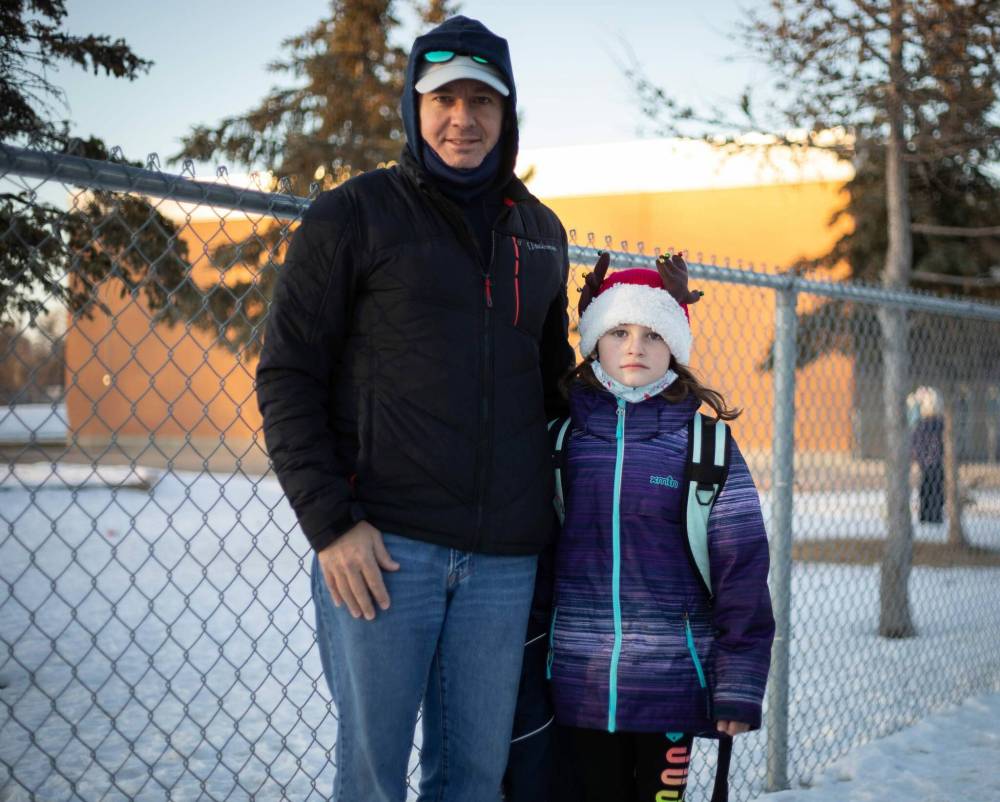
École Dieppe father Andre Martel said he has been trying to speak more French at home with his daughter to make up for all the COVID-19 learning disruptions that have marked her introductory years to immersion.
“I probably don’t do it as much as I should, but she seems to be picking it up pretty quickly,” said Martel, who applauded Pembina Trails’ plans to hire more language support staff. “I feel for parents who can’t speak French.”

One way families can help boost their students’ language skills at home is by consuming as much French language media — with English subtitles — as possible, said Michael Hudon, president of the Manitoba chapter of Canadian Parents for French.
“Parents have always had to make difficult decisions about whether to continue enrolling their kids in French second language programs and (pandemic learning loss) is just going to accentuate the questions that they are asking themselves,” he said.
But Hudon, a father of two immersion students, said it’s important to “keep our eye on the finish line” because the benefits of being multilingual are worth it.
maggie.macintosh@freepress.mb.ca
Twitter: @macintoshmaggie
Maggie Macintosh
Education reporter
Maggie Macintosh reports on education for the Free Press. Originally from Hamilton, Ont., she first reported for the Free Press in 2017. Read more about Maggie.
Funding for the Free Press education reporter comes from the Government of Canada through the Local Journalism Initiative.
Every piece of reporting Maggie produces is reviewed by an editing team before it is posted online or published in print — part of the Free Press‘s tradition, since 1872, of producing reliable independent journalism. Read more about Free Press’s history and mandate, and learn how our newsroom operates.
Our newsroom depends on a growing audience of readers to power our journalism. If you are not a paid reader, please consider becoming a subscriber.
Our newsroom depends on its audience of readers to power our journalism. Thank you for your support.
Maggie Macintosh
Education reporter
Maggie Macintosh reports on education for the Free Press. Originally from Hamilton, Ont., she first reported for the Free Press in 2017. Read more about Maggie.
Funding for the Free Press education reporter comes from the Government of Canada through the Local Journalism Initiative.
Every piece of reporting Maggie produces is reviewed by an editing team before it is posted online or published in print — part of the Free Press‘s tradition, since 1872, of producing reliable independent journalism. Read more about Free Press’s history and mandate, and learn how our newsroom operates.
Our newsroom depends on a growing audience of readers to power our journalism. If you are not a paid reader, please consider becoming a subscriber.
Our newsroom depends on its audience of readers to power our journalism. Thank you for your support.
Advertisement Advertise With Us
Advertisement Advertise With Us