

Leaders’ campaign stops carefully controlled
Advertisement
Read this article for free:
or
Already have an account? Log in here »
To continue reading, please subscribe:

Digital Subscription
One year of digital access for only $205*
- Enjoy unlimited reading on winnipegfreepress.com
- Read the E-Edition, our digital replica newspaper
- Access News Break, our award-winning app
- Play interactive puzzles
*First annual payment billed as $205.00 + GST for one year. This annual subscription will automatically renew at $233.00 + GST every 52 weeks (10% off the regular annual price of $259.35). Offer available to new and qualified returning subscribers only. Cancel any time.
To continue reading, please subscribe:
Add Free Press access to your Brandon Sun subscription for only an additional
$1 for the first 4 weeks*
- Enjoy unlimited reading on winnipegfreepress.com
- Read the E-Edition, our digital replica newspaper
- Access News Break, our award-winning app
- Play interactive puzzles
*Your next Brandon Sun subscription payment will increase by $1.00 and you will be charged $17.95 plus GST for four weeks. After four weeks, your payment will increase to $24.95 plus GST every four weeks.
Read unlimited articles for free today:
or
Already have an account? Log in here »
Hey there, time traveller!
This article was published 10/10/2015 (3993 days ago), so information in it may no longer be current.
Sunday, Sept. 27 – NDP leader Tom Mulcair
TORONTO — On an otherwise sleepy sunny Sunday afternoon in downtown Toronto, there is a flurry of activity around a newly constructed community cultural hub in Regent Park. This neighbourhood has often been in the headlines for its high crime rates, but efforts by Toronto Community Housing and private developers have turned things around.
Federal NDP Leader Tom Mulcair is here for a town hall and to unveil his environment platform, including a national cap-and-trade program. Wearing a white shirt with an open collar and no tie, and a slightly rumpled black suit jacket he leaves unbuttoned, Mulcair speaks to the assembled crowd of about 300 people with his characteristic style. It’s a combination of folksy and intellectual.
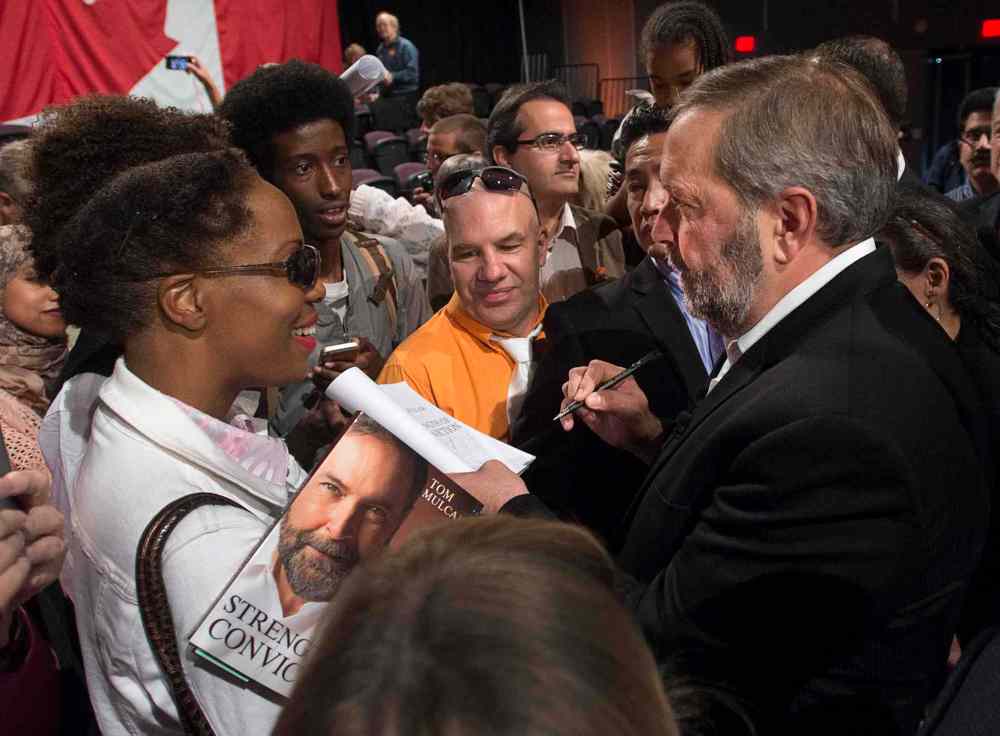
At times he’s a little awkward, such as when he says, “It’s great to be back in this incredible city, where we can feel the ‘moment-TOM.” He then cracks up laughing at his own little joke.
In Regent Park, Mulcair is speaking to a friendly crowd. He shrugs in an almost “aw-shucks” manner as the crowd gives him an extended standing ovation and apologizes for taking so long to get into the room.
“If you’re wondering why it took Catherine and I a little longer to get in, there’s a pretty large overflow crowd out there,” Mulcair said, referring to his wife.
In reality, it was only a minute-and-a-half from the moment University-Rosedale NDP candidate and former journalist Jennifer Hollett introduced Mulcair until the crowd quieted down and he began to speak.
The “pretty large overflow” crowd was perhaps three dozen people who watched the speech from the foyer outside on television screens.
But it fits with the narrative all the parties want to project: that so many people are clamouring to see the leader, some couldn’t get inside.
In this room, the NDP carefully positions most of the crowd of about 300 behind Mulcair. Some, including a dog, wear orange NDP shirts, but most do not. There is a giant Canadian flag above their heads.
Once his speech is over (he speaks for 28 minutes), he sits down with Hollett to take questions from the audience. This is a town hall after all, where he is supposed to spend more time answering questions than stumping.
Mulcair seems upbeat, even though at this particular point his party has already started to see a slide in the polls. He greets members of the national media by name and waves down a supporter in the crowd who groans when Mulcair turns from taking carefully planted questions from the audience to taking questions from the media.
“This is the NDP,” he says, chuckling while taking a shot at Prime Minister Stephen Harper’s well-documented antipathy toward the media. “We’ll let Mr. Harper’s crew do that.”
Every line delivered is a possible chance to earn another vote, every opportunity that arises to take a shot at an opponent is jumped on.
—
This is a perfect example of how carefully orchestrated campaign events are. While the Conservatives take the biggest flack for the overly controlled style of their events, all the parties control every little detail. From what the leaders are wearing down to what colours will be used to ensure a leader isn’t accidentally photographed with the wrong party’s colour.
Liberal Leader Justin Trudeau has to wear red tape on his hands under his boxing gloves; Mulcair and Hollett perch on orange-covered stools during the town hall.
At a Chinese festival in the Toronto suburb of Richmond Hill in late September, Harper was handed a brush to paint the lion’s eyes, a tradition to wake the sleeping lion to awaken its spirit. And of course, which coloured lion did Harper choose to “paint?” The blue one.
Tour events take one of three main formats:
— Rallies, where party supporters are drummed up through ridings associations to wear party colours and wave and cheer at every little thing the leader says or does.
— Photo ops, where leaders can display their prowess at being regular people who drink coffee, play street hockey and canoe down rivers in the morning fog.
— And announcements, where leaders visit businesses or venues that relate to the topic at hand.
Tuesday, Sept. 29 – Conservative leader Stephen Harper

Way out in the outer limits of the Greater Toronto Area, the Conservative campaign bus winds its way past housing development after housing development in the city of Vaughan. More than 51,000 new homes were built in Vaughan between 1986 and 2006. By comparison, Winnipeg’s Waverley West, which is also to be built over a 20-year period, is supposed to build about 11,000 new units.
It is at one of these new developments Harper chose to stage an event Sept. 29 to announce a goal to create 700,000 new homeowners in Canada by 2020.
The media tour follows Harper into a development, where workers scurry about toting wooden beams and plumbing fixtures and the sounds of hammers and power tools echo in the quiet of the crisp September morning.
But for more than an hour, most of that work comes to a stop so the prime minister can make his announcement.
Security is extremely tight.
On Harper’s tour, media have to assemble several hundred metres down the road from where the event is taking place.
Television cameras and equipment must be deposited in the garage of an unfinished home so a sniffer dog can give them the smell test before they are allowed anywhere near the prime minister’s event.
With a few minutes to spare before Harper arrives, the crowd of reporters and photographers is finally allowed to head down to the area where three dozen people are already seated on folding plastic chairs on the gravel, facing a podium. Behind that, about 30 workers in safety vests and hard hats stand holding up blue signs that read “Protect our economy” and “Economy #1 priority.”
Harper’s RCMP motorcade pulls up one street over, and the prime minister and his wife, Laureen, stop for a photo op in a house, where Harper takes up a nail gun for a moment before stepping up to the podium to speak.
“Owning a home is more than a roof over your head,” he said in a speech that lasted only about 10 minutes. “It’s a statement of optimism.”
Harper looks trimmer and more fit than he has in years. Dressed in a half-unzipped navy blue windbreaker with Canada printed across the chest over an open-collared blue shirt and black pants, he is also relaxed, even chipper.
He tends to clasp his hands in front of his stomach as he speaks, but the tension that marked his body language in August is gone.
He won’t be asked questions about Sen. Mike Duffy today. Instead, he gets to pontificate on topics he likes — trade, national security and the fight against the Islamic State.
Harper’s campaign events have been the same for years. He takes exactly five questions every day from the media — four from the national reporters, who spend $12,500 a week per person to ride on his campaign bus and plane, and one from a local reporter in whatever city he is in.
On this day, one national reporter expresses her plan to ask two questions, given it is a week with two debates and Harper doesn’t have many public events planned.
“You can always ask,” he says with a shrug, generating a small chuckle from the audience.
Saturday, Oct. 4 – Liberal leader Justin Trudeau

Several days later, the Powerade Centre in Brampton, Ont., is buzzing. Traffic is in gridlock as dozens of yellow school buses filled with supporters and hundreds of cars fight their way into the parking lot.
Politicians in Canada have for years preferred smaller events, where things can be more easily controlled. An event with more than 1,000 people is considered big.
But the Liberal Party of Canada is on a mission in 2015 to prove it’s back with a vengeance. To prove that, the party has assembled 7,000 supporters from across Ontario and western Quebec for a rally.
Songs such as Everybody Dance Now and Walk the Moon ignite the crowd, interspersed with Liberal ads played on the Jumbotron.
The energy in this room is electric, as the crowd holds up hundreds of campaign signs for candidates from across Ontario. In one stand, a young man waves a Canadian flag back and forth.
The stage in the middle is surrounded by fans, rock concert-style.
Sophie Grégoire, Trudeau’s wife, takes the stage in a white blouse and pants and warms up the crowd with one-liners. She makes light of Trudeau’s mistake at the last French debate, when he accidentally called Bloc Québécois Leader Gilles Duceppe “mon amour” instead of “mon ami.”
“You know this campaign has gone on too long when… ” she says, drawing laughter.
Then, with lights flashing and the crowd on its feet roaring, Trudeau comes out into the spotlight, right into the middle of the crowd, from one of the aisles. In a blue shirt with the sleeves rolled up to his elbows and a red tie with no jacket, Trudeau is grinning from ear to ear and shaking hands as he slowly makes his way to the stage.
On the speaker system, a new song is playing.
“Are you ready for a change,” sings a woman in a slightly bluegrass country song. “I believe there is a better way.”
The song is the new Liberal theme song, penned just for them by Ottawa Valley musicians Kelly and Kaylen Prescott and released for the first time at the rally.
Trudeau’s speech is similar to most of the stump speeches he has given for the last 10 weeks, but the crowd doesn’t care.
“We are on the verge of something special,” he tells them, as they chant “Trudeau” back at him.
His voice at times sounds hoarse, the likely consequence of an election campaign that has taken Canadians from beach weather to parkas and everything in between.
His speech is just over 23 minutes long.
When it’s over, Grègoire and their three children run up onto the stage for kisses and hugs, and 20-month-old Hadrien almost steals the show when he spots himself on the giant screen and begins waving wildly with a huge smile on his face. One big happy family.
All the leaders have used their families at varying points in the campaign. Laureen Harper and Mulcair’s wife, Catherine Pinhas, have been by their sides throughout. Harper and Trudeau’s kids have been around at varying points.
It’s all part of painting the image of these men as family guys, ordinary guys, people with wives, kids and bills to pay.
After the rally, Trudeau does a quick media scrum with reporters and then disappears into the afternoon, on his way to his next event down the road in Waterloo.
One woman on her way out of the rally can’t hold back a smile and stops to chat with volunteers to share her mirth.
“One thing I really notice,” said Nancy Brooks, a retired hockey administrator from Oakville, Ont. “Everybody is walking out of here happy.”
mia.rabson@freepress.mb.ca
Related Articles
Liberals win 4th mandate as NDP vote collapses and Singh announces he will resign







Advertisement Advertise With Us
Advertisement Advertise With Us