

Canada’s reputation on trial
Refugee-crisis response could end up being No. 1 election issue

Advertisement
Read this article for free:
or
Already have an account? Log in here »
To continue reading, please subscribe:

Digital Subscription
One year of digital access for only $205*
- Enjoy unlimited reading on winnipegfreepress.com
- Read the E-Edition, our digital replica newspaper
- Access News Break, our award-winning app
- Play interactive puzzles
*First annual payment billed as $205.00 + GST for one year. This annual subscription will automatically renew at $233.00 + GST every 52 weeks (10% off the regular annual price of $259.35). Offer available to new and qualified returning subscribers only. Cancel any time.
To continue reading, please subscribe:
Add Free Press access to your Brandon Sun subscription for only an additional
$1 for the first 4 weeks*
- Enjoy unlimited reading on winnipegfreepress.com
- Read the E-Edition, our digital replica newspaper
- Access News Break, our award-winning app
- Play interactive puzzles
*Your next Brandon Sun subscription payment will increase by $1.00 and you will be charged $17.95 plus GST for four weeks. After four weeks, your payment will increase to $24.95 plus GST every four weeks.
Read unlimited articles for free today:
or
Already have an account? Log in here »
Hey there, time traveller!
This article was published 10/10/2015 (3938 days ago), so information in it may no longer be current.
As of Friday, the full platforms for all three major parties have been released to the voting public. For better or worse, we now have before us the complete list of pledges and policies each party has put forward to win our support.
Taken in their entirety, what do the platforms tell us?
One party (the Conservatives) wants smaller government and lower taxes. And two other parties (the NDP and Liberals) want to raise taxes for some groups (corporations and the wealthy, respectively) while maintaining or, in some instances, increasing the size and role of government in our lives.
There are other differences, of course. The Liberals have taken the lead on new infrastructure investment. The NDP has championed improved health care. And the Conservatives continue to ride a wave of targeted cuts and credits — including income splitting — that will lower the overall tax burden.
In other words, there are lots of issues out there on which voters can base their final decision. Still, you may wonder, is there any one issue that deserves to become the principal ballot-box question?
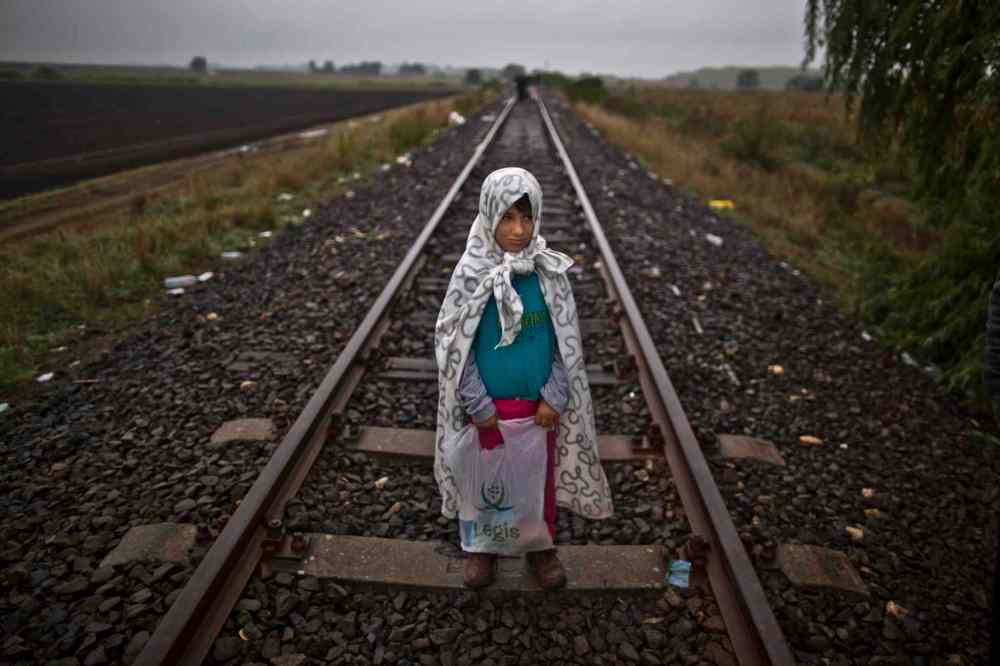
Although it may not be the first issue you think of, there is a strong case to be made the plight of Syrian refugees — and Canada’s role in the response to this international humanitarian crisis — should be the definitive election issue.
This was not an issue any of the parties could plan for, erupting in early September after the world saw a horrific photograph of a Syrian toddler, dead on a Turkish beach after trying unsuccessfully to flee to Greece. The gravity of that tragedy not only alerted the world to the threat faced by displaced Syrians, but also Canada’s tepid response.
In short, to date Canada has made very little contribution to a situation that is among the most urgent humanitarian crises in the world, and a problem that has been on the radar of developed nations for some time now.
In January, Canada promised to process up to 10,000 Syrian refugees. However, eight months into that program, only about 300 have been provided with visas from the federal government. Another 1,500 privately sponsored refugees have been admitted.
Of greater concern, news reports have confirmed Prime Minister Stephen Harper and staff at the Prime Minister’s Office intervened to review and approve specific refugee applications. This political review prompted Ottawa to stop processing refugee applications for reasons that are still unclear.
Critics of the Conservative government have raised the spectre of ethnic or religious screening of the refugee claimants, specifically to exclude Muslims. That would be difficult to prove without more information about which refugees were actually admitted. If there is a non-Muslim theme to decisions being made at the senior-most levels of government, it would rank among the most despicable manipulations engineered by any government in this country.
However, even without those details, the tremendously underwhelming response by our federal government remains, on its own, scandalous.
Why, you may wonder, is that a key election issue?
The nature of our response to this humanitarian crisis will have a major impact on how the rest of the world sees us. And right now, it’s important to remember we have developed a reputation as a nation that talks a lot and does very little.
Federal spending on defence and foreign aid are pathetic. Our contributions to NATO and the United Nations have dwindled considerably. We still attend the big international summits, such as the G7, but our actual performance in areas that define Canada on the international stage is woefully inadequate.
Which brings us to immigration and the Syrian refugee crisis. Canadians like to think of themselves as among the most generous and enlightened people on Earth. Our response to the Syrian refugee challenge will reveal the degree to which there is any truth to that self-image.
Our response to this challenge will also define our relationship with many European nations that have become, thanks mostly to the curse of proximity, the most popular landing spots for refugees fleeing Syria. And with countries that have already stepped up and accepted much larger numbers of refugees.
One can only imagine what Turkey, Germany or Greece — countries that together have absorbed millions of desperate Syrians — think about Canada’s decision to allow a mere 300 government-sponsored Syrian refugees into this country.
In this election, we have pledges from the NDP and Liberals to expedite the admission of tens of thousands of Syrian refugees, a gesture they claim is commensurate with the gravity of the crisis. The Conservatives, on the other hand, are promising to speed up their original pledge of 10,000 refugees but have refused to set more ambitious goals to meet the growing numbers of Syrians looking for safe refuge because of security concerns.

There are many points of contrast in this election. On many issues, you can find clear differences between the pledges and policies on which to base a voting decision. However, there may be no other issue in this campaign that is as urgent or as important.
The way we vote in this election will, for all intents and purposes, determine our response to this humanitarian crisis.
And in doing so, we will also have determined the way in which the rest of the world views us.
dan.lett@freepress.mb.ca
Dan Lett is a columnist for the Free Press, providing opinion and commentary on politics in Winnipeg and beyond. Born and raised in Toronto, Dan joined the Free Press in 1986. Read more about Dan.
Dan’s columns are built on facts and reactions, but offer his personal views through arguments and analysis. The Free Press’ editing team reviews Dan’s columns before they are posted online or published in print — part of the our tradition, since 1872, of producing reliable independent journalism. Read more about Free Press’s history and mandate, and learn how our newsroom operates.
Our newsroom depends on a growing audience of readers to power our journalism. If you are not a paid reader, please consider becoming a subscriber.
Our newsroom depends on its audience of readers to power our journalism. Thank you for your support.
Dan Lett is a columnist for the Free Press, providing opinion and commentary on politics in Winnipeg and beyond. Born and raised in Toronto, Dan joined the Free Press in 1986. Read more about Dan.
Dan’s columns are built on facts and reactions, but offer his personal views through arguments and analysis. The Free Press’ editing team reviews Dan’s columns before they are posted online or published in print — part of the our tradition, since 1872, of producing reliable independent journalism. Read more about Free Press’s history and mandate, and learn how our newsroom operates.
Our newsroom depends on a growing audience of readers to power our journalism. If you are not a paid reader, please consider becoming a subscriber.
Our newsroom depends on its audience of readers to power our journalism. Thank you for your support.
Related Articles
Liberals win 4th mandate as NDP vote collapses and Singh announces he will resign







Advertisement Advertise With Us
Advertisement Advertise With Us