Small towns connect through curling
Study shows rural women benefit socially, mentally from game
Advertisement
Read this article for free:
or
Already have an account? Log in here »
To continue reading, please subscribe:
Digital Subscription
One year of digital access for only $1.44 a week*
- Enjoy unlimited reading on winnipegfreepress.com
- Read the E-Edition, our digital replica newspaper
- Access News Break, our award-winning app
- Play interactive puzzles
*Billed as $5.77 plus GST every four weeks. After 52 weeks, price increases to the regular rate of $19.95 plus GST every four weeks. Offer available to new and qualified returning subscribers only. Cancel any time.
To continue reading, please subscribe:
Add Free Press access to your Brandon Sun subscription for only an additional
$1 for the first 4 weeks*
- Enjoy unlimited reading on winnipegfreepress.com
- Read the E-Edition, our digital replica newspaper
- Access News Break, our award-winning app
- Play interactive puzzles
*Your next Brandon Sun subscription payment will increase by $1.00 and you will be charged $17.95 plus GST for four weeks. After four weeks, your payment will increase to $24.95 plus GST every four weeks.
Read unlimited articles for free today:
or
Already have an account? Log in here »
Hey there, time traveller!
This article was published 17/03/2011 (5703 days ago), so information in it may no longer be current.
HALIFAX — Who would have thought that a sheet of ice, a few polished pieces of granite and some shouted words of encouragement could change lives.
Researchers behind a three-year Sport Canada funded study on the role of curling in promoting the mental, physical, emotional and social health of women in rural Canada say they are already bearing witness to the sport’s impact.
Communities
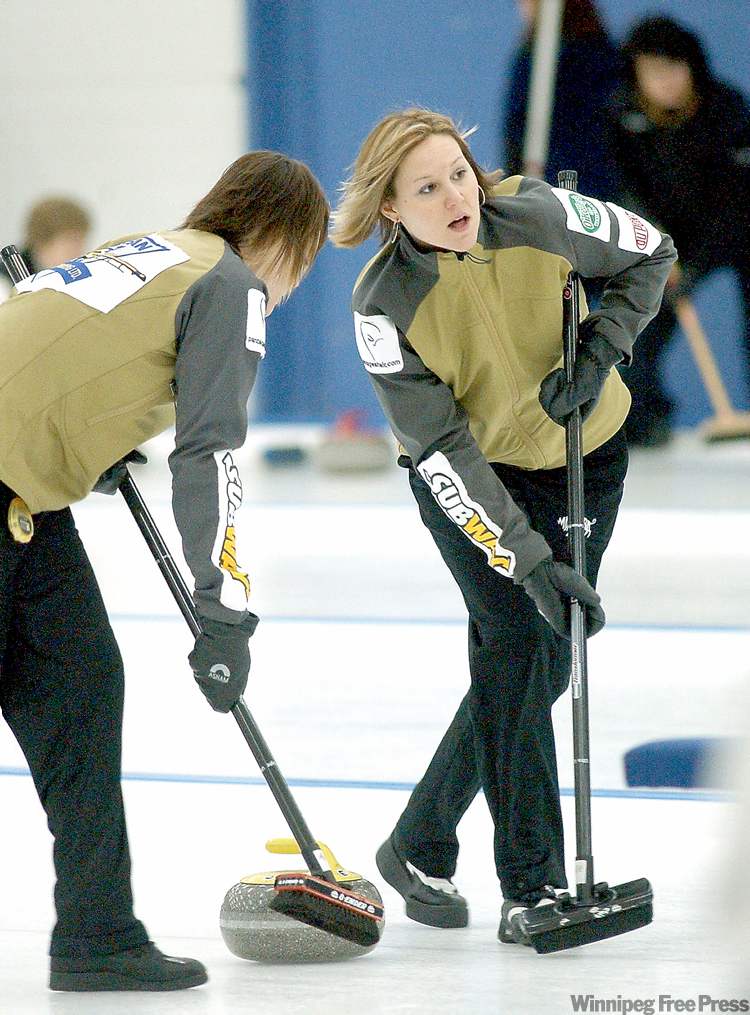
More than 60 per cent of Canada’s curling clubs are in communities with fewer than 10,000 people.
Eight focus groups have been set up in Nova Scotia, Manitoba, Ontario and the Northwest Territories to track the experiences of 50 to 60 women.
Dr. Donna Meagher-Stewart, a nursing professor at Dalhousie University in Halifax, has made contact with 16 women from Pugwash, N.S., a tiny village of 800 on the province’s north shore, and Windsor, a town of about 3,800 a 30-minute drive west of Halifax.
“One of the key things is to look at what sport and recreation means to women in smaller communities across Canada,” said Meagher-Stewart. “What we’ve done is given these women cameras so they can take pictures, a technique known as photo-voice, and talk about what curling and curling clubs mean in terms of their health.”
The women were also given journals to record their thoughts and reflections on a game researchers say tends to be under-supported.
“We’re hoping to affect policy on building community or community capacity and to see sport bring people together,” said Meagher-Stewart.
At a recent meeting in Pugwash, she said one woman who was new to the game told her that she never expected to be pushing a broom on ice in her 60s.
But it’s the pictures taken by some of the older women that have left the biggest impression so far.
“When you look at one of the pictures it shows the big bruise on the hip, the brace on the knee, wrapped ankles and wrists, all over a caption that says ‘Nothing can hold a good woman down,’ ” said Meagher-Stewart.
And it’s not just the game itself but the socializing that comes with it, both on the ice and over a cup of tea or coffee afterwards.
Margie Hoganson, one of the women involved in the study, moved to the Pugwash area when she and her husband retired, having done much of their curling in the Halifax and Charlottetown areas.
Settling into a small community with no roots and no real connections, other than through curling, wasn’t easy. That all changed with the construction of the Northumberland Community Curling Club a few years ago.
“What curling has done for this community has been phenomenal,” said Hoganson, who has been teaching women how to play and looking after their bonspiels. “We were from away. The village initially didn’t want any input from outsiders when the rink was being built, but everything kind of melded together and now there’s such a sense of community.”
Hoganson said the cameras they were given by the researchers have really allowed some of the women to express their feelings more poignantly than they perhaps could in words.
“One woman had a picture of the road going up to the curling club and her comment was ‘This road changed my life,’ ” said Hoganson. “She was in her 60s, lived in the country all her life, had never been involved in sports, didn’t know it could be fun.”
Ultimately, said Hoganson, it’s about connecting with other people.

“As one woman said, ‘I’m a waitress and I can come here and sit at the same table with the doctors and the lawyers and it doesn’t matter.’ “
The study, which began last year, will run until the end of 2012.
Meagher-Stewart said they plan to begin a more detailed analysis of the pictures and journals as they approach the halfway point.
— The Canadian Press