

Olympic curling is a family affair for US women and others
Advertisement
Read this article for free:
or
Already have an account? Log in here »
To continue reading, please subscribe:

Digital Subscription
One year of digital access for only $205*
- Enjoy unlimited reading on winnipegfreepress.com
- Read the E-Edition, our digital replica newspaper
- Access News Break, our award-winning app
- Play interactive puzzles
*First annual payment billed as $205.00 + GST for one year. This annual subscription will automatically renew at $233.00 + GST every 52 weeks (10% off the regular annual price of $259.35). Offer available to new and qualified returning subscribers only. Cancel any time.
To continue reading, please subscribe:
Add Free Press access to your Brandon Sun subscription for only an additional
$1 for the first 4 weeks*
- Enjoy unlimited reading on winnipegfreepress.com
- Read the E-Edition, our digital replica newspaper
- Access News Break, our award-winning app
- Play interactive puzzles
*Your next Brandon Sun subscription payment will increase by $1.00 and you will be charged $17.95 plus GST for four weeks. After four weeks, your payment will increase to $24.95 plus GST every four weeks.
Read unlimited articles for free today:
or
Already have an account? Log in here »
Hey there, time traveller!
This article was published 11/02/2022 (1697 days ago), so information in it may no longer be current.
BEIJING (AP) — When she settled into her room at the athlete’s village in Beijing, American curler Nina Roth decorated a wall with family photos to remind herself of the support she has back home.
Her teammates brought the real thing.
Skip Tabitha Peterson needs only to look down the ice for a comforting face: Her sister, Tara, is also on the U.S. women’s team. Becca Hamilton’s brother is playing for the American men, giving them something most athletes at these Olympics can’t have — family in Beijing to support them.
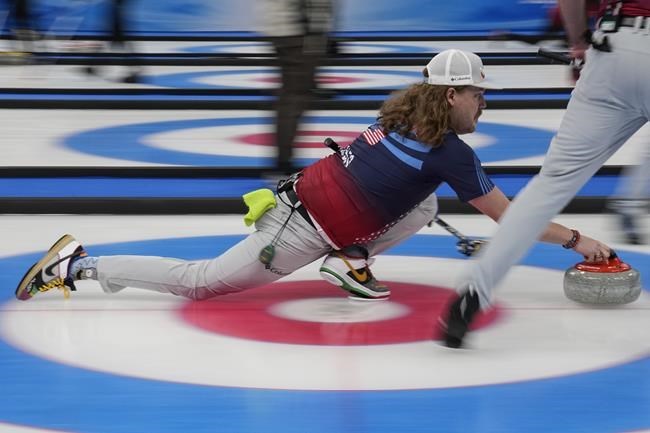
“To be able to lean on my brother — and I guess it’s the same for the sisters on my team, they have each other — it’s just awesome to have some sort of family here,” Becca Hamilton said. “I mean it’s not always rainbows and butterflies. But for the most part, it’s great.”
Much like last year’s Summer Games in Tokyo, the Winter Olympics are being played in only partially filled venues and without foreign fans. China has also imposed travel restrictions in an attempt to control the spread of COVID-19.
That forced most athletes to leave at home the small entourage of friends and relatives that would ordinarily accompany them to the Olympics — part of the payoff for helping them reach the pinnacle of their sport.
“This is such an opportunity, that our family members also work for, and none of us would be able to do this without their support,” said Roth, who also competed in Pyeongchang. “It was really good fun to celebrate with them at the last Olympics. So it’s a big bummer that they can’t be here this time.”
But some of her teammates found the perfect way to get around the restrictions. The Hamiltons competed as a mixed doubles pair four years ago and are still spending plenty of time together at these Olympics.
“I’ve got, like, one of my best friends and my curling partner here,” Matt Hamilton said. “Not only do I have a sister and a confidant in here, I’ve got someone who’ll do my laundry. … So she really takes care of me while we’re out here.”
They aren’t the only families hanging out at the Ice Cube curling venue this month.
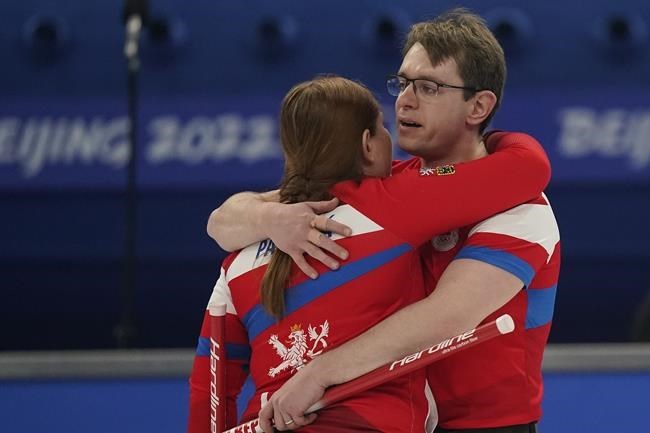
The mixed doubles field last week featured two married couples: Norway’s Magnus Nedregotten and Kristin Skaslien, who won the silver medal, and Czechs Zuzana Paulova and Tomas Paul. Canadian men’s and women’s players Jocelyn Peterman and Brett Gallant are engaged, with plans to wed in June.
And the Danish women’s curling team also includes a pair of sisters, Madeleine and Denise Dupont.
“I think it just makes the bond between us a lot stronger,” Madeleine Dupont said. “I can’t imagine not seeing her all the time.”
A niche sport played mostly in a few colder climes, curling has long been a family affair, passed down from parents like a treasured heirloom or favorite recipe.
Norway’s Magnus Vaagberg is the son of two Olympic curlers. His father, Lars, and uncle Paal Trulsen won gold in 2002 in a foursome that also included Magnus’ current teammate — and six-time Olympian — Torger Nergaard.
“I remember staying up late, understanding that something cool had happened,” said Vaagberg, who was 7 at the time. “That’s something very unique with curling, a tight family bond all over. So you play against the people that played against my father at the time, and their sons and daughters, it’s quite cool.”
The Petersons’ mother grew up in Winnipeg, Manitoba, and picked up curling from her father. She taught it to her daughters, who started when they were 10 and 8; a brother, Trent, also curled for a while before turning to professional golf.
“You’re kind of born into the sport,” Tara Peterson said.
While siblings might be expected to team up, there’s no guarantee that they’ll get along over the hundreds of hours they spend together practicing, playing and traveling to tournaments each year. Tensions between any set of teammates can boil over — even before adding in the additional resentment over who wrecked the family car or neglected to take out the trash.
Madeleine Dupont said she and her sister used to fight about curling until their mother would give them a time out.
“When we were young, 100%, my mom was always like, ‘Now we need curling-free time. You can’t talk about curling all the time,’” she said. “Now we all live separate places, so it’s not a problem anymore. But it’s still hard to just leave it at the rink.”
Nedregotten said he and Skaslien do what they call a “hot wash” — talking out their feelings before moving on to the next match. Mostly, though, the siblings and spouses say teaming up with a relative might even offer a competitive edge.
“We’re on the same page a lot without even really need to say anything,” Tabitha Peterson said. “If there is any conflict, or whatever, I think it’s easier as siblings to kind of forgive and forget a lot quicker.”

American men’s skip John Shuster is at his fifth Olympics. When he won the gold medal in Pyeongchang, his parents, wife and one of his children were in the crowd. These Games, he is FaceTiming his family from 14 time zones away, while they organize watch parties and special school events to stay connected the best way they can.
“I’ve been fortunate to have them with me at four Olympics,” Shuster said. “This is a chance for them to be at home and experience the Olympics with a lot of friends and family that have never come to the Olympics with us.
“They’re getting a chance to see that other side,” he said. “It’s not better, for sure. But it’s not really feeling any worse, either.”
___
More AP Olympics: https://apnews.com/hub/winter-olympics and https://twitter.com/AP_Sports
Related Articles
Days of Canadian curling domination "long gone"





Advertisement Advertise With Us
Advertisement Advertise With Us