

Canada beats Russia in overtime in world hockey championship quarterfinal
Advertisement
Read this article for free:
or
Already have an account? Log in here »
To continue reading, please subscribe:

Digital Subscription
One year of digital access for only $205*
- Enjoy unlimited reading on winnipegfreepress.com
- Read the E-Edition, our digital replica newspaper
- Access News Break, our award-winning app
- Play interactive puzzles
*First annual payment billed as $205.00 + GST for one year. This annual subscription will automatically renew at $233.00 + GST every 52 weeks (10% off the regular annual price of $259.35). Offer available to new and qualified returning subscribers only. Cancel any time.
To continue reading, please subscribe:
Add Free Press access to your Brandon Sun subscription for only an additional
$1 for the first 4 weeks*
- Enjoy unlimited reading on winnipegfreepress.com
- Read the E-Edition, our digital replica newspaper
- Access News Break, our award-winning app
- Play interactive puzzles
*Your next Brandon Sun subscription payment will increase by $1.00 and you will be charged $17.95 plus GST for four weeks. After four weeks, your payment will increase to $24.95 plus GST every four weeks.
Read unlimited articles for free today:
or
Already have an account? Log in here »
Hey there, time traveller!
This article was published 03/06/2021 (1955 days ago), so information in it may no longer be current.
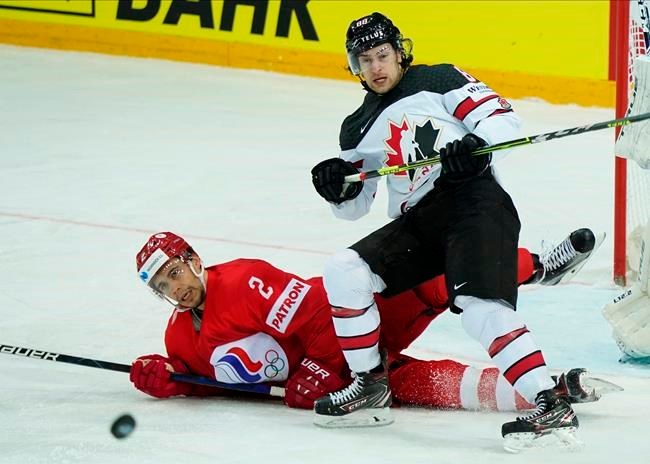
RIGA, Latvia – Andrew Mangiapane scored a highlight-reel goal in overtime as Canada beat Russia 2-1 in quarterfinal action at the world hockey championship on Thursday.
The Calgary Flames forward’s goal, on a pass from Troy Stecher, 2:12 into the extra frame gave Canada the upset victory.
After taking a drop pass from Mangiapane, Stecher eluded two Russian defenders and made a cross-ice feed back to his teammate for the winner.
“I pulled off a move like that in practice yesterday and (assistant general manager) Shane Doan kind of gave me a hard time about not doing it in a game,” Stecher said. “I think my instincts took over and I was able to find (Mangiapane), and it all just kind of worked out. I feel like I have started to play with a lot of confidence in this tournament, confidence I did not necessarily have during the NHL regular season. It has been paying off for me and it certainly paid off in overtime.”
Canada will face the U.S. in a semifinal on Saturday. Finland plays Germany in the other semi. The final is Sunday.
It marks the first time Canada and the U.S. have played so late in the tournament since 1950.
After losing its first three games of the tournament, Canada won its next three before losing in a shootout to Finland to secure the fourth and final playoff spot in its group.
Canada barely avoided missing the playoffs for the first time at an Olympics or world championship.
Russia, meanwhile, won six of seven games in the preliminary round to finish first in the other group.
“It was an all-around great effort by our team tonight,” Mangiapane said. “I think everyone in our room believed we could (win). We know our game has been trending in the right direction and it was great for us to battle back in the third period to get the win.”
Mangiapane has five goals and four assists in five games.

Adam Henrique scored the tying goal on a power play for Canada in the third period. Yevgeni Timkin opened the scoring for Russia.
Darcy Kuemper blocked 24 shots for Canada, while Sergei Bobrovsky made 23 saves for Russia.
“I am really proud of our group,” coach Gerard Gallant said. “It was tough coming over to Latvia because we had a few days of quarantine and then only three days of practice before we started the tournament. It took us a little while to find our game, but our team found a way and battled hard through our seven preliminary-round games. It was rewarding to see our group work as hard as it did, and tonight was a huge win for us.”
In the other quarterfinals, Germany beat Switzerland 3-2 in a shootout, the U.S. beat Slovakia 6-1 and Finland edged the Czech Republic 1-0.
This report by The Canadian Press was first published June 3, 2021.