New concussion guidelines launched for Canada’s Olympians, Paralympians
Advertisement
Read this article for free:
or
Already have an account? Log in here »
To continue reading, please subscribe:

Digital Subscription
One year of digital access for only $205*
- Enjoy unlimited reading on winnipegfreepress.com
- Read the E-Edition, our digital replica newspaper
- Access News Break, our award-winning app
- Play interactive puzzles
*First annual payment billed as $205.00 + GST for one year. This annual subscription will automatically renew at $233.00 + GST every 52 weeks (10% off the regular annual price of $259.35). Offer available to new and qualified returning subscribers only. Cancel any time.
To continue reading, please subscribe:
Add Free Press access to your Brandon Sun subscription for only an additional
$1 for the first 4 weeks*
- Enjoy unlimited reading on winnipegfreepress.com
- Read the E-Edition, our digital replica newspaper
- Access News Break, our award-winning app
- Play interactive puzzles
*Your next Brandon Sun subscription payment will increase by $1.00 and you will be charged $17.95 plus GST for four weeks. After four weeks, your payment will increase to $24.95 plus GST every four weeks.
Read unlimited articles for free today:
or
Already have an account? Log in here »
Hey there, time traveller!
This article was published 18/03/2019 (2714 days ago), so information in it may no longer be current.
CALGARY – Danielle Lappage clonked heads with another wrestler during a training camp at Brock University last summer.
Typical of a driven athlete, the 28-year-old Olympian from Olds, Alta., tried to shake it off and continue until dizziness and nausea made it impossible.
Lappage returned to Calgary to consult with concussion specialist Dr. Brian Benson, who confirmed she was in fact concussed.
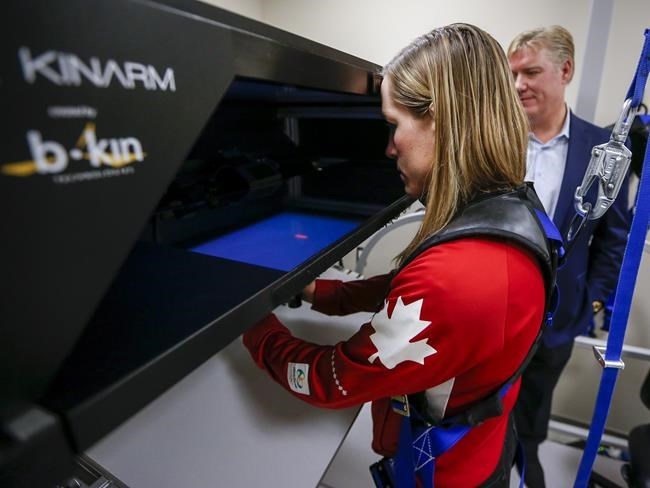
A couple weeks later, Lappage told Benson she was ready to return to the mat. Benson showed her data that said otherwise in the form of baseline tests conducted when she was fully healthy.
“The baseline test allows you to compare post-concussion to pre-concussion and make sure those numbers are back to their original before you go back to sport,” Lappage said. “This baseline test insures you don’t go back before you’re ready.
“To take that stress off me as an athlete, and to not give me the choice, because I would always choose to go back, to kind of take that out of my hands is actually great for me.”
Baseline testing is among the recommendations in national concussion guidelines announced Monday for Canadian athletes in high-performance sports.
The guidelines were developed by chief medical experts of the Canadian Olympic Committee, Canadian Paralympic Committee, Own the Podium, and the network of high-performance sport institutes across the country.
“While we have great athletes, our talent pool is actually relatively shallow when we look at our competitor countries like the U.S. and U.K., Germany and China,” COC chief medical officer Bob McCormack said.
“It’s important we give them the best possible care to make sure they’re able to perform at the highest level. Our priority is safety.
“To have evidence-based guidelines that are punching at the highest possible level to protect the athletes and to make sure that they can get back as quickly, as safely, possible is important.”
The guidelines will be in effect for the COC and CPC at both this summer’s Pan American/Parapan American Games in Lima, Peru, as well as the 2020 Summer Olympics and Paralympics in Tokyo.
The document’s foundation is Parachute Canada’s Canadian Guideline on Concussion in Sport, which has been adopted by the majority of sport organizations across Canada.
The high-performance strategy capitalizes on the fact that elite athletes have access to medical and sport science professionals, who can administer tests producing hard data.
“We all want to return them to sport quickly,” Benson said. “Timely assessment and appropriate management right out of the gates, can in essence, accelerate recovery.
“But we do need objective criteria rather than just a symptom-based approach to determine if they’re actually recovered from their injury or not.”
Baseline testing was just one recommendation, but one that was repeatedly mentioned as an example Monday.
During the pre-season, or prior to the first day of competition, it is suggested an athlete undergo a battery of tests providing a baseline for future comparisons.
“Going into the season, if they do sustain a concussive injury, we have something to compare it to objectively,” Benson said.
While most of the guidelines “suggest” or “recommend”, the language is stronger for almost 30 Olympic and Paralympic sports identified as high-risk for concussion.

Sports such as alpine and freestyle skiing, hockey, speedskating, gymnastics and wheelchair athletics, must have a concussion policy and protocol compliant with Rowan’s Law addressing education, code of conduct, removal from sport and return to sport.
Ontario was the first province to pass concussion-related law, which was named after 17-year-old Rowan Stringer of Ottawa. She died after suffering multiple concussions playing high school rugby.
Lappage, a law student with her sights set on Tokyo next year, suffered the first of her two concussions almost a decade ago in competition.
“As a high-performance athlete, you are rushing to get back,” she said. “I know for a fact I went back too early with my first one. I didn’t go through any of this testing.
“The most recent one that I have suffered from and going through these new protocols and processes was very reassuring, to know when I went back I wasn’t risking re-injuring my brain or my future brain.”