

Canadian team’s doctor in Beijing says COVID-19 measures working so far
Advertisement
Read this article for free:
or
Already have an account? Log in here »
To continue reading, please subscribe:

Digital Subscription
One year of digital access for only $205*
- Enjoy unlimited reading on winnipegfreepress.com
- Read the E-Edition, our digital replica newspaper
- Access News Break, our award-winning app
- Play interactive puzzles
*First annual payment billed as $205.00 + GST for one year. This annual subscription will automatically renew at $233.00 + GST every 52 weeks (10% off the regular annual price of $259.35). Offer available to new and qualified returning subscribers only. Cancel any time.
To continue reading, please subscribe:
Add Free Press access to your Brandon Sun subscription for only an additional
$1 for the first 4 weeks*
- Enjoy unlimited reading on winnipegfreepress.com
- Read the E-Edition, our digital replica newspaper
- Access News Break, our award-winning app
- Play interactive puzzles
*Your next Brandon Sun subscription payment will increase by $1.00 and you will be charged $17.95 plus GST for four weeks. After four weeks, your payment will increase to $24.95 plus GST every four weeks.
Read unlimited articles for free today:
or
Already have an account? Log in here »
Hey there, time traveller!
This article was published 02/02/2022 (1704 days ago), so information in it may no longer be current.
BEIJING – The Canadian team’s head doctor in Beijing says COVID-19 preventions before and upon athletes’ arrivals has kept the virus mostly at bay so far.
One asymptomatic non-athlete in Canada’s delegation of about 415 was in isolation Wednesday two days before the opening ceremonies, which was down from five personnel in protocol last week.
“Our goal … is to enable the athletes and the teams to get to the starting line safely, and to try and enable every athlete that is here in Beijing to be able to compete through all these protocols,” Dr. Mike Wilkinson said Wednesday at the Canadian Olympic Committee’s opening news conference.
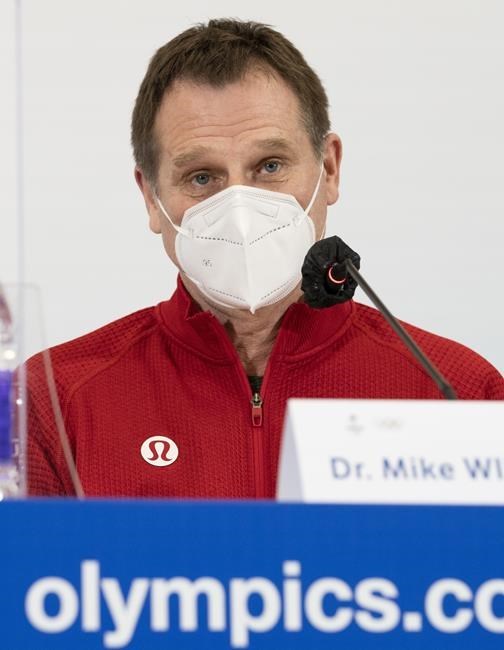
“We have challenges, yes, and challenges will continue.”
When no Canadian athlete tested positive in last summer’s Tokyo Olympics, the COC planned similar virus measures for Beijing. Then came the highly infectious Omicron variant.
“We learned from Tokyo. We put the plans together. We ended up throwing most of that out of the window when Omicron came into Canada, and around the world,” Wilkinson said. “We’ve had to adapt, and we will continue to adapt. However, all those learnings and the protocols we put in place are working.
“If prior to Tokyo, you’d asked me would we get out of there without any cases of COVID? I would have said not in my wildest dreams. I think we have to be realistic about what’s going on and the transmissibility and infectiousness of Omicron here.”
But COVID will keep at least one athlete out of an event. Figure skater Keegan Messing still needs to produce the requisite negative tests to be able to fly to Beijing.
He won’t travel to China in time for the team event starting Friday, but Messing might still be able to compete in men’s singles next week.
A number of contingency plans are in place for the 30-year-old figure skater to compete if cleared, including flying him into Beijing the night before the men’s short program if necessary, said COC chief sport officer Eric Myles.
“We will take it to the maximum to bring him here,” Myles said.
No other Canadian athletes were in danger of missing their event because of a positive test, Wilkinson said.
“What will happen over the next couple of days or weeks when we have more athletes coming in? I’m not sure,” the doctor said. “What I tell you now is going to change in about half an hour. That’s the nature of the pandemic.”
Myles said athletes have been discouraged from removing their masks to take selfies in the village.
“We did push a note to all the athletes about not taking pictures, recommending not taking picture without a mask near the (Olympic) rings, for example,” he said.
COC chief executive officer David Shoemaker had yet to arrive in Beijing because of a potential close contact a week and a half ago.
The COC encourages athletes based in Beijing’s hub to march in Friday’s opening ceremonies if their competition schedule allows for it.
Short-track speedskater Charles Hamelin of Sainte-Julie., Que., and women’s hockey captain Marie-Philip Poulin of Beauceville, Que., were named joint flag-bearers Wednesday.
Hamelin is a three-time Olympic gold medallist and Poulin owns two gold medals.
Canada’s team of 215 athletes features 45 who are already Olympic medallists, as well as 117 rookies. The athletes are divided between three competition hubs — Beijing, Yanqing and Zhangjiakou.
Canadians start competing the day before the opening ceremonies. Canadian mixed doubles duo John Morris and Rachel Homan open the preliminary round Thursday against Britain and Norway.
Poulin and her teammates take on Switzerland in a Pool A game Thursday when reigning Olympic men’s champion Mikael Kingsbury leads the freestyle skiers into the moguls qualification round.

Speedskaters, long and short-track, and Kingsbury in men’s moguls are Canada’s strongest medal chances Saturday.
Canada totalled 29 medals (11 gold, eight silver and 10 bronze) four years ago in Pyeongchang, South Korea, for the most at a single Winter Olympics.
The global data analytics company Gracenote’s most recent projections Wednesday forecast Canada tied for fourth with the United States with 22 medals (six gold, five silver and 11 bronze).
The California-based company, which supplies statistical analysis to sports leagues around the world, picked Norway to top the medal table again with 44 medals, including 21 gold.
This report by The Canadian Press was first published Feb. 2, 2022.
Related Articles
IOC president Thomas Bach’s vision of the Olympic movement has turned it into a travelling money box



Advertisement Advertise With Us
Advertisement Advertise With Us