

Alexander Bolshunov wins Olympic gold in 30K skiathlon
Advertisement
Read this article for free:
or
Already have an account? Log in here »
To continue reading, please subscribe:

Digital Subscription
One year of digital access for only $205*
- Enjoy unlimited reading on winnipegfreepress.com
- Read the E-Edition, our digital replica newspaper
- Access News Break, our award-winning app
- Play interactive puzzles
*First annual payment billed as $205.00 + GST for one year. This annual subscription will automatically renew at $233.00 + GST every 52 weeks (10% off the regular annual price of $259.35). Offer available to new and qualified returning subscribers only. Cancel any time.
To continue reading, please subscribe:
Add Free Press access to your Brandon Sun subscription for only an additional
$1 for the first 4 weeks*
- Enjoy unlimited reading on winnipegfreepress.com
- Read the E-Edition, our digital replica newspaper
- Access News Break, our award-winning app
- Play interactive puzzles
*Your next Brandon Sun subscription payment will increase by $1.00 and you will be charged $17.95 plus GST for four weeks. After four weeks, your payment will increase to $24.95 plus GST every four weeks.
Read unlimited articles for free today:
or
Already have an account? Log in here »
Hey there, time traveller!
This article was published 06/02/2022 (1699 days ago), so information in it may no longer be current.
ZHANGJIAKOU, China (AP) — Russian athlete Alexander Bolshunov pulled away from the pack early and won the first men’s cross-country skiing gold medal at the Beijing Olympics on Sunday in the 30-kilometer skiathlon.
Bolshunov, the World Cup leader in distance races, grabbed a Russian Olympic Committee flag in the final stretch and waved it in the air as he crossed the finish line in 1 hour, 16 minutes, 9.8 seconds.
“My emotions cannot be expressed,” he said after the race. “I still have not realized that I am truly an Olympic champion.”
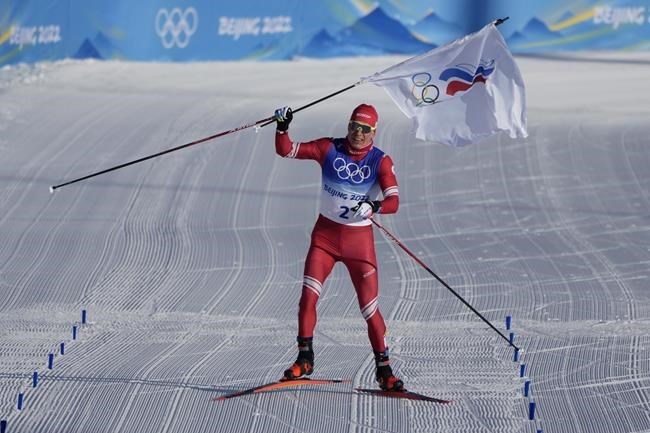
Bolshunov and Iivo Niskanen of Finland led the race through the first four classic ski laps, but Russian athlete Denis Spitsov passed Niskanen on the freestyle legs.
Spitsov stayed out front and secured the silver, 1:11 behind Bolshunov. Niskanen held on for the bronze, 2:00 behind.
Bolshunov said that once he and Niskanen moved into the lead, he knew it was his chance.
“I just started to work together with him and then on the freeskate portion I understood that the most important thing was to get to the finish line without being overwhelmed by any personal emotions and to take my gold medal,” Bolshunov said.
Niskanen said his plan was to push on the classic legs, but the skate half was tougher.
“The pace was high after the first lap all the time and I couldn’t hang with the Russians,” he said. “They were so strong that it was a long race to push alone. To get the bronze, I’m happy about it.”
Spitsov said he was pleased with how his skis worked in the classic section.
“But on the freeskate, in the last three laps, I was just enduring the pain and dreaming for this race to end faster because it was very hard,” he said.
The first Norwegian to cross the line was Hans Christer Holund in fourth. He won the bronze medal at the 2018 Pyeongchang Olympics. Norwegian teammate Paal Golberg was fifth.
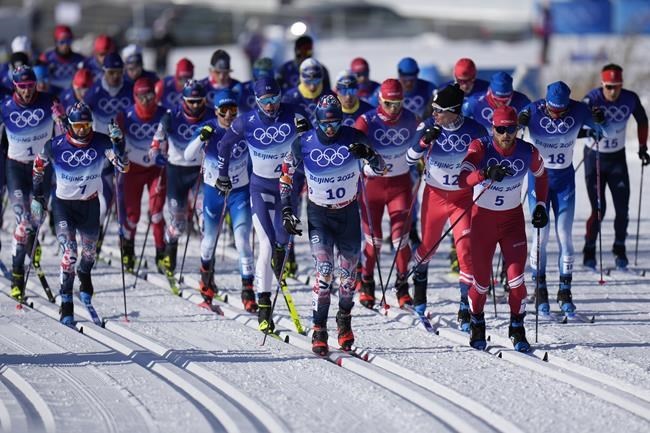
Johannes Hoesflot Klaebo of Norway, the overall World Cup leader, lost touch with the front group during the classic laps and continued to lose time. He finished in 40th place, 9:06 behind Bolshunov. He did not stop to talk with reporters after the race.
The skiathlon is a mass-start race that began with 15 kilometers of classic skiing. After four laps around the 3.75-kilometer course, racers came through the stadium and quickly switched to skate skis before heading out for another four laps.
Klaebo dominates cross-country skiing, but his gold medals in 2018 were in the free sprint, 4×10-kilometer relay and team sprint. Bolshunov stands just in front of him in the distance competition.
The Russian pair’s coach, Yury Borodavko, was suspended from working with the national team for two years in 2010 after the country’s cross-country federation said he was among a group of coaches “involved in doping cases.”
Air temperatures for Sunday’s skiathlon were warmer than the women’s race on Saturday, hovering around minus-11 degrees C (12.2 degrees F). The winds were calmer, which helped with the wind chill, which dipped as low as minus-30 C (minus-22 F).
Niskanen, the best classic skier in the world, pulled away from the pack on the second lap and was joined by Bolshunov. They led 12 chasers by 15 seconds on the second lap and by the third, only three were about 18 seconds behind — Spitsov, Holund and Golberg. Klaebo was back 42 seconds in ninth place.
Niskanen and Bolshunov stayed in front through the transition to skate skis with the three chasers about 30 seconds behind. Klaebo was in 11th place 1:39 behind.
Bolshunov pulled away from Niskanen halfway through the first skate lap and Spitsov caught him. By the second skate lap, Spitsov gained time on Niskanen and the two Norwegians continued to chase. Holund never caught him.
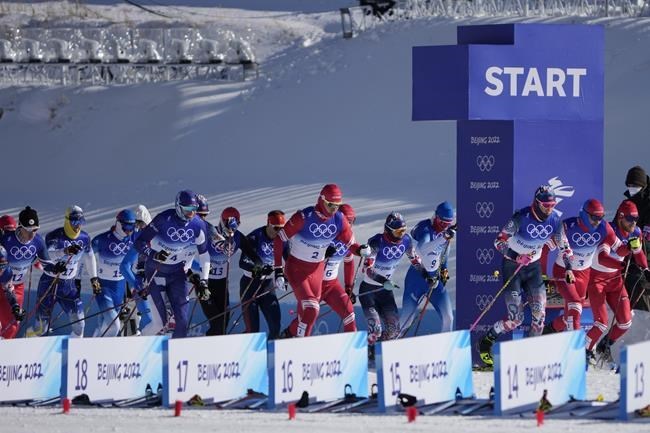

Norway swept the Olympic podium in the skiathlon in 2018, but defending champion Simen Hegstad Krüger was not able to defend his title after testing positive for COVID-19. His skiathlon gold came after he crashed and broke a pole just after the race started but managed to pass 60 skiers to win.
Pyeongchang silver medalist Martin Johnsrud Sundby retired in 2021. Holund, who won bronze, had to settle for fourth.
The World Cup skiathlon title has been staged three times since 2018 and Bolshunov has won two of them, in 2019 and 2020. Emil Iverson of Norway took gold in 2021.
___
More AP Olympics: https://apnews.com/hub/winter-olympics and https://twitter.com/AP_Sports
Related Articles
Sweden's Sara Hector wins Olympic GS gold after Shiffrin out





Advertisement Advertise With Us
Advertisement Advertise With Us