

IOC’s Bach defends Russia stance amid pro-Ukraine protest
Advertisement
Read this article for free:
or
Already have an account? Log in here »
To continue reading, please subscribe:

Digital Subscription
One year of digital access for only $205*
- Enjoy unlimited reading on winnipegfreepress.com
- Read the E-Edition, our digital replica newspaper
- Access News Break, our award-winning app
- Play interactive puzzles
*First annual payment billed as $205.00 + GST for one year. This annual subscription will automatically renew at $233.00 + GST every 52 weeks (10% off the regular annual price of $259.35). Offer available to new and qualified returning subscribers only. Cancel any time.
To continue reading, please subscribe:
Add Free Press access to your Brandon Sun subscription for only an additional
$1 for the first 4 weeks*
- Enjoy unlimited reading on winnipegfreepress.com
- Read the E-Edition, our digital replica newspaper
- Access News Break, our award-winning app
- Play interactive puzzles
*Your next Brandon Sun subscription payment will increase by $1.00 and you will be charged $17.95 plus GST for four weeks. After four weeks, your payment will increase to $24.95 plus GST every four weeks.
Read unlimited articles for free today:
or
Already have an account? Log in here »
Hey there, time traveller!
This article was published 22/03/2023 (1274 days ago), so information in it may no longer be current.
ESSEN, Germany (AP) — International Olympic Committee president Thomas Bach defended his organization’s efforts to create a pathway for Russian and Belarusian athletes to return to competition in a speech in his home country of Germany which took place amid a pro-Ukraine protest Wednesday.
Bach reiterated the IOC’s position that it would be discriminatory to exclude Russians and Belarusians based on citizenship alone and argued the Olympics can help promote dialogue at a tense time. Public broadcaster WDR reported nearly 200 pro-Ukraine protesters gathered outside the venue calling for Russia to be excluded entirely from the Olympics.
The IOC recommended excluding Russia and Belarus on safety grounds soon after the invasion last year but now argues for letting the two countries’ athletes compete as neutrals without national symbols ahead of a packed calendar of qualification events for the 2024 Paris Olympics.
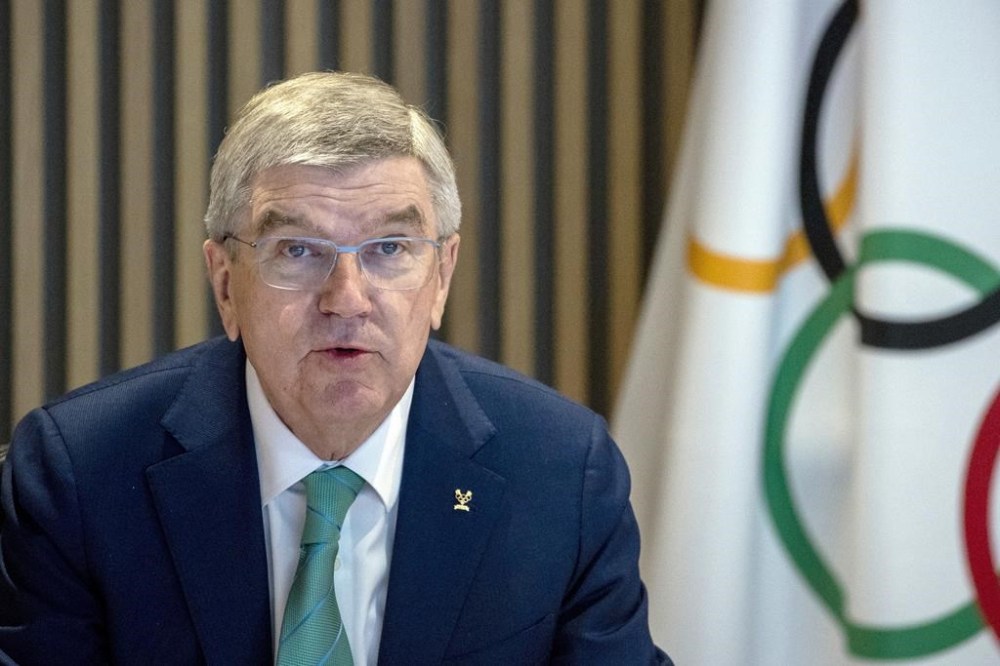
Bach said he opposed political influence on sports and any suggestion that Russians should be treated as if they have “collective guilt.” The Olympics, he added, need to remain neutral to be a unifying force.
The IOC previously said it wants to keep out athletes deemed to be “actively supporting the war,” with a final decision lying with the international federations running individual sports, but it has given few details of how that would work.
Bach refined that approach Wednesday, indicating the IOC could recommend barring athletes who pose with a “Z” symbol, a marking used on Russian military vehicles which has become a symbol of support for the war.

“Our principles say clearly and distinctly that any active support for the war, and that includes wearing this ‘Z’, that includes posts and much else besides (is prohibited). Anyone who supports the war in this way cannot, or in relation to the international federations, since we are issuing this only as a recommendation, should not take part in these competitions,” Bach said.
Asked about what to do with the many Russian athletes who are part of the military or have ties to military organizations, Bach indicated the IOC could decide on its approach at a board meeting next week.
“Wait until the middle of next week. I am confident that we will come up with appropriate guidelines then,” he said.
___
More AP coverage of the Paris Olympics: https://apnews.com/hub/2024-paris-olympic-games and https://twitter.com/AP_Sports
Related Articles
Olympic rowing champion Helen Glover aiming for Paris Games
Advertisement Advertise With Us
Advertisement Advertise With Us