

Swiss loss sets up enticing rematch with Serbia at World Cup
Advertisement
Read this article for free:
or
Already have an account? Log in here »
To continue reading, please subscribe:

Digital Subscription
One year of digital access for only $205*
- Enjoy unlimited reading on winnipegfreepress.com
- Read the E-Edition, our digital replica newspaper
- Access News Break, our award-winning app
- Play interactive puzzles
*First annual payment billed as $205.00 + GST for one year. This annual subscription will automatically renew at $233.00 + GST every 52 weeks (10% off the regular annual price of $259.35). Offer available to new and qualified returning subscribers only. Cancel any time.
To continue reading, please subscribe:
Add Free Press access to your Brandon Sun subscription for only an additional
$1 for the first 4 weeks*
- Enjoy unlimited reading on winnipegfreepress.com
- Read the E-Edition, our digital replica newspaper
- Access News Break, our award-winning app
- Play interactive puzzles
*Your next Brandon Sun subscription payment will increase by $1.00 and you will be charged $17.95 plus GST for four weeks. After four weeks, your payment will increase to $24.95 plus GST every four weeks.
Read unlimited articles for free today:
or
Already have an account? Log in here »
Hey there, time traveller!
This article was published 28/11/2022 (1404 days ago), so information in it may no longer be current.
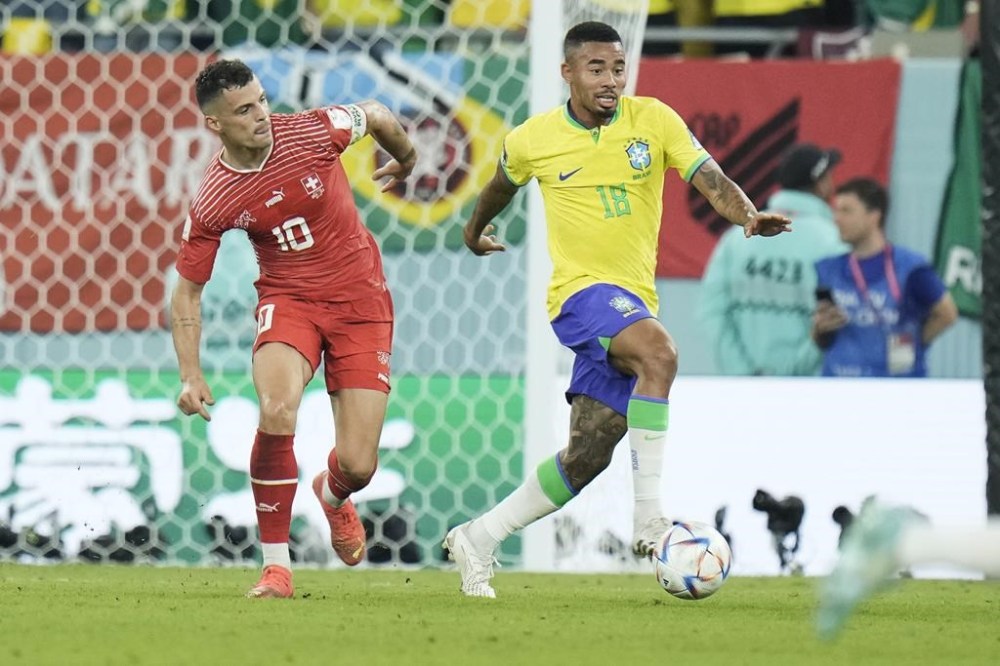
DOHA, Qatar (AP) — Switzerland’s loss made its upcoming World Cup rematch all the more enticing, and with a lot more on the line.
Ever since the match schedule was made in April, the Group G game between Switzerland and Serbia has been one to keep an eye on. Not just because of the talented players on both teams, but because of the political tensions they brought on the field when they met at the last World Cup.
Four years ago in Russia, Switzerland captain Granit Xhaka celebrated his goal against Serbia by making a double-headed eagle with his hands — thumbs representing the heads of the two eagles, fingers fanned to look like feathers. The figure is considered to be an Albanian nationalist symbol.
Xherdan Shaqiri added another goal in the final minute of the game, and did the same thing with his hands as the Swiss won 2-1 in the second of the three group matches.
Xhaka and Shaqiri both have ethnic Albanian heritage and family ties to Kosovo. They were teenagers growing up in Switzerland when Kosovo declared independence from Serbia, something the Serbs still don’t recognize 14 years later.
Both players were fined by FIFA during the tournament, and the government of Albania opened a bank account for people to contribute toward paying the 10,000 Swiss franc ($10,500) penalties.
On Friday, only one of the two teams will be able to advance to the round of 16 in Qatar. Brazil, which beat the Swiss 1-0 on Monday and defeated Serbia 2-0 last Thursday, has already assured itself of a spot in the knockout round.
The Swiss likely need only a draw at Stadium 974, and Shaqiri should be available to play after sitting out the match against Brazil with a muscle injury.
Xhaka, now 30 and a mature leader for his country, brushed aside the controversial match from four years ago.
“(There’s) nothing in the history behind these two games,” the Arsenal midfielder said. “We are Switzerland, they are Serbia, that’s it. We are here to play football — them, us as well.”
Still, the Serbian delegation at this year’s World Cup has already made the politics of Kosovo an issue.
Serbia’s locker room ahead of its opening game against Brazil displayed a national flag with territory that included Kosovo and the slogan “No Surrender.” FIFA opened a disciplinary case against the Serbian soccer federation on Saturday.
The Kosovo soccer federation formally complained to FIFA after a photograph circulated and the country’s sports minister, Hajrulla Ceku, described the image as using the World Cup to promote “hateful, xenophobic and genocidal messages.”

The Swiss advanced to the round of 16 in 2018 after a draw with Costa Rica in their final group match, while the Serbs were eliminated after losing to Brazil. This time, the teams go head-to-head in their final group game.
“Of course, the history is the history,” said Switzerland goalkeeper Yann Sommer, who also played against Serbia four years ago in Kaliningrad. “But in this moment it will be the game that is important.
“We know this game already,” Sommer added. “We had it in Russia.”
___
AP World Cup coverage: https://apnews.com/hub/world-cup and https://twitter.com/AP_Sports
Related Articles
'A different time:' Stoumbos remembers Canada's first-ever World Cup goal





Advertisement Advertise With Us
Advertisement Advertise With Us