

Stalled ‘super league’ cloaked in greed, cynicism
Advertisement
Read this article for free:
or
Already have an account? Log in here »
To continue reading, please subscribe:
Monthly Digital Subscription
$0 for the first 4 weeks*
- Enjoy unlimited reading on winnipegfreepress.com
- Read the E-Edition, our digital replica newspaper
- Access News Break, our award-winning app
- Play interactive puzzles
*No charge for 4 weeks then price increases to the regular rate of $19.00 plus GST every four weeks. Offer available to new and qualified returning subscribers only. Cancel any time.
Monthly Digital Subscription
$4.75/week*
- Enjoy unlimited reading on winnipegfreepress.com
- Read the E-Edition, our digital replica newspaper
- Access News Break, our award-winning app
- Play interactive puzzles
*Billed as $19 plus GST every four weeks. Cancel any time.
To continue reading, please subscribe:
Add Free Press access to your Brandon Sun subscription for only an additional
$1 for the first 4 weeks*
*Your next subscription payment will increase by $1.00 and you will be charged $16.99 plus GST for four weeks. After four weeks, your payment will increase to $23.99 plus GST every four weeks.
Read unlimited articles for free today:
or
Already have an account? Log in here »
Hey there, time traveller!
This article was published 23/04/2021 (1695 days ago), so information in it may no longer be current.
I truly hope this is the final column I have to write about European club football’s so-called “super league.”
It’s a fool’s hope, I know; I’m aware of the naivete. But I would so much rather assign this space to some of the weekend’s eye-catching match-ups, such as Manchester United-Leeds, Bayer Leverkusen-Eintracht Frankfurt, Lazio-AC Milan and Lyon-Lille.
There’s also a rather notable transfer rumour to discuss involving Cristiano Ronaldo, and then, for a feel-good story we could all use about now, there’s Marcus Rashford’s ramped-up initiative to provide affordable food for vulnerable U.K. families.
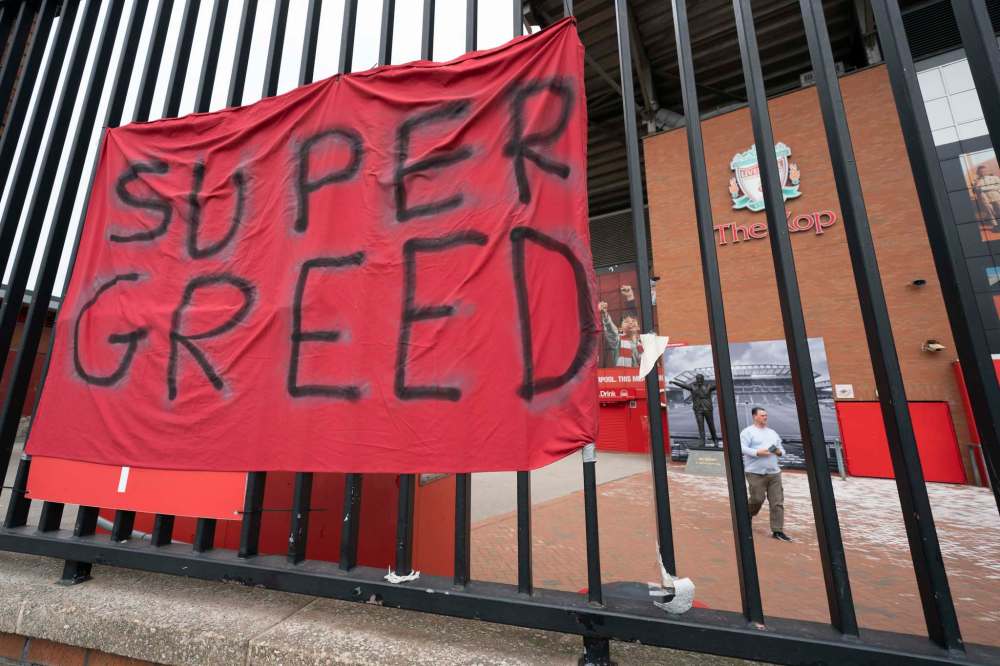
But no, 12 of the continent’s biggest clubs — not even the 12 best ones (Tottenham, really?!) — decided to get very, very greedy, and so here we are. What makes the story even more discouraging, if that’s possible, is the absolute cynicism of it.
You just know the super league group, (I refuse to capitalize the name, as it’s not actually a thing) headed by Real Madrid president Florentino Perez and Juventus chairman Andrea Agnelli, figured they could announce their enterprise during the pandemic, which continues to embattle the EU, and launch it amidst mere reluctance from COVID-weary fanbases.
What they didn’t realize — and in this instance their naivete exceeds even my own — is the room they failed to read is virtual, and pent up, and the fans they disregarded — who haven’t been able to attend matches in more than a year — had suppressed passions set to ignite at the slightest spark.
And ignite they did.
There were furious protests outside Stamford Bridge, seething crowds at Anfield, triggered rioters who invaded the Carrington training complex in Manchester. Nearly three-quarters of Italian fans, as surveyed by La Gazzetta dello Sport, answered in opposition to the super league; thousands of flare-wielding fans protested near Estadio Ramon de Carranza as Real Madrid took on host side Cadiz.
Rather bravely, Manchester City manager Pep Guardiola and Arsenal boss Mikel Arteta railed against decisions made by their employers, and players movements, led by Liverpool captain Jordan Henderson and Manchester United skipper Harry Maguire, further challenged club executives who hadn’t thought to consult them in the decision-making process.
Crucially, super league funders JP Morgan pulled out of the scheme to salvage its reputation (“JP Morgan Chase has scored a Super League own goal,” read a headline in the Financial Times), but not before it was handed a degraded sustainability rating for its part in the plot.
So deranged was the idea it even caused U.K. prime minister Boris Johnson and French president Emmanuel Macron to agree about something.
Perhaps even more unlikely was, and is, its unifying influence on Clasico rivals Real Madrid and Barcelona, albeit in a belligerent insistence that a super league is in their best interests. Incidentally, a Friday report in Der Spiegel revealed the two Spanish clubs stood to make €60 million more than their English and Italian counterparts — something those 10 other clubs won’t soon forget.
And still, it’s hard to believe the super league is well and truly dead. “Stalled” might be a better word. When there are so many billions to be made, the powerful tend to find a way to make those billions.

But what if—let’s entertain my naivete once again — they don’t have to be made? What if, in this period of late-stage capitalism, a lot of people have simply had enough? What if, in emerging from the pandemic, folks realize their own power in embracing the smaller, the fairer and the more local at the expense of the bigger, unequal and impersonal?
Ultimately, it’s people power that kiboshed the super league. They’ll likely have to do it again at some point in the future, and then again after that — so hellbent are the rich to get richer. But what if they do? And what if this really is the last column I have to write about it?
It’s what I’m hoping for. A fool’s hope, no doubt. But what if, for now, that’s enough?
jerradpeters@gmail.com
Our newsroom depends on a growing audience of readers to power our journalism. If you are not a paid reader, please consider becoming a subscriber.
Our newsroom depends on its audience of readers to power our journalism. Thank you for your support.