

Sports with little fanfare
Advertisement
Read this article for free:
or
Already have an account? Log in here »
To continue reading, please subscribe:

Digital Subscription
One year of digital access for only $205*
- Enjoy unlimited reading on winnipegfreepress.com
- Read the E-Edition, our digital replica newspaper
- Access News Break, our award-winning app
- Play interactive puzzles
*First annual payment billed as $205.00 + GST for one year. This annual subscription will automatically renew at $233.00 + GST every 52 weeks (10% off the regular annual price of $259.35). Offer available to new and qualified returning subscribers only. Cancel any time.
To continue reading, please subscribe:
Add Free Press access to your Brandon Sun subscription for only an additional
$1 for the first 4 weeks*
- Enjoy unlimited reading on winnipegfreepress.com
- Read the E-Edition, our digital replica newspaper
- Access News Break, our award-winning app
- Play interactive puzzles
*Your next Brandon Sun subscription payment will increase by $1.00 and you will be charged $17.95 plus GST for four weeks. After four weeks, your payment will increase to $24.95 plus GST every four weeks.
Read unlimited articles for free today:
or
Already have an account? Log in here »
Hey there, time traveller!
This article was published 24/04/2020 (2276 days ago), so information in it may no longer be current.
A lot of us who are casual sports observers are asking a pretty simple question: How can you play big-league sports without fans? In other words, without us?
Pretty much every major sports league — hockey, baseball, basketball, soccer, golf, you name it — is considering plans to resume play with athletes, officials and TV crews, but no fans. There won’t be any hometown crowds, just performers in bubble communities.
In a recent virtual episode of Saturday Night Live, Tom Hanks was telling jokes in his kitchen. The pauses after each punchline seemed to last forever. Maybe the jokes were funny; maybe they weren’t. Who could tell without a live audience to laugh?
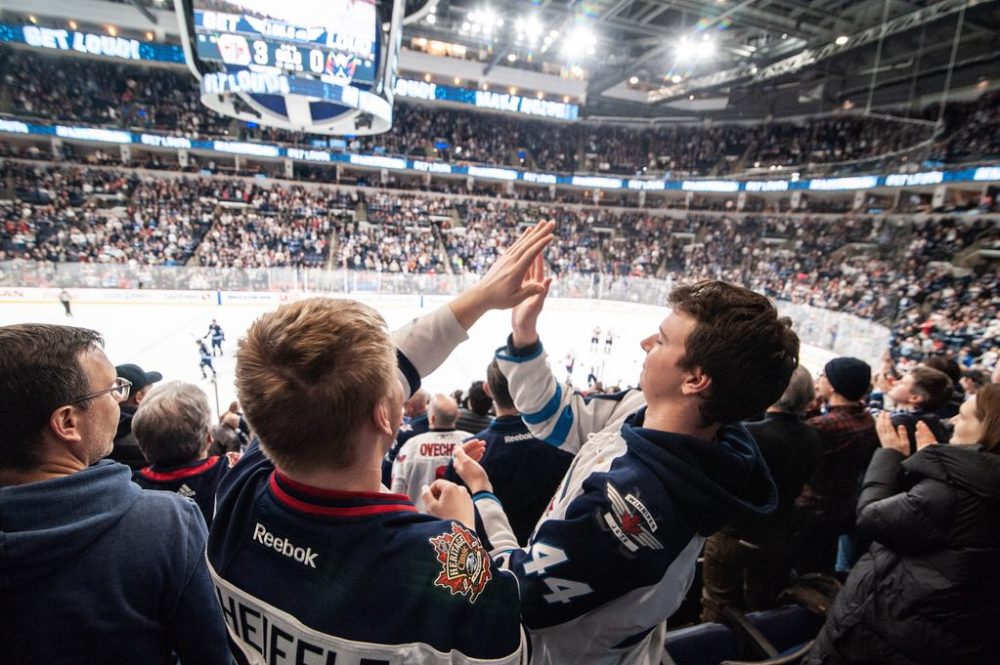
So you have to wonder how exciting it will be if there is no one to cheer when Patrik Laine blasts the puck over a goalie’s shoulder. It may feel more like a televised practice for those viewing at home.
Fans bring emotion to sports. They love their teams and the games they play. They live and die watching their favourite players win and lose. They aren’t just observers; they are an integral part of the games.
Without fans in arenas, stadiums and ballparks, professional sports becomes a bloodless pursuit without passion. What’s the point?
Of course, the point is money. Professional sports is all about money. The teams, leagues and TV networks have taken massive hits from the cancellation of live events. Understandably, they are desperate to start the cash machine again. The big question is whether it will work without anyone to cheer every goal, every basket, every home run.
This could be a very interesting experiment in determining the real value of fans. Is sports worth watching if masses of people are not cheering and booing and carrying on in the background? Will fans watch if the celebration after an NHL goal looks and feels about the same as what beer-league players do after scoring?
In normal times, virtually every athlete, club owner and league president praises fans.
However, money too often trumps the interests of fans. Anyone who has attended a Jets or Bombers game, and sat through endless TV commercial breaks in play, can attest to this. The people who pay to be in the stands get their experience interrupted to fulfill revenue-generating demands of TV.
Fans too often get sobering reminders that they’re important, sure, but it’s mainly because they have money, and because, in big enough numbers, they can be sold to advertisers and bring in even more money.
Sometimes we even learn from these lessons.
When I was 13, my idol, goalie Ken Dryden, fresh off winning his second Stanley Cup with the Montreal Canadiens in 1973, did not play for an entire season because he wanted more money and the team would not pay it. So much for what fans wanted.
I was also among fans of the Montreal Expos who watched in 1994 as they tore up the National League, notching the best record in baseball by mid-August, looking like World Series contenders for the first time in team history. Then all major league players went on strike and the season was over. No playoffs, no World Series. The Expos never recovered as a franchise and moved to Washington a decade later.

I’ve never idolized a hockey player since 1973 and I’ve rarely watched a major league baseball game since 1994.
My habits changed and I wonder how much sports fans will change this time.
It’s quite possible professional sports organizations are making a miscalculation, taking it for granted that fans are desperate enough that they will watch on TV, without sharing the experience in person, or in bars, or even in the homes of friends and relatives. The TV contracts, the sponsorships, the advertising all depend on this.
What if fans are such an integral part of the sports experience that games simply aren’t very entertaining without them? After all, Tom Hanks wasn’t funny without a live audience. What if sports isn’t interesting without a live audience? What if people watch on TV in much smaller numbers?
It could be a good lesson for everyone in the multibillion-dollar sports industrial complex that has become so dominant. Maybe some balance will be restored and fans will take their rightful place as an integral part of what makes sports worth watching.
History
Updated on Friday, April 24, 2020 11:02 PM CDT: Adds photos