

Facetious remark becomes new tennis centre

Advertisement
Read this article for free:
or
Already have an account? Log in here »
To continue reading, please subscribe:

Digital Subscription
One year of digital access for only $205*
- Enjoy unlimited reading on winnipegfreepress.com
- Read the E-Edition, our digital replica newspaper
- Access News Break, our award-winning app
- Play interactive puzzles
*First annual payment billed as $205.00 + GST for one year. This annual subscription will automatically renew at $233.00 + GST every 52 weeks (10% off the regular annual price of $259.35). Offer available to new and qualified returning subscribers only. Cancel any time.
To continue reading, please subscribe:
Add Free Press access to your Brandon Sun subscription for only an additional
$1 for the first 4 weeks*
- Enjoy unlimited reading on winnipegfreepress.com
- Read the E-Edition, our digital replica newspaper
- Access News Break, our award-winning app
- Play interactive puzzles
*Your next Brandon Sun subscription payment will increase by $1.00 and you will be charged $17.95 plus GST for four weeks. After four weeks, your payment will increase to $24.95 plus GST every four weeks.
Read unlimited articles for free today:
or
Already have an account? Log in here »
Hey there, time traveller!
This article was published 16/07/2022 (1524 days ago), so information in it may no longer be current.
WHAT started as a silly quip six years ago is now a multi-million-dollar project, just two weeks from breaking ground in West St. Paul.
Tennis Manitoba executive director Mark Arndt was at a backyard barbeque in May 2016, speaking with a committee member of the Sunova Centre, a recreation site in West St. Paul. The individual mentioned the committee was considering additional uses for its 17,000-square-foot facility.
Facetiously, Arndt asked if there was room for tennis.
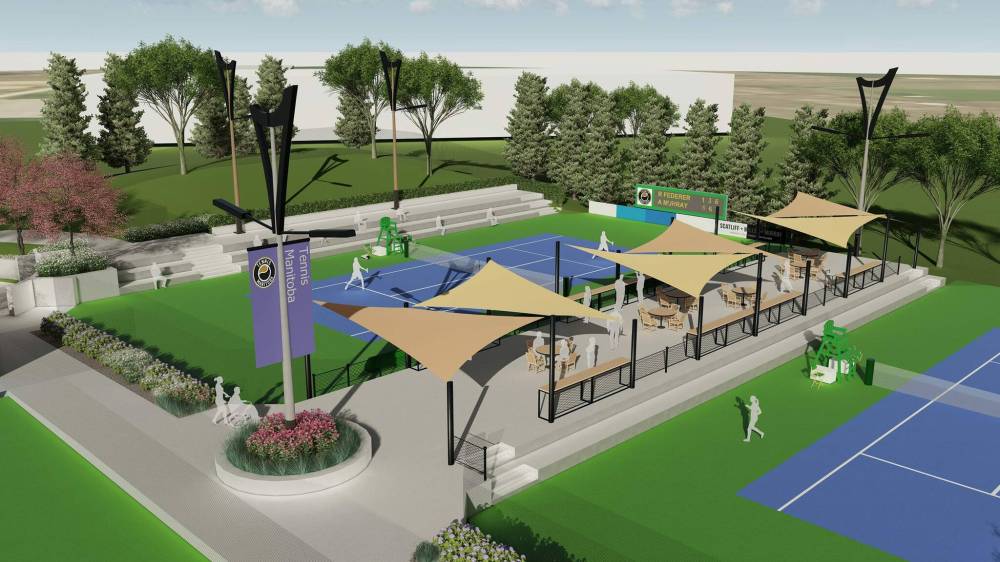
“Honestly, (it was) a joke… I didn’t think much of it. And then here we are. It’s just so satisfying to be at this point,” Arndt told the Free Press earlier this week.
While the COVID-19 pandemic stalled the project’s fundraising until last 2021, construction on the Tennis Manitoba Hub at West St. Paul is about to begin.
Not only will the hub act as a publicly accessible facility, but also a provincial training centre, where provincial and Canada Games teams can practise and tournaments can be held.
The facility will feature four indoor hard courts and six outdoor hard courts, highlighted by one stadium court which can seat more than 500 spectators under the bright lights for matches at night.
The project will cost $5.2 million — $1.2 million for Phase 1 (outdoor courts) and $4 million for Phase 2 (indoor courts). Arndt said funding has come through grants and private donors.
Phase 1 of the hub could be completed by as early as October.
The agreement between Tennis Manitoba and rural municipality includes a tentative stipulation allowing residents of West St. Paul to book a court for free. People outside of the municipality will need to pay a fee to play.
For any group training programs available at the facility, local residents would be offered a reduced fee.
“West St. Paul and the region is under-serviced as far as tennis courts are concerned. I mean, the population is exploding — 4,000-5,000 homes are being built, there are no proper tennis courts in the area … so, this is hoping to service that area,” Arndt said.
“The popularity of tennis, we were just finding that there was a growth, there was a demand for it and we have a very good relationship with the Seven Oaks School Division.”
Manitoba isn’t the first province to build a provincial training centre. Tennis BC and Tennis Nova Scotia have added hubs to their communities. Both facilities have been “very successful” in facilitating growth in participation, according to Tennis Canada.
In B.C., the bookable tennis facilities and programs are all in demand, resulting in waitlists, said John McMurchy, executive director for Tennis BC.
A similar rise in participation would be a welcomed sight by Tennis Manitoba. In the prairies, just 11 per cent of residents play tennis, ranking last in the country, according to a 2018 study commissioned by Tennis Canada.
Getting kids involved remains a top priority.
“The goal here, obviously, is the school system and getting tennis into schools and finding prospects at schools, and just increasing the awareness in schools,” Arndt said.
Tennis Manitoba is active in several school divisions across the province, offering programs to teach kids about the game, and also offers a professional development course for teachers once a year.
“This facility will be able to accommodate and expand any of that programming,” Arndt said. “If we want kids to play and stay in the sport, we need to provide proper facilities for them to enjoy the experience.”
Robert Kennedy, an elementary-school teacher in the Seven Oaks School Division and coach for Tennis Manitoba, said the hub is a natural fit in the community.
Kennedy helps manage the tennis program — offered for 23 years — at his school, which is one of the leaders for growing the game within the school division.
“What the new facility means is there’s an opportunity for the school division to access coaching there and kind of be using it as a hub for growing tennis in that area. Hopefully, by giving kids opportunities in a smaller setting, it’ll spark their enthusiasm for the sport,” he said.
Kennedy noted before the pandemic hit, upwards of nine schools in the division were running tennis programs. The extra-curricular programs became so successful, the schools created a two-day tournament that attracted about 250 kids.

“Who knows where it would have led to if there wasn’t a pandemic, right?”
While Kennedy and the other schools try to re-spark their programs, he believes the booming interest in his division could be a sign for the rest of the province.
“I think anytime you can give people a place to grow the sport, it will grow. Tennis is highly popular and it’s on the rise.”
jfreysam@freepress.mb.ca
Twitter: @jfreysam
Josh Frey-Sam reports on sports and business at the Free Press. Josh got his start at the paper in 2022, just weeks after graduating from the Creative Communications program at Red River College. He reports primarily on amateur teams and athletes in sports. Read more about Josh.
Every piece of reporting Josh produces is reviewed by an editing team before it is posted online or published in print — part of the Free Press‘s tradition, since 1872, of producing reliable independent journalism. Read more about Free Press’s history and mandate, and learn how our newsroom operates.
Our newsroom depends on a growing audience of readers to power our journalism. If you are not a paid reader, please consider becoming a subscriber.
Our newsroom depends on its audience of readers to power our journalism. Thank you for your support.
Josh Frey-Sam reports on sports and business at the Free Press. Josh got his start at the paper in 2022, just weeks after graduating from the Creative Communications program at Red River College. He reports primarily on amateur teams and athletes in sports. Read more about Josh.
Every piece of reporting Josh produces is reviewed by an editing team before it is posted online or published in print — part of the Free Press‘s tradition, since 1872, of producing reliable independent journalism. Read more about Free Press’s history and mandate, and learn how our newsroom operates.
Our newsroom depends on a growing audience of readers to power our journalism. If you are not a paid reader, please consider becoming a subscriber.
Our newsroom depends on its audience of readers to power our journalism. Thank you for your support.
Advertisement Advertise With Us
Advertisement Advertise With Us