

As losses mount in toxic opioid crisis, Ontario cities memorialize overdose victims
Advertisement
Read this article for free:
or
Already have an account? Log in here »
To continue reading, please subscribe:

Digital Subscription
One year of digital access for only $205*
- Enjoy unlimited reading on winnipegfreepress.com
- Read the E-Edition, our digital replica newspaper
- Access News Break, our award-winning app
- Play interactive puzzles
*First annual payment billed as $205.00 + GST for one year. This annual subscription will automatically renew at $233.00 + GST every 52 weeks (10% off the regular annual price of $259.35). Offer available to new and qualified returning subscribers only. Cancel any time.
To continue reading, please subscribe:
Add Free Press access to your Brandon Sun subscription for only an additional
$1 for the first 4 weeks*
- Enjoy unlimited reading on winnipegfreepress.com
- Read the E-Edition, our digital replica newspaper
- Access News Break, our award-winning app
- Play interactive puzzles
*Your next Brandon Sun subscription payment will increase by $1.00 and you will be charged $17.95 plus GST for four weeks. After four weeks, your payment will increase to $24.95 plus GST every four weeks.
Read unlimited articles for free today:
or
Already have an account? Log in here »
Hey there, time traveller!
This article was published 18/09/2024 (703 days ago), so information in it may no longer be current.
TORONTO – There is less and less space on the lawn for the dozens upon dozens of bright white crosses.
The grass between the fire station and the sidewalks on a downtown corner in Sudbury, Ont., is crowded with markers bearing the names of people lost to the opioid overdose crisis.
Too many more are dying.
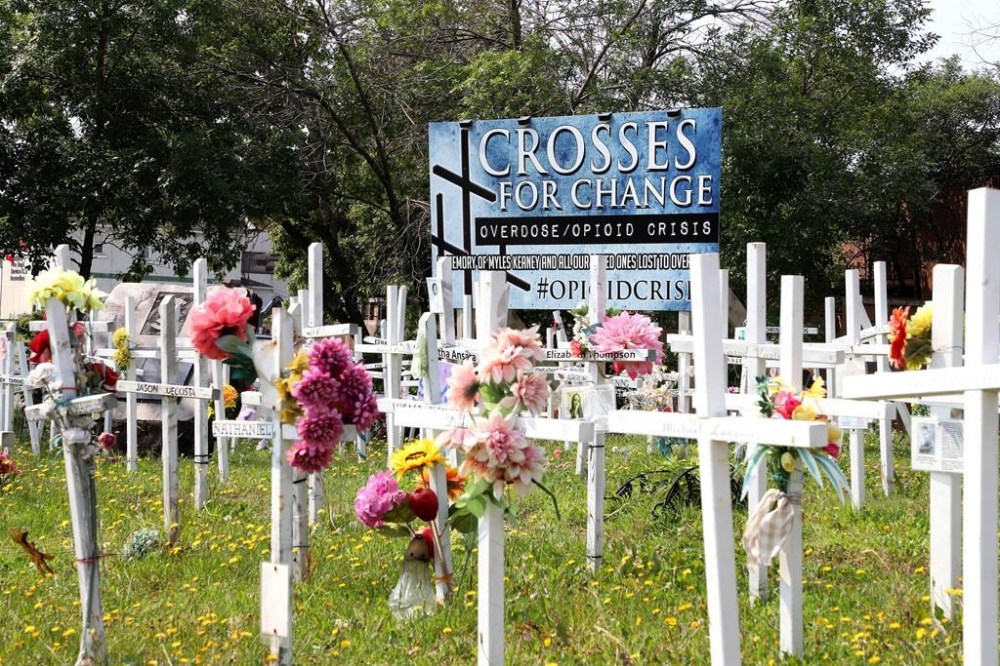
What started four years ago as a memorial to a local woman’s son has grown so much in size and in the public consciousness that the city has pledged to find space for a permanent installation.
It’s not the only municipality with such plans in Ontario, where opioid toxicity contributes to an estimated seven deaths a day, or some 1,249 people in the first five months of the year, according to preliminary estimates.
Across the province, data from the Office of the Chief Coroner show rates have been significantly higher since the onset of the COVID-19 pandemic, from an average of 130 deaths per month in 2019 to a peak of 238 a month in 2021. Four in five deaths involve fentanyl.
Greater Sudbury Mayor Paul Lefebvre says his municipality has been struggling to keep up over the past few years, despite “lots of outreach going on.”
“We’re trying to address it, but it’s getting tougher and tougher,” he said in an interview. “We’ve never seen that in our lifetime.”
From January through August, 90 people died from a suspected drug overdose in the Sudbury and Manitoulin districts, Public Health Sudbury & Districts reports – about 15 per cent more than in the same period last year. Another 245 people visited emergency departments for confirmed opioid overdoses.
Over the course of 2023, the region saw the highest rate of toxic drug deaths per capita.
Lefebvre said he’s working with the founder of the downtown memorial, called Crosses for Change, to find an appropriate space in the city where residents can come to grieve.
“We need to memorialize what these folks, our friends and family members, have gone through, and their tragic passing in this crisis we’re all facing,” he said.
A similar effort is underway in Guelph, Ont. Though its region’s rates of opioid-related deaths are consistently among the lowest in the province, community members are far from immune to this particular type of grief.
People closely affected by toxic drug use worked with the Wellington Guelph Drug Strategy and other community partners to design a “contemplative space” that will be built in a city park, says Jean Hopkins, the strategy’s manager.
The Pathways to Remembering Monument is imagined as a stone podium surrounded by tall grasses, meant to symbolize lost loved ones.
A spokesman for the City of Guelph confirmed the city is looking at options for a site, will fund bench purchases and lead the project implementation. Other costs are being covered by a fundraising effort that Hopkins said began in 2022 and has raised about one-third of a $50,000 goal so far.
“It is so important to have reflective spaces within our community to call attention to this issue, and ensure we are honouring those we have lost to a preventable cause,” Hopkins said in an email. “We hope that the memorial will also address the stigma that is linked to substance use and drug poisoning.”
This report by The Canadian Press was first published Sept. 18, 2024.