

Alberta teachers fail to get court injunction on back-to-work law that ended strike
Advertisement
Read this article for free:
or
Already have an account? Log in here »
To continue reading, please subscribe:
Monthly Digital Subscription
$1 per week for 24 weeks*
- Enjoy unlimited reading on winnipegfreepress.com
- Read the E-Edition, our digital replica newspaper
- Access News Break, our award-winning app
- Play interactive puzzles
*Billed as $4.00 plus GST every four weeks. After 24 weeks, price increases to the regular rate of $19.95 plus GST every four weeks. Offer available to new and qualified returning subscribers only. Cancel any time.
Monthly Digital Subscription
$4.99/week*
- Enjoy unlimited reading on winnipegfreepress.com
- Read the E-Edition, our digital replica newspaper
- Access News Break, our award-winning app
- Play interactive puzzles
*Billed as $19.95 plus GST every four weeks. Cancel any time.
To continue reading, please subscribe:
Add Free Press access to your Brandon Sun subscription for only an additional
$1 for the first 4 weeks*
*Your next subscription payment will increase by $1.00 and you will be charged $16.99 plus GST for four weeks. After four weeks, your payment will increase to $23.99 plus GST every four weeks.
Read unlimited articles for free today:
or
Already have an account? Log in here »
EDMONTON – A judge denied on Friday an injunction application from Alberta teachers against legislation that forced them back to work and ended a provincewide strike last fall.
Justice Douglas Mah told court there are serious issues to be hashed out about the law and its use of the Charter’s notwithstanding clause.
But he said the Alberta Teachers’ Association failed to prove the issues are so pressing and harmful that the law should be put on hold, potentially allowing teachers to strike again.
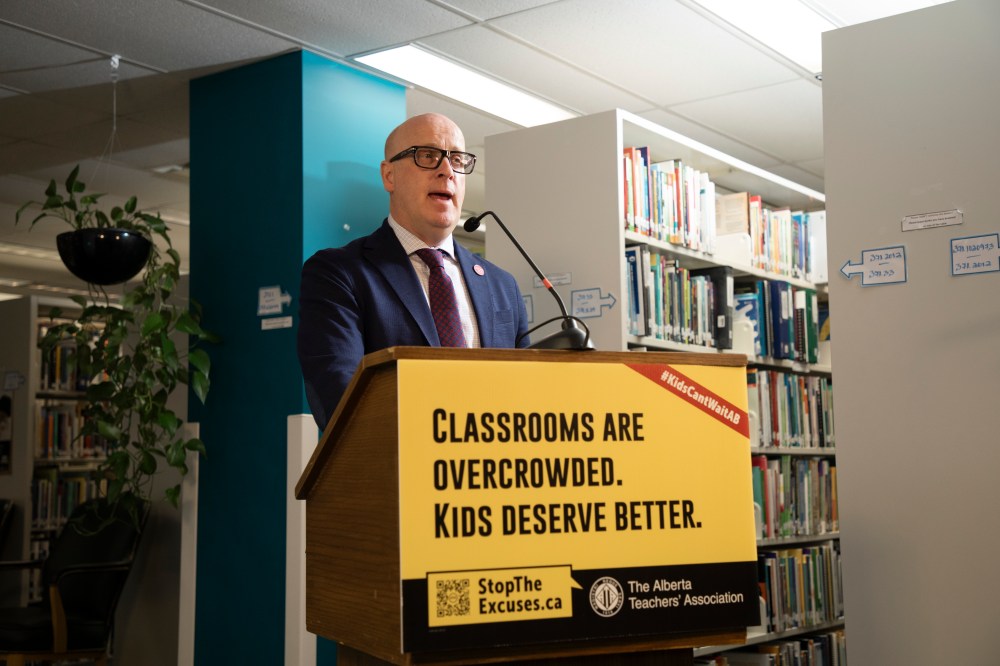
“Suspending (the act) will almost certainly create chaos and uncertainty for the parties, parents and students who could be immediately placed out of school,” Mah said.
“What is not uncertain is that teachers would be back on strike.”
The case stretches back to October, when Premier Danielle Smith’s government ended the teachers strike and imposed a contract deal they had previously rejected. The government invoked the notwithstanding clause to protect the law from being overturned in court.
Mah said his decision shouldn’t be taken as a declaration that the province “governed effectively” in ending the strike. The judge said it’s is about whether the public is better served by granting or denying the injunction.
The judge also appeared to take issue with Smith’s recent public criticism of the courts and how reform is needed to give Alberta more of a say in appointing judges.
Mah said there’s no question teachers suffered harm — “if not despair and disrespect” — at the hands of the government. But union lawyers didn’t prove further irreparable harm would be prevented with an injunction, which is a requirement under the legal test to grant one, said the judge.
“The exercise of their right to strike, a democratic right guaranteed under Canada’s Constitution and their only bargaining chip, was eliminated and a previously rejected collective agreement was rammed down their throats,” he said.
“But this atmosphere of labour relations cynicism is brought on by the enactment of the (act), not by the lack of an injunction.”
Mah said while the decision isn’t what teachers wanted, they will still have their day in court when a full hearing for the legal challenge is held in September.
Union lawyers touched on their positions in the injunction hearing earlier this month, saying one argument will be that the government misused the notwithstanding clause to override rights beyond what’s allowed under the Constitution.
They also argue the clause was improperly used to retroactively impose the labour contract starting in September 2024, more than a year before the bill was tabled in the legislature.
Outside court, union president Jason Schilling said he wasn’t surprised the injunction was denied. He said the ruling doesn’t invalidate the entire case.
“(The government) might gloat about this, but this is not the win that they think it is,” Schilling said.
Justice Minister Mickey Amery’s office said the government is encouraged by the decision.
“This decision reaffirms that the notwithstanding clause is a legitimate constitutional tool — one that allows elected governments to act swiftly in the public interest,” Amery’s press secretary Heather Jenkins said.
Opposition NDP critic Amanda Chapman said the teachers’ fight is everyone’s fight.
“All Albertans had their rights affected when the government used the notwithstanding clause to trample teachers’ constitutional rights. Today’s court decision has not changed that reality,” she said.
Mah also appeared to take issue with repeated criticisms from the premier that there are “activist” courts in Alberta and how she doesn’t want to see “unelected” judges impede the will of democratically elected governments.
In a letter to Prime Minister Mark Carney in January, Smith said Alberta needs to have more say in how judges are appointed. Doing so would “strengthen public confidence in the administration of justice, promote national unity within Alberta and help ensure judicial decision-making reflects the values and expectations of Albertans,” she said in the letter.
Mah said “contrary to what some might think,” judges don’t let their personal views as private citizens play a role in court rulings.
“Decisions must follow the law and the evidence and respect the rule of law,” he said.
“Personal and political sentiment do not matter. That is the job.”
Alberta’s three chief justices spoke out after Smith’s comments. In a rare public statement in January, they urged respect for the independence of the courts, saying democracy can’t function without that understanding.
Smith’s office didn’t immediately respond to a request for comment about Mah’s remarks.
This report by The Canadian Press was first published March 13, 2026.