

Out-of-control wildfire northeast of Halifax grows significantly overnight
Advertisement
Read this article for free:
or
Already have an account? Log in here »
To continue reading, please subscribe:

Digital Subscription
One year of digital access for only $205*
- Enjoy unlimited reading on winnipegfreepress.com
- Read the E-Edition, our digital replica newspaper
- Access News Break, our award-winning app
- Play interactive puzzles
*First annual payment billed as $205.00 + GST for one year. This annual subscription will automatically renew at $233.00 + GST every 52 weeks (10% off the regular annual price of $259.35). Offer available to new and qualified returning subscribers only. Cancel any time.
To continue reading, please subscribe:
Add Free Press access to your Brandon Sun subscription for only an additional
$1 for the first 4 weeks*
- Enjoy unlimited reading on winnipegfreepress.com
- Read the E-Edition, our digital replica newspaper
- Access News Break, our award-winning app
- Play interactive puzzles
*Your next Brandon Sun subscription payment will increase by $1.00 and you will be charged $17.95 plus GST for four weeks. After four weeks, your payment will increase to $24.95 plus GST every four weeks.
Read unlimited articles for free today:
or
Already have an account? Log in here »
HALIFAX – A wildfire that prompted an evacuation order northeast of Halifax grew significantly overnight and remained out of control in the region as of Friday afternoon, Nova Scotia’s Department of Natural Resources said.
The evacuation order affecting about 100 cottages, cabins and homes along Mooseland Road was issued Thursday night by Halifax Regional Fire and Emergency. At that time, the fire was estimated to be about three square kilometres in size.
Jim Rudderham, Nova Scotia’s director of fleet and forest protection with the Department of Natural Resources, told reporters Friday afternoon that the fire had grown to 17 square kilometres and remained out of control, about 100 kilometres northeast of Halifax.
He said there hasn’t been a chance yet to investigate the cause of this blaze, but that lightning strikes or human activity were both possibilities.
“We’ve been getting a lot of lightning-starts lately, which are difficult to deal with,” he said during a press conference.
Such fires can “can pop up any time after, long after, lightning goes through,” he said.
In addition, “we still have a lot of human-caused fires as well, from people just not paying attention to what they’re doing and not following our burn safety restrictions,” Rudderham said.
Natural Resources Minister Tory Rushton said about 100 wildfires have been recorded this year, which is more than double the number of fires seen last year at this time.
Rudderham said the fire is not currently posing a risk to homes in the area, but the evacuation order is a necessary precaution as firefighters tackle the blaze.
“The fire started in the woods and continues in the woods… it’s a rural community, there are homes scattered through this area, but it’s very rural. So that’s good news for us,” he said.

“We don’t like to see anything burn, but it really, really bothers us when homes burn. So far we’re doing good in that way,” Rudderham added.
Bob Robichaud, an Environment Canada meteorologist, said the forecast is calling for rain in the area of the fire on Sunday.
“The system on Sunday that we’re looking at looks like it’s probably going to bring a significant amount of precipitation,” of between 15 to 30 millimetres, Robichaud said during Friday’s press conference.
“We’re fairly confident that that’s going to occur, but we’re certainly watching it very closely,” he added.
But in the meantime, Robichaud said humidity levels are expected to lower “a little bit” Saturday, and winds are forecast to change to a southwesterly direction.
Two fixed-wing water bombers from Newfoundland are responding to the Mooseland Road fire alongside two of Nova Scotia’s helicopters and four of the province’s fixed-wing water bombers.
There are 40 Department of Natural Resources firefighters, more than 30 Halifax Regional Municipality fire fighters and a number of volunteer firefighters working to tackle the blaze.
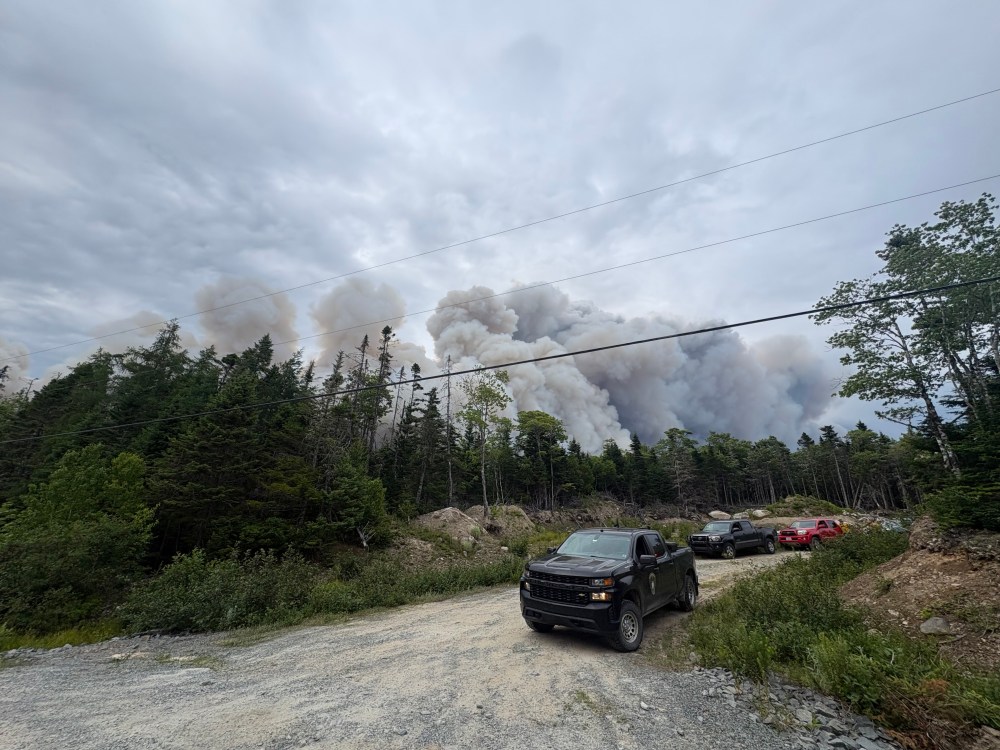
In addition to this blaze in the Halifax area, two new fires were reported Friday — one in Queens County and one in Digby County.
Department minister Rushton said “while our crews are managing current wildfire activity, conditions are becoming drier, and the risk is increasing.”
The minister urged Nova Scotians to check the province’s online fire updates every day, follow all fire restrictions and to take care when having a fire or disposing of cigarettes.
This report by The Canadian Press was first published July 17, 2026.
Related Articles
Ontario wildfire smoke upends campers, shifts into Winnipeg
Advertisement Advertise With Us
Advertisement Advertise With Us