

Researchers work to build a national online library to house Canada’s history
Advertisement
Read this article for free:
or
Already have an account? Log in here »
To continue reading, please subscribe:
Digital Subscription
One year of digital access for only $1.44 a week*
- Enjoy unlimited reading on winnipegfreepress.com
- Read the E-Edition, our digital replica newspaper
- Access News Break, our award-winning app
- Play interactive puzzles
*Billed as $5.77 plus GST every four weeks. After 52 weeks, price increases to the regular rate of $19.95 plus GST every four weeks. Offer available to new and qualified returning subscribers only. Cancel any time.
To continue reading, please subscribe:
Add Free Press access to your Brandon Sun subscription for only an additional
$1 for the first 4 weeks*
- Enjoy unlimited reading on winnipegfreepress.com
- Read the E-Edition, our digital replica newspaper
- Access News Break, our award-winning app
- Play interactive puzzles
*Your next Brandon Sun subscription payment will increase by $1.00 and you will be charged $17.95 plus GST for four weeks. After four weeks, your payment will increase to $24.95 plus GST every four weeks.
Read unlimited articles for free today:
or
Already have an account? Log in here »
Hey there, time traveller!
This article was published 16/11/2011 (5310 days ago), so information in it may no longer be current.
TORONTO – Across Canada, efforts are being made to digitize some of our oldest and more important historical documents so they can be preserved indefinitely and accessed online by anyone across the country, or even around the world.
While those working behind the scenes are pleased with the progress to date, they can’t help but look a little jealously at what’s happening down south and across the Atlantic.
Governments in the United States and the European Union have committed significant budgets to building online libraries to digitally showcase their most important historical artifacts.
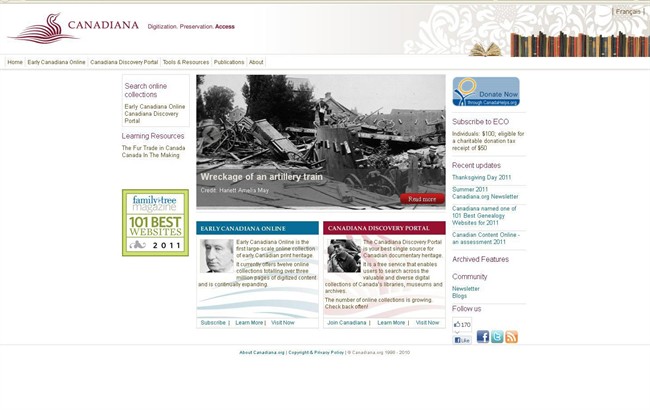
Similar work is happening in Canada but it’s being done — with less funding — by researchers, schools and a non-profit group called Canadiana, which is trying to spearhead a national archive.
“It provides citizens with more knowledge about their country, it provides them with a deeper understanding of where they come from — that to me is really important,” said Lynn Copeland, president of Canadiana.ca.
“I think it also serves to trumpet the country to the rest of the world, it’s a way of saying, ‘Here we are, here’s our history and we’re proud of it.'”
Founded a few years ago, the website hosts relics of Canadian history — including books, important documents, audio and video — and also serves as a starting point for research with links to other sites from across the country.
“We’ve worked with big and small organizations,” Copeland said.
“There are hundreds and hundreds of small archives and museums across the country, it’s amazing how many there are.”
To date, there are about three million pages of fully searchable text in the archive and another 65 million pages that are searchable by subject and keywords.
While some content can be freely viewed, full access to the site is based on subscriptions. It’s $100 a year for the general public to subscribe — although it qualifies for a $50 charitable tax credit — while libraries, schools and organizations pay more.
One section, called Early Canadiana Online, contains digitized versions of pre-1920 Canadian periodicals — including Canada’s first magazine, the Nova Scotia Magazine, which was first published in 1789 — and government documents. The Canadiana Discovery Portal section links out to resources around the web and currently highlights archival information of 20th century aboriginal-government relations, Ontario genealogy, War of 1812 campaigns, Ontario and the environment, and vegetable gardening.
Canadiana simply doesn’t get enough government support to keep doing its archival work and make it all free.
“We don’t have the $50 million or whatever grand sum of money we might want from government but in general I’d say they’re supportive in principle,” Copeland said.
“Our primary funder at the moment are the libraries and we’re working in partnership with them.”
Copeland said significant work and resources also need to be dedicated to ensure that digitalized documents don’t disappear. Some already have.
“In some sense it’s the least exciting but one of the more worthwhile things that we’re doing,” she said.
“It means that six years from now — when a computer where some of the digital material might be stored dies — there will still be copies of the material, it won’t just disappear into the void.”
Karen Adams, president of the Canadian Library Association, said it’s up to us to protect and highlight our heritage because no one else will.
“Exposure of Canada to the world ought to be one of our national goals, that seems obvious,” said Adams.
“Relying on other people to digitize our national heritage just seems unlikely.”