

Lions dined on fewer people than believed
Advertisement
Read this article for free:
or
Already have an account? Log in here »
To continue reading, please subscribe:
Monthly Digital Subscription
$1 per week for 24 weeks*
- Enjoy unlimited reading on winnipegfreepress.com
- Read the E-Edition, our digital replica newspaper
- Access News Break, our award-winning app
- Play interactive puzzles
*Billed as $4.00 plus GST every four weeks. After 24 weeks, price increases to the regular rate of $19.95 plus GST every four weeks. Offer available to new and qualified returning subscribers only. Cancel any time.
Monthly Digital Subscription
$4.99/week*
- Enjoy unlimited reading on winnipegfreepress.com
- Read the E-Edition, our digital replica newspaper
- Access News Break, our award-winning app
- Play interactive puzzles
*Billed as $19.95 plus GST every four weeks. Cancel any time.
To continue reading, please subscribe:
Add Free Press access to your Brandon Sun subscription for only an additional
$1 for the first 4 weeks*
*Your next subscription payment will increase by $1.00 and you will be charged $16.99 plus GST for four weeks. After four weeks, your payment will increase to $23.99 plus GST every four weeks.
Read unlimited articles for free today:
or
Already have an account? Log in here »
Hey there, time traveller!
This article was published 03/11/2009 (6017 days ago), so information in it may no longer be current.
WASHINGTON — The nightly attacks by two man-eating lions terrified railway workers and brought construction to a halt in one of east Africa’s most notorious onslaughts more than 100 years ago. But the death toll, scientists now say, was not as high as previously thought.
Over nine months, the two voracious hunters claimed 35 lives — no small figure, but much less than some accounts of as many as 135 victims.
It was 1898, when labourers from India and local natives building the Uganda Railroad across Kenya became the prey for the pair, a case that has been the subject of numerous accounts and at least three movies.
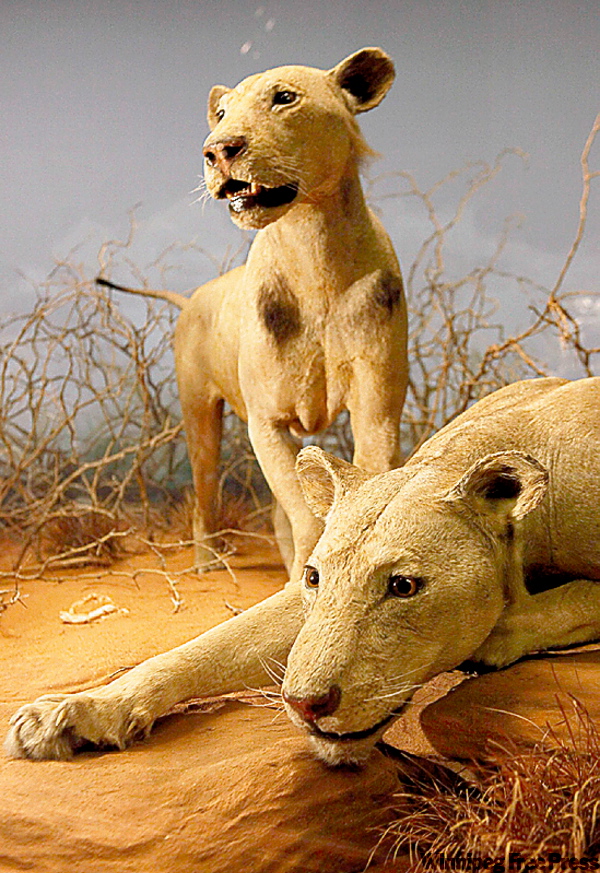
The death toll had been estimated at 28 railway workers and "scores of unfortunate African natives," with the total ranging as high as 135. Delay of the railroad was even subject to debate in Britain’s House of Commons.
Scientists hoping to figure out the actual number of people eaten decided to study the remains of the two male lions, now on display at the Field Museum of Natural History in Chicago, testing the types of carbon and nitrogen in their teeth and hair. Those chemical ratios were compared with the carbon and nitrogen found in modern lions in the region, in lions’ normal prey animals and in humans. Bones and teeth store carbon and nitrogen isotopes over long periods, while the ratios in hair change more rapidly, allowing the scientists to determine the long-term diet and how it changed in the lions’ last months.
Humans made up at least half of the diet of one of the lions in the last months of his life, consuming at least 24 people, they concluded. The other lion had eaten 11 people, researchers led by anthropologist Nathaniel J. Dominy and Justin D. Yeakel of the University of California, Santa Cruz, report in Tuesday’s edition of Proceedings of the National Academy of Sciences.
They noted estimates of the death toll at the time ranged from 28 reported by the Ugandan Railway Company, to 135, claimed by Lt. Col. John H. Patterson, a British officer who killed the lions in December, 1898.
The researchers did note their study covers only the number of people eaten, while the number killed may have been higher.
The killings occurred at a time when drought and disease sharply reduced the number of grazing animals that are the normal food for the lions, while at the same time construction of the railway brought an increased number of people into the area.
— The Associated Press