

No escape for Libyan refugees
Fleeing migrant workers forced back to work
Advertisement
Read this article for free:
or
Already have an account? Log in here »
To continue reading, please subscribe:
Monthly Digital Subscription
$0 for the first 4 weeks*
- Enjoy unlimited reading on winnipegfreepress.com
- Read the E-Edition, our digital replica newspaper
- Access News Break, our award-winning app
- Play interactive puzzles
*No charge for 4 weeks then price increases to the regular rate of $19.95 plus GST every four weeks. Offer available to new and qualified returning subscribers only. Cancel any time.
Monthly Digital Subscription
$4.99/week*
- Enjoy unlimited reading on winnipegfreepress.com
- Read the E-Edition, our digital replica newspaper
- Access News Break, our award-winning app
- Play interactive puzzles
*Billed as $19.95 plus GST every four weeks. Cancel any time.
To continue reading, please subscribe:
Add Free Press access to your Brandon Sun subscription for only an additional
$1 for the first 4 weeks*
*Your next subscription payment will increase by $1.00 and you will be charged $16.99 plus GST for four weeks. After four weeks, your payment will increase to $23.99 plus GST every four weeks.
Read unlimited articles for free today:
or
Already have an account? Log in here »
Hey there, time traveller!
This article was published 09/03/2011 (5412 days ago), so information in it may no longer be current.
GENEVA — Soldiers loyal to Libyan strongman Moammar Gadhafi have blocked some 30,000 migrant workers from fleeing into Tunisia and forced many to return to work in the Libyan capital, a Red Crescent official said Tuesday.
The migrant workers were rounded up and apparently held in Libyan immigration buildings near the Tunisian border last week, Ibrahim Osman of the International Federation of Red Cross and Red Crescent Societies told The Associated Press.
Osman, who heads the agency’s assessment teams in northern Africa, said Gadhafi soldiers were forcibly returning many of the 30,000 Bangladeshis, Egyptians and sub-Saharan Africans nearing the Ras Ajdir border crossing.
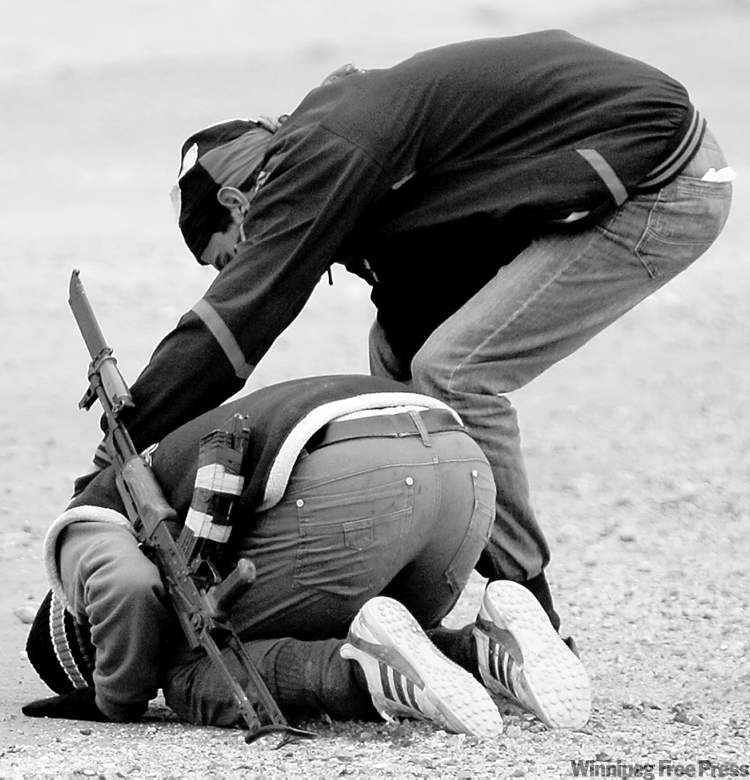
Osman said it’s possible some of them got into Tunisia with other successful migrants, but he assumes the 30,000 were crammed into the Libyan border offices to be processed and then returned to Tripoli.
“All of them are either Egyptians, Bangladeshis and Africans,” he said. “They were taken back to resume their services, because Tripoli used a lot of those people for basic workers, to clean the hospitals, to work…
As of Tuesday, 224,661 migrants had reached Libya’s borders with Tunisia, Egypt, Niger and Algeria since February 20, according to the latest International Organization for Migration figures provided Tuesday to AP.
Of those, 115,399 reached the Tunisia border; 101,609 got to the Egyptian border, 5,448 went to Algeria; and 2,205 fled to Niger.
Much of the humanitarian aid in Libya is being provided by Red Crescent volunteers who operate in the port city of Benghazi held by rebels, and in the government stronghold of Tripoli, where Osman said relief supplies are running out.
Meanwhile, U.S. President Barack Obama and British Prime Minister David Cameron conferred Tuesday on the spectrum of military and humanitarian responses to Libya’s worsening civil strife. The British leader bluntly said after the talk that the world cannot stand aside and let Moammar Gadhafi brutalize his people.
In weighing the options, the Obama administration underscored that any authorization of a no-fly zone over Libya must from the United Nations Security Council. The comment reflected Obama’s thinking that any action intended to halt Libya’s violence must carry the legitimacy and strength of an international coalition.
But military experts said a no-fly zone over Libya would likely have a limited impact on Moammar Gadhafi’s offensives against rebel forces and civilians.
Launching its annual report on international military might, the International Institute for Strategic Studies said the use of jets by Gadhafi loyalists appeared to pose less of a threat than the deployment of attack helicopters — which can get around flight prohibitions because they are harder to detect.
The report also warned that defence budget cuts in the West over the last year had accelerated a shift in military powers toward emerging countries in Asia and the Middle East.
Libya’s rebel movement has been countered by overwhelming power from Gadhafi loyalists. Pro-regime forces halted its drive on Tripoli with a heavy barrage of rockets in the east and threatened Tuesday to recapture the closest rebel-held city to the capital in the west.
The continuing violence increased pressure, from NATO to Washington, for intervention.
Rebels are fighting to oust Gadhafi from power after more than 41 years. His bloody crackdown has left hundreds, and perhaps thousands, dead.
— The Associated Press