

‘I thought I was going to die’
Earthquake, tsunami destroy homes, highways and shatter lives
Advertisement
Read this article for free:
or
Already have an account? Log in here »
To continue reading, please subscribe:

Digital Subscription
One year of digital access for only $205*
- Enjoy unlimited reading on winnipegfreepress.com
- Read the E-Edition, our digital replica newspaper
- Access News Break, our award-winning app
- Play interactive puzzles
*First annual payment billed as $205.00 + GST for one year. This annual subscription will automatically renew at $233.00 + GST every 52 weeks (10% off the regular annual price of $259.35). Offer available to new and qualified returning subscribers only. Cancel any time.
To continue reading, please subscribe:
Add Free Press access to your Brandon Sun subscription for only an additional
$1 for the first 4 weeks*
- Enjoy unlimited reading on winnipegfreepress.com
- Read the E-Edition, our digital replica newspaper
- Access News Break, our award-winning app
- Play interactive puzzles
*Your next Brandon Sun subscription payment will increase by $1.00 and you will be charged $17.95 plus GST for four weeks. After four weeks, your payment will increase to $24.95 plus GST every four weeks.
Read unlimited articles for free today:
or
Already have an account? Log in here »
Hey there, time traveller!
This article was published 12/03/2011 (5675 days ago), so information in it may no longer be current.
TOKYO — For more than two terrifying, seemingly endless minutes Friday, the most powerful earthquake ever recorded in Japan shook apart homes and buildings, cracked open highways and unnerved even those who have learned to live with swaying skyscrapers. Then came a devastating tsunami that slammed into northeastern Japan and killed hundreds of people.
The violent wall of water swept away houses, cars and ships. Fires burned out of control. Power to a cooling system at a nuclear power plant was knocked out, forcing thousands to flee. A boat was caught in the vortex of a whirlpool at sea.
The death toll rose steadily throughout the day, but the true extent of the disaster was not known because roads to the worst-hit areas were washed away or blocked by debris and airports were closed.
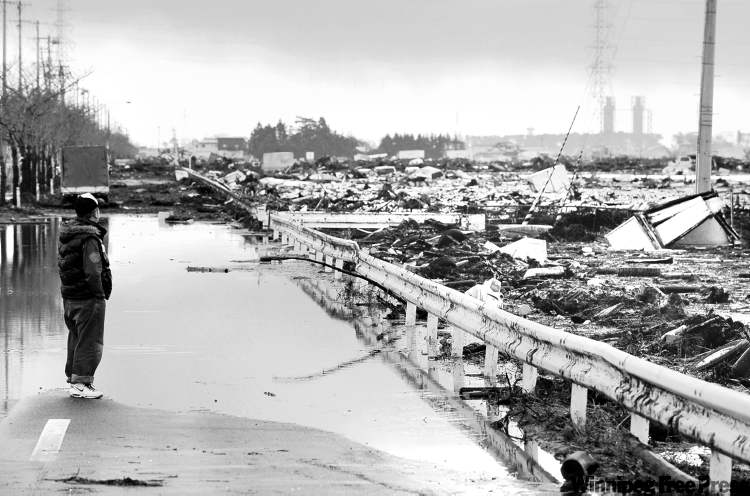
After dawn today, the scale of destruction became clearer.
Aerial scenes of the town of Ofunato showed homes and warehouses in ruins. Sludge and high water spread over acres of land, with people seeking refuge on roofs of partially submerged buildings. At one school, a large white “SOS” had been spelled out in English.
Chief Cabinet Secretary Yukio Edano said an initial assessment found “enormous damage,” adding the Defence Ministry was sending troops to the hardest-hit region.
U.S. President Barack Obama pledged assistance following what he called a potentially “catastrophic” disaster. He said one U.S. aircraft carrier is already in Japan and a second was on its way. A U.S. ship was also heading to the Marianas Islands to assist as needed, he added.
The entire Pacific had been put on alert — including coastal areas of South America, Canada and Alaska — but waves were not as bad as expected.
The magnitude-8.9 offshore quake struck at 2:46 p.m. local time and was the biggest to hit Japan since record-keeping began in the late 1800s.
The quake shook dozens of cities and villages along a 2,100-kilometre stretch of coast and tall buildings swayed in Tokyo, hundreds of kilometres from the epicenter. Prime Minister Naoto Kan was attending a parliamentary session at the time.
“I thought I was going to die,” said Tokyo marketing employee Koto Fujikawa. “It felt like the whole structure was collapsing.”
Fujikawa, 28, was riding a monorail when the quake hit and had to later pick her way along narrow, elevated tracks to the nearest station.
Minutes later, the earthquake unleashed a seven-metre tsunami along the northeastern coast of Japan near the coastal city of Sendai in Miyagi prefecture. The quake was followed for hours by aftershocks. Data from the U.S. Geological Survey showed there were 124 quakes off Japan’s main island of Honshu, 111 of them of magnitude 5.0 or higher.
Large fishing boats and other vessels rode the high waves ashore, slamming against overpasses or scraping under them and snapping power lines along the way. A fleet of partially submerged cars bobbed in the water. Ships anchored in ports crashed against each other.
The tsunami roared over embankments, washing anything in its path inland before reversing direction and carrying the cars, homes and other debris out to sea. Flames shot from some of the homes, apparently from burst gas pipes.
Waves of muddy waters flowed over farms near Sendai, carrying buildings, some of them ablaze. Drivers attempted to flee. The tarmac at Sendai’s airport was inundated with thick, muddy debris that included cars, trucks, buses and even light planes.
Highways to the worst-hit coastal areas buckled. Telephone lines snapped. Train service was suspended in northeastern Japan and in Tokyo, which normally serves 10 million people a day. Untold numbers of people were stranded in stations or roaming the streets. Tokyo’s Narita airport was closed indefinitely.
Police said 200 to 300 bodies were found in Sendai, although the official casualty toll was 185 killed, 741 missing and 948 injured.
A ship with 80 dock workers was swept away from a shipyard in Miyagi. Everyone aboard the ship was believed safe, although the vessel had sprung a leak and was taking on some water, Japan’s coast guard said.
In the coastal town of Minami-soma, about 1,800 houses were destroyed or ravaged, a Defence Ministry spokeswoman said. Fire burned well past dark in a large section of Kesennuma, a city of 70,000 people in Miyagi.
A resident in Miyagi prefecture who had been stranded on his roof, surrounded by water, mud and fallen trees, was lifted to safety by a Self-Defence Force helicopter safety tether this morning, TV footage showed.
A large fire erupted at the Cosmo oil refinery in the city of Ichihara and burned out of control with 30-metre flames whipping into the sky.
Also in Miyagi prefecture, a fire broke out in a turbine building of a nuclear power plant, but it was later extinguished, said Tohoku Electric Power Co.
Japanese automakers Toyota, Nissan and Honda halted production at some assembly plants in areas hit by the quake. One worker was killed and more than 30 injured after being crushed by a collapsing wall at a Honda Motor Co. research facility in northeastern Tochigi prefecture, the company said.
Jesse Johnson, a native of Nevada who lives in Chiba, north of Tokyo, was eating at a sushi restaurant with his wife when the quake hit.
“At first it didn’t feel unusual, but then it went on and on. So I got myself and my wife under the table,” he told the AP. “I’ve lived in Japan for 10 years and I’ve never felt anything like this before. The aftershocks keep coming. It’s gotten to the point where I don’t know whether it’s me shaking or an earthquake.”
Early today, a magnitude-6.6 earthquake struck the central, mountainous part of Japan — far from the original quake’s epicenter. It was not immediately clear if that temblor was related to the others.
—- The Associated Press
6.8 quake strikes on Saturday
SENDAI, Japan — Huge earthquakes rocked northeastern Japan on Saturday, a day after a giant temblor set off a powerful tsunami.
The United States Geological Survey said a strong earthquake struck just before noon in the sea in virtually the same place where the magnitude 8.9 quake on Friday unleashed one of the greatest disasters Japan has witnessed — a 23-foot (7-meter) tsunami.
Saturday’s magnitude 6.8 quake was followed by a series of temblors originating from the same area, the USGS said. It was not immediately known whether the new quakes caused any more damage. All were part of the more than 125 aftershocks since Friday’s massive quake.
— The Associated Press

Advertisement Advertise With Us
Advertisement Advertise With Us