

Quake could be felt through world economy
Japan focuses on recovery, needs refined fuels
Advertisement
Read this article for free:
or
Already have an account? Log in here »
To continue reading, please subscribe:

Digital Subscription
One year of digital access for only $205*
- Enjoy unlimited reading on winnipegfreepress.com
- Read the E-Edition, our digital replica newspaper
- Access News Break, our award-winning app
- Play interactive puzzles
*First annual payment billed as $205.00 + GST for one year. This annual subscription will automatically renew at $233.00 + GST every 52 weeks (10% off the regular annual price of $259.35). Offer available to new and qualified returning subscribers only. Cancel any time.
To continue reading, please subscribe:
Add Free Press access to your Brandon Sun subscription for only an additional
$1 for the first 4 weeks*
- Enjoy unlimited reading on winnipegfreepress.com
- Read the E-Edition, our digital replica newspaper
- Access News Break, our award-winning app
- Play interactive puzzles
*Your next Brandon Sun subscription payment will increase by $1.00 and you will be charged $17.95 plus GST for four weeks. After four weeks, your payment will increase to $24.95 plus GST every four weeks.
Read unlimited articles for free today:
or
Already have an account? Log in here »
Hey there, time traveller!
This article was published 12/03/2011 (5676 days ago), so information in it may no longer be current.
WASHINGTON — The powerful earthquake and tsunami that slammed northern Japan knocked out car plants and steel mills, stranded thousands in offices and at Disney’s resort in Tokyo, and pummelled financial markets in Asia and Europe. But the biggest effect on the world economy may yet come in further roiling oil prices that already have cast a pall on the global recovery.
That’s because the 8.9-magnitude temblor forced the shutdown of a number of Japan’s oil refining facilities as well as some of its nuclear power plants. The loss of substantial refining capacity in the world’s third-largest economy is likely to inject more volatility into gasoline prices — raising the risk of even higher pump prices for American motorists.
Industry experts say if Japan can’t get its refineries back online quickly, there will be a spike in that country’s demand for gasoline, diesel and jet fuel. Global suppliers, including refineries in California, may find it more profitable to increase shipments to Japan instead of selling the fuel domestically, resulting in a bidding-up of prices.
“It’s a ‘yikes’ situation,” said James DiGeorgia, editor of the Gold & Energy Advisor. “The sudden importation of large amounts of distilled products is expensive and it’s a heavy logistics burden. That is going to drive up the market price for everything from diesel and gasoline to jet fuel.”
Experts say Canada stands to lose out on short-term trade as Japan focuses on recovering from the earthquake. Japan imported about $9.2 billion of Canadian goods last year, including wheat, lumber, coal and minerals used in manufacturing.
But with several Japanese factories shut down following the disaster, the focus will be on recovery rather than producing cars and goods.
Japanese authorities declared a state of emergency Saturday for five nuclear reactors at two quake-stricken power plants as military and utility officials scrambled to tame rising pressure and radioactivity levels inside the units and stabilize the facilities used to cool the plants’ hot reactor cores.
Radiation surged to around 1,000 times the normal level in the control room of one reactor, Japan’s Nuclear and Industrial Safety Agency (NISA) said.
On Saturday, an official with Japan’s nuclear safety commission says that a meltdown at nuclear power plant affected by the country’s massive earthquake is possible.
Ryohei Shiomi said Saturday that officials were checking whether a meltdown had taken place at the Fukushima Dai-ichi power plant, which had lost cooling ability in the aftermath of Friday’s powerful earthquake.
Shiomi said that even if there was a meltdown, it wouldn’t affect humans within a six-mile (10-kilometre) radius.
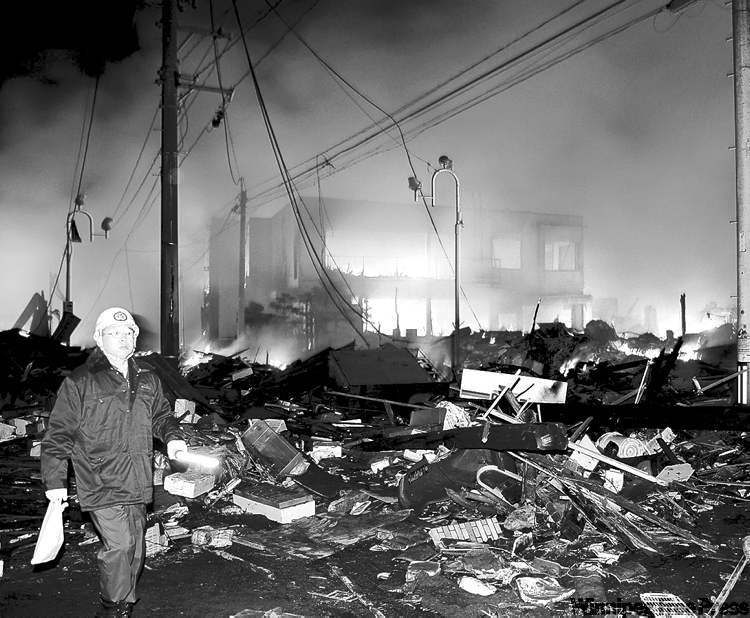
Bob van der Valk, a fuel-price specialist and consultant, took note of news footage of a refinery burning in Japan.
“Someone is going to have to make up for that,” he said. “That could come from the West Coast.”
American consumers can ill afford to pay more for gas. On Friday, the U.S. average for a gallon of regular gasoline was $3.54, up 7 cents from a week earlier, according to AAA. The California average was $3.94.
Oil prices declined sharply Friday, with crude futures briefly dipping below $100 a barrel.
— McClatchy and other wire services


Advertisement Advertise With Us