

Fly-sized frog world’s tiniest vertebrate
Advertisement
Read this article for free:
or
Already have an account? Log in here »
To continue reading, please subscribe:
Digital Subscription
One year of digital access for only $75*
- Enjoy unlimited reading on winnipegfreepress.com
- Read the E-Edition, our digital replica newspaper
- Access News Break, our award-winning app
- Play interactive puzzles
*Billed as $5.77 plus GST every four weeks. After 52 weeks, price increases to the regular rate of $19.95 plus GST every four weeks. Offer available to new and qualified returning subscribers only. Cancel any time.
Monthly Digital Subscription
$4.99/week*
- Enjoy unlimited reading on winnipegfreepress.com
- Read the E-Edition, our digital replica newspaper
- Access News Break, our award-winning app
- Play interactive puzzles
*Billed as $19.95 plus GST every four weeks. Cancel any time.
To continue reading, please subscribe:
Add Free Press access to your Brandon Sun subscription for only an additional
$1 for the first 4 weeks*
- Enjoy unlimited reading on winnipegfreepress.com
- Read the E-Edition, our digital replica newspaper
- Access News Break, our award-winning app
- Play interactive puzzles
*Your next Brandon Sun subscription payment will increase by $1.00 and you will be charged $17.95 plus GST for four weeks. After four weeks, your payment will increase to $24.95 plus GST every four weeks.
Read unlimited articles for free today:
or
Already have an account? Log in here »
Hey there, time traveller!
This article was published 12/01/2012 (5242 days ago), so information in it may no longer be current.
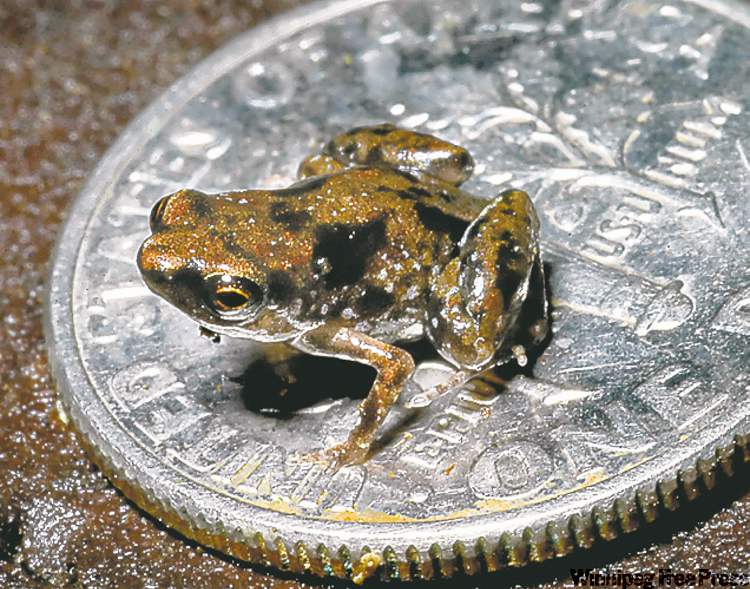
TORONTO — It’s only the size of a housefly, but this critter doesn’t take to the air on wings — it hops.
The unimaginably tiny frog, averaging just 7.7 millimetres from snout to butt, has now earned the distinction of being the smallest vertebrate in the world.
Named after the Amau River in Papua New Guinea where it was discovered, Paedophryne amauensis has a mighty voice for its size, said one of the biologists who unearthed the amphibian during a three-month expedition in 2009.
“It does not sound like a frog, it sounds like an insect,” Christopher Austin of Louisiana State University said in a telephone interview from Baton Rouge. “And it’s these… single notes that continuously come out of the frog, like tink, tink, tink, tink, tink, but really high-pitched.”
That repetitive mating call amid the cacophony of sound made by various creatures in the nighttime tropical forest drew Austin and his post-doctoral student Eric Rittmeyer.
“For some reason, we decided to try to find out what was making this call. And there were lots of them calling in this one area,” Austin recalled. “I think biologists by nature are sort of curious individuals, and I think that’s what sort of drives us into science — to answer questions.”
Their reaction when they discovered the miniature hopper was something like “Holy cow,” Austin said.
“They’re also incredible jumpers,” he said, noting the puny frog can leap a distance about 30 times its body length — about 25 centimetres. To put that in perspective, it would be the same as a six-foot man leaping 54 metres.
“Presumably that’s to avoid predation by other large invertebrates in the leaf litter,” such as scorpions, said Austin, who describes the discovery in the journal PLoS One (www.plosone.org) on Wednesday.
While the scientists haven’t seen P. amauensis eat, Austin suspects it chows down on almost microscopically small insects in its leaf-litter habitat. Nor have they seen its eggs or newly hatched froglets, both of which Austin would like to search for when he returns to the area this summer.
What they do know from genetic sequencing is the tiny frog, which weighs 0.02 grams, has likely been around for millions of years; it was just never found and described before.
“They’re so small that even with the naked eye, they’re very difficult to see.”
— The Canadian Press