

Miss this show and you’ll wait 105 years
Transit of Venus to occur Tuesday
Advertisement
Read this article for free:
or
Already have an account? Log in here »
To continue reading, please subscribe:

Digital Subscription
One year of digital access for only $205*
- Enjoy unlimited reading on winnipegfreepress.com
- Read the E-Edition, our digital replica newspaper
- Access News Break, our award-winning app
- Play interactive puzzles
*First annual payment billed as $205.00 + GST for one year. This annual subscription will automatically renew at $233.00 + GST every 52 weeks (10% off the regular annual price of $259.35). Offer available to new and qualified returning subscribers only. Cancel any time.
To continue reading, please subscribe:
Add Free Press access to your Brandon Sun subscription for only an additional
$1 for the first 4 weeks*
- Enjoy unlimited reading on winnipegfreepress.com
- Read the E-Edition, our digital replica newspaper
- Access News Break, our award-winning app
- Play interactive puzzles
*Your next Brandon Sun subscription payment will increase by $1.00 and you will be charged $17.95 plus GST for four weeks. After four weeks, your payment will increase to $24.95 plus GST every four weeks.
Read unlimited articles for free today:
or
Already have an account? Log in here »
Hey there, time traveller!
This article was published 02/06/2012 (5213 days ago), so information in it may no longer be current.
LOS ANGELES — It’s a spectacle that won’t repeat for another century — the sight of Venus slowly inching across the face of the sun.
So unless scientists discover the fountain of youth, none of us alive today will likely ever witness this celestial phenomenon again, dubbed a “transit of Venus.”
It’s so unique museums and schools around the globe are hosting Venus-viewing festivities — all for a chance to see our star sport a fleeting beauty mark. Even astronauts aboard the International Space Station plan to observe the event.
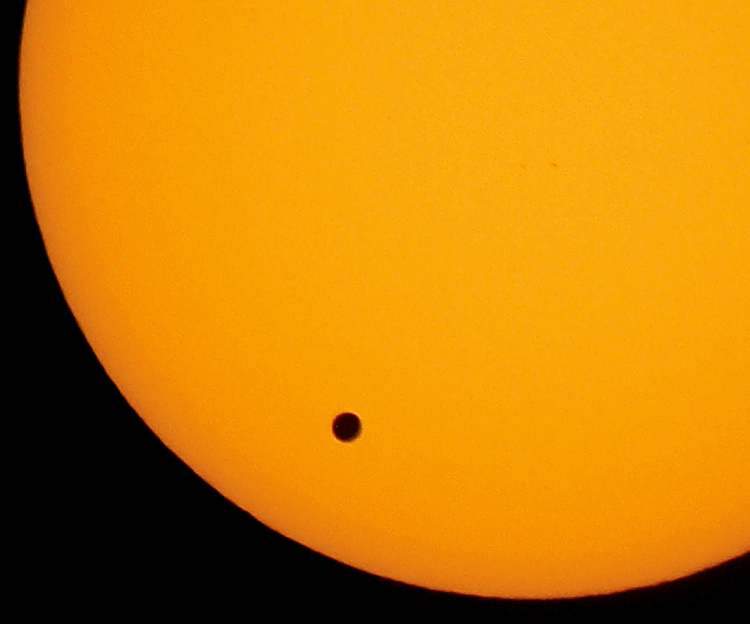
The drama unfolds Tuesday afternoon from the Western Hemisphere (Wednesday morning from the Eastern Hemisphere.)
Venus will appear as a small black dot gliding across the disk of the sun. As in a solar eclipse, do not stare directly at the sun; wear special protective glasses.
The entire transit, lasting six hours and 40 minutes, will be visible from the western Pacific, eastern Asia and eastern Australia.
Skywatchers in the United States, Canada, Mexico, Central America and the northern part of South America will see the beginning of the show before the sun sets. Europe, western and central Asia, eastern Africa and western Australia will catch the tail end after sunrise. Those who don’t want to leave their homes can follow live webcasts by NASA and various observatories.
“Anything silhouetted on the sun looks interesting. Seeing Venus is extremely rare,” said astronomer Anthony Cook of the Griffith Observatory.
Perched on the south slope of Mount Hollywood in Los Angeles, the observatory is girding for heavy traffic Tuesday afternoon as throngs are expected to peer through telescopes with special filters set up on the lawn.
Skygazers who want the full experience are flocking to Hawaii, considered one of the prime viewing spots since the whole transit will be visible. From the world-famous Waikiki Beach on Oahu to the summit of Mauna Kea on the Big Island, eclipse glasses will be passed out so people can safely see Venus crossing without damaging their eyes.
Just remember to have patience.
“There’s no one big climactic moment. It takes longer to happen” than a solar or lunar eclipse, said Larry O’Hanlon, who does outreach at the W.M. Keck Observatory on the Big Island.
The second planet from the sun between Mercury and Earth, Venus is about the same size as Earth. It appears as one of the brightest objects in the night sky because its thick clouds reflect much of the sunlight back into space.
There will be no obvious change to the brightness of the sky during the event; Venus only blocks out a tiny fraction of the sun.
“You have to know it’s happening,” said David DeVorkin, a senior curator at the Smithsonian’s National Air and Space Museum.
Venus is the third celestial show to grace the sky in less than a month. Just a day earlier, a partial lunar eclipse will be visible from western North America, South America, Australia and eastern Asia. And there was the much-hyped “ring of fire” solar eclipse on May 20.
Unlike eclipses, Venus transits are truly rare. They come in pairs, separated by more than 100 years. The last one occurred in 2004 and the next pair in 2117 and 2125.
Since the German astronomer Johannes Kepler first predicted it in the 17th century, only six have been observed. The upcoming one will be the seventh.
Only two people were said to have seen the transit of 1639. The 1882 transit was a bigger deal — people jammed the sidewalks of New York City and paid 10 cents to peek through a telescope. John Philip Sousa even composed a score called Transit of Venus March.
The one in 2004 was viewed by millions — in person and online.
University of Alabama astronomer William Keel was determined not to miss the 2004 transit, the first one in 122 years. But he only caught 45 minutes of the action before clouds rolled in. This time, he plans to set up telescopes on the roof and hopes for clear skies.
The early Venus viewings were a big deal to scientists who used the alignment to measure the size of our solar system. The technique is still used today to search for alien worlds outside our solar system.
— The Associated Press

Advertisement Advertise With Us
Advertisement Advertise With Us