

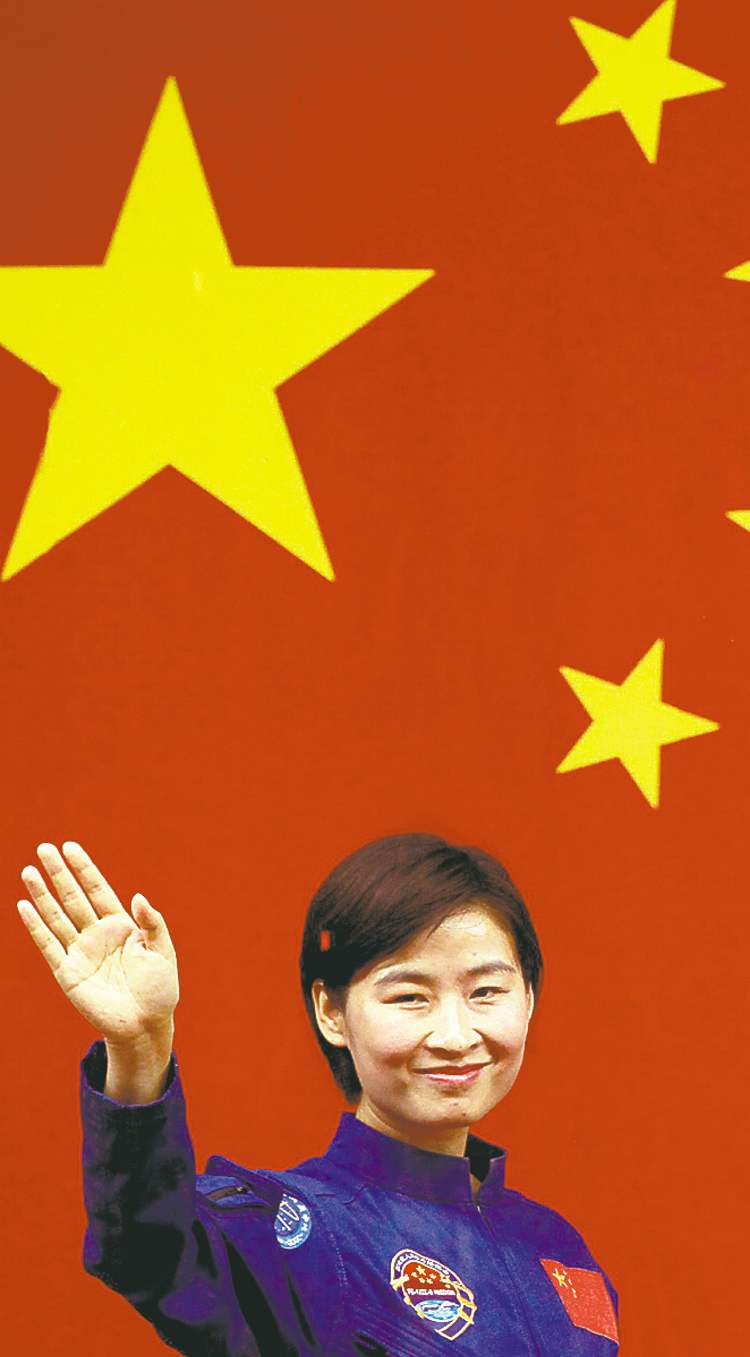
The first Chinese female astronaut
Air force pilot joins nation's space efforts
Advertisement
Read this article for free:
or
Already have an account? Log in here »
To continue reading, please subscribe:
Monthly Digital Subscription
$1 per week for 24 weeks*
- Enjoy unlimited reading on winnipegfreepress.com
- Read the E-Edition, our digital replica newspaper
- Access News Break, our award-winning app
- Play interactive puzzles
*Billed as $4.00 plus GST every four weeks. After 24 weeks, price increases to the regular rate of $19.95 plus GST every four weeks. Offer available to new and qualified returning subscribers only. Cancel any time.
Monthly Digital Subscription
$4.99/week*
- Enjoy unlimited reading on winnipegfreepress.com
- Read the E-Edition, our digital replica newspaper
- Access News Break, our award-winning app
- Play interactive puzzles
*Billed as $19.95 plus GST every four weeks. Cancel any time.
To continue reading, please subscribe:
Add Free Press access to your Brandon Sun subscription for only an additional
$1 for the first 4 weeks*
*Your next subscription payment will increase by $1.00 and you will be charged $16.99 plus GST for four weeks. After four weeks, your payment will increase to $23.99 plus GST every four weeks.
Read unlimited articles for free today:
or
Already have an account? Log in here »
Hey there, time traveller!
This article was published 16/06/2012 (4975 days ago), so information in it may no longer be current.
JIUQUAN, China — China will send its first woman and two other astronauts into space Saturday to work on a temporary space station for about a week, in a key step toward becoming only the third nation to set up a permanent base in orbit.
Liu Yang, a 34-year-old air force pilot, and two male colleagues will be launched today aboard the Shenzhou 9 spacecraft, which will dock with the bus-sized Tiangong 1 space module now orbiting at 343 kilometres (213 miles) above the Earth.
“Arranging for women astronauts to fly is not only a must for the development of human spaceflight, but also the expectation of the public,” space program spokeswoman Wu Ping said. “This is a landmark event.”
Two of the astronauts will live and work inside the module to test its life-support systems while the third will remain in the capsule to deal with any unexpected emergencies. Wu said the mission will last more than 10 days before the astronauts return to Earth in the capsule, landing by parachute on Western Chinese grasslands.
The rocket began fueling Friday at the Jiugquan Satellite Launch Center on the edge of the Gobi desert in northern China, Wu told reporters at the centre. The launch is scheduled for 6:37 p.m. (1237 GMT) Saturday, she said.
Joining Liu, a major, is veteran astronaut and mission commander Jing Haipeng and newcomer Liu Wang, both air force senior colonels.
“You could say this mission is a combination of the old and the new and co-ordination between the male and female,” Wu said.
Success in docking — and in living and working aboard the Tiangong 1 — would smooth the way for more ambitious projects, including the creation of a permanent space station and missions to the moon, and add to China’s prestige in line with its economic prowess.
China is hoping to join the United States and Russia as the only countries to have sent independently maintained space stations into orbit. It already is in the exclusive three-nation club to have launched a spacecraft with astronauts on its own.
The mission demonstrates China’s commitment to “long-term human spaceflight” and marks a test of “the technological capabilities requisite for a future permanent space station,” said Joan Johnson-Freese, an expert on the Chinese space program at the U.S. Naval War College in Rhode Island.
Still, that is some years away. The Tiangong 1 is only a prototype, and the plan is to replace it with a permanent — and bigger — space station due for completion around 2020.
Analysts say China’s exclusion from the ISS, largely on objections from the United States, was one of the key spurs for it to pursue an independent program 20 years ago, which reaches a high point with Saturday’s launch.
China first launched a man into space in 2003, followed by a two-man mission in 2005 and a three-man trip in 2008 that featured China’s first space walk.
— The Associated Press