

Deformed butterflies linked to meltdown
Humans mostly unaffected by radiation
Advertisement
Read this article for free:
or
Already have an account? Log in here »
To continue reading, please subscribe:
Digital Subscription
One year of digital access for only $1.44 a week*
- Enjoy unlimited reading on winnipegfreepress.com
- Read the E-Edition, our digital replica newspaper
- Access News Break, our award-winning app
- Play interactive puzzles
*Billed as $5.77 plus GST every four weeks. After 52 weeks, price increases to the regular rate of $19.95 plus GST every four weeks. Offer available to new and qualified returning subscribers only. Cancel any time.
To continue reading, please subscribe:
Add Free Press access to your Brandon Sun subscription for only an additional
$1 for the first 4 weeks*
- Enjoy unlimited reading on winnipegfreepress.com
- Read the E-Edition, our digital replica newspaper
- Access News Break, our award-winning app
- Play interactive puzzles
*Your next Brandon Sun subscription payment will increase by $1.00 and you will be charged $17.95 plus GST for four weeks. After four weeks, your payment will increase to $24.95 plus GST every four weeks.
Read unlimited articles for free today:
or
Already have an account? Log in here »
Hey there, time traveller!
This article was published 17/08/2012 (5040 days ago), so information in it may no longer be current.
TOKYO — Radiation that leaked from the Fukushima nuclear plant following last year’s tsunami caused mutations in some butterflies — including dented eyes and stunted wings — though humans seem relatively unaffected, researchers say.
The mutations are the first evidence the radiation has caused genetic changes in living organisms. They are likely to add to concerns about potential health risks among humans, though there is no evidence of it yet. Scientists say more study is needed to link human health with the Fukushima disaster.
The catastrophic meltdowns in three reactors of Fukushima Dai-ichi power plant after it was damaged by the 9.0-magnitude earthquake and tsunami on March 11, 2011, prompted a public backlash against nuclear power, and forced the government to reassess its energy strategy. But the most visible example of the radiation’s effect was discovered by a group of Japanese researchers who found radical changes in successive generations of a type of butterfly, which they said was caused by radiation exposure. They also said the threat to humans remains unclear.
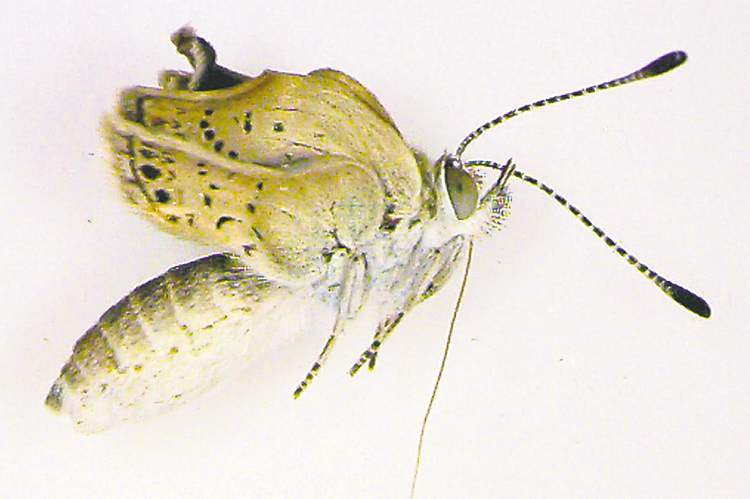
“Our findings suggest that the contaminants are causing ecological damage. I do not know its implication to humans,” Joji Otaki of the University of the Ryukyus in Okinawa, a member of the research team, told The Associated Press in an email.
A separate study, released this week, found very low levels of radioactivity in people who were living near the plant when it suffered the meltdowns.
The paper, published in the Journal of the American Medical Association, measured cesium levels in 8,066 adults and 1,432 children and found average doses of less than one millisievert, which is considered safe. It was the first such study measuring internal exposures to cesium in a large number of people following the disaster.
The research shows contamination decreased over time, particularly among children, in part because more precautions were taken with their food, water and outdoor activity.
“No case of acute health problems has been reported so far; however, assessments of the long-term effect of radiation requires ongoing monitoring of exposure and the health conditions of the affected communities,” the report said.
So far, the radiation doses inflicted just after the accident are not exactly known, though exposure is thought to be minimal, said David J. Brenner, a radiation physicist at Columbia University, who was not part of the research.
“We do need improved estimates of the radiation dose that people in and near Fukushima prefecture actually received,” he said. “Right now our estimates are based on very, very rough calculations.”
The research on the butterflies was published in Scientific Reports, an open-access online journal.
It says pale grass blue butterflies, a common species in Japan, collected from several areas near the Fukushima plant showed signs of genetic mutations, such as malformed legs and antennae, and stunted wings.
The results show the butterflies deteriorated physically and genetically, with the share of those showing abnormalities increasing from 12 per cent in the first generation to 18 per cent in the second and 34 per cent in the third.
— The Associated Press