

Heightened security can’t stop every threat
Nothing can foil an attacker determined to kill
Advertisement
Read this article for free:
or
Already have an account? Log in here »
To continue reading, please subscribe:
Monthly Digital Subscription
$1 per week for 24 weeks*
- Enjoy unlimited reading on winnipegfreepress.com
- Read the E-Edition, our digital replica newspaper
- Access News Break, our award-winning app
- Play interactive puzzles
*Billed as $4.00 plus GST every four weeks. After 24 weeks, price increases to the regular rate of $19.95 plus GST every four weeks. Offer available to new and qualified returning subscribers only. Cancel any time.
Monthly Digital Subscription
$4.99/week*
- Enjoy unlimited reading on winnipegfreepress.com
- Read the E-Edition, our digital replica newspaper
- Access News Break, our award-winning app
- Play interactive puzzles
*Billed as $19.95 plus GST every four weeks. Cancel any time.
To continue reading, please subscribe:
Add Free Press access to your Brandon Sun subscription for only an additional
$1 for the first 4 weeks*
*Your next subscription payment will increase by $1.00 and you will be charged $16.99 plus GST for four weeks. After four weeks, your payment will increase to $23.99 plus GST every four weeks.
Read unlimited articles for free today:
or
Already have an account? Log in here »
Hey there, time traveller!
This article was published 16/04/2013 (4739 days ago), so information in it may no longer be current.
After nearly a dozen years of foiled plots, the United States on Monday suffered the first large-scale bombing since the attacks of Sept. 11, 2001, opened an era of heightened security affecting nearly every aspect of American life.
The disruption of those plots underscores the enormous strides the American national security apparatus has taken, including the adoption of policies that remain the subject of intense concern among human rights and civil liberties groups.
But the success of the strike on the Boston Marathon, an international symbol of a city’s pride, highlights the enduring difficulty U.S. officials face in impeding a determined attacker.
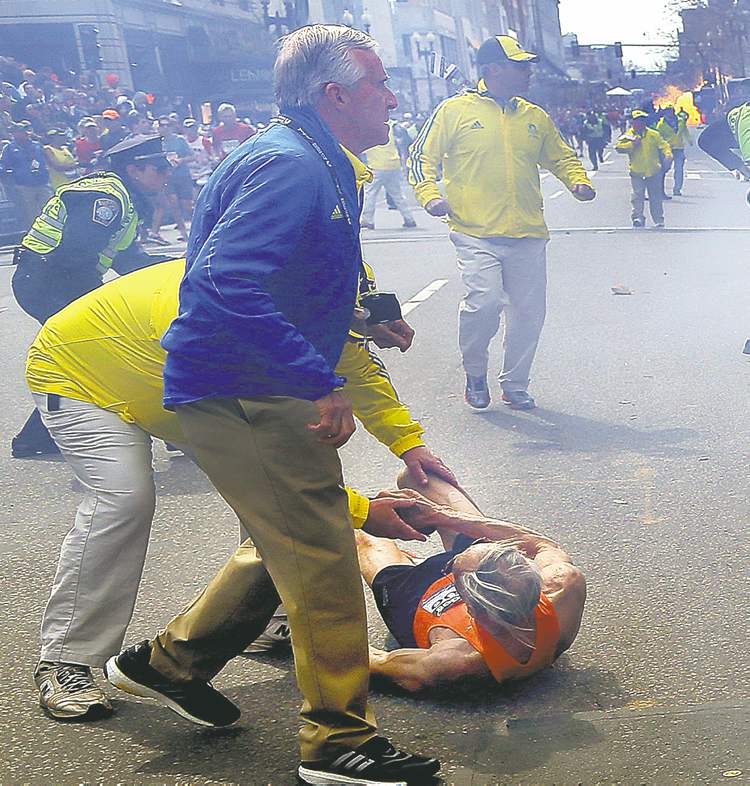
In remarks Monday evening, President Barack Obama did not label the bombings as terrorism, but a White House official, who spoke on the condition of anonymity, said the incident was an “act of terror,” the same term the president used in the aftermath of the attack on the U.S. diplomatic post in Benghazi, Libya, in September.
A former counterterrorism official said the Boston attack didn’t appear to have the signature of a co-ordinated al-Qaida bombing, in which a sophisticated explosive device packed with shrapnel is detonated in an enclosed space to maximize casualties. The evidence could point to a domestic group, but White House officials and investigators cautioned it was too soon to link the attack to any particular kind of perpetrator.
“At this stage, it’s perplexing,” said the former official, who would discuss an ongoing investigation only on the condition of anonymity. “It’s not a military or particularly iconic target like Times Square or the New York subway. This could be someone with limited or no foreign connections.”
From the FBI to local police departments, law-enforcement agencies have dramatically shifted their emphasis to counterterrorism over the past decade, gathering intelligence on both domestic and foreign extremist groups. The Bush and Obama administrations have created an enormous global apparatus designed to track and target terrorists.
But officials have always warned the United States cannot prevent every attempted strike on U.S. soil. In some recent plots, authorities have benefited as much from luck as investigative skill.
The last mass terrorist killing on U.S. soil was carried out by Maj. Nidal Hassan, an army psychiatrist, who fatally shot 13 people and wounded 30 more at Fort Hood, Texas, in November 2009. Hassan had connections to al-Qaida in the Arabian Peninsula and the American-born Islamic cleric Anwar al-Awlaki, who was later killed by a U.S. drone strike in Yemen.
But there have been a series of failed or foiled bomb plots since the Sept. 11 attacks.
Less than three months after airliners crashed into the World Trade Center and the Pentagon, Richard Reid tried to detonate a shoe filled with explosives on a flight from Miami to Paris.
Eight years later, Umar Farouk Abdulmutallab attempted to set off explosives in his underwear on a commercial flight near Detroit.
The bombs failed to detonate correctly in both cases.
In two other incidents, authorities were able to prevent bomb plots.
A September 2009 attempt to set off bombs in the New York City subway system by an al-Qaida associate was thwarted. And in May of the following year, Times Square in New York was evacuated after the discovery of a car bomb left by Faisal Shahzad, a dual citizen of Pakistan and the United States.
Monday’s attack evoked for many the wrenching scenes of Sept. 11, especially among those who witnessed the mid-afternoon explosions firsthand.
Charlotte Holler, 24, was working seven storeys above the scene in the Prudential Tower overlooking Boylston Street when she heard two thuds and felt the explosions rock the floor under her feet. For an instant, she thought that her building or something nearby was collapsing.
— The Washington Post
Related Articles
Dozens of Manitobans reported safe
Advertisement Advertise With Us
Advertisement Advertise With Us