

Ancient skull tells tales of evolution
Advertisement
Read this article for free:
or
Already have an account? Log in here »
To continue reading, please subscribe:
Monthly Digital Subscription
$1 per week for 24 weeks*
- Enjoy unlimited reading on winnipegfreepress.com
- Read the E-Edition, our digital replica newspaper
- Access News Break, our award-winning app
- Play interactive puzzles
*Billed as $4.00 plus GST every four weeks. After 24 weeks, price increases to the regular rate of $19.95 plus GST every four weeks. Offer available to new and qualified returning subscribers only. Cancel any time.
Monthly Digital Subscription
$4.99/week*
- Enjoy unlimited reading on winnipegfreepress.com
- Read the E-Edition, our digital replica newspaper
- Access News Break, our award-winning app
- Play interactive puzzles
*Billed as $19.95 plus GST every four weeks. Cancel any time.
To continue reading, please subscribe:
Add Free Press access to your Brandon Sun subscription for only an additional
$1 for the first 4 weeks*
*Your next subscription payment will increase by $1.00 and you will be charged $16.99 plus GST for four weeks. After four weeks, your payment will increase to $23.99 plus GST every four weeks.
Read unlimited articles for free today:
or
Already have an account? Log in here »
Hey there, time traveller!
This article was published 18/10/2013 (4551 days ago), so information in it may no longer be current.
DMANISI — The discovery of a 1.8-million-year-old skull of a human ancestor buried under a medieval Georgian village provides a vivid picture of early evolution and indicates our family tree may have fewer branches than some believe, scientists say.
The fossil is the most complete pre-human skull uncovered. With other partial remains previously found at the rural site, it gives researchers the earliest evidence of human ancestors moving out of Africa and spreading north to the rest of the world, according to a study published Thursday in the journal Science.
The skull and other remains offer a glimpse of a population of pre-humans of various sizes living at the same time — something scientists had not seen before for such an ancient era. This diversity bolsters one of two competing theories about the way our early ancestors evolved, spreading out more like a tree than a bush.
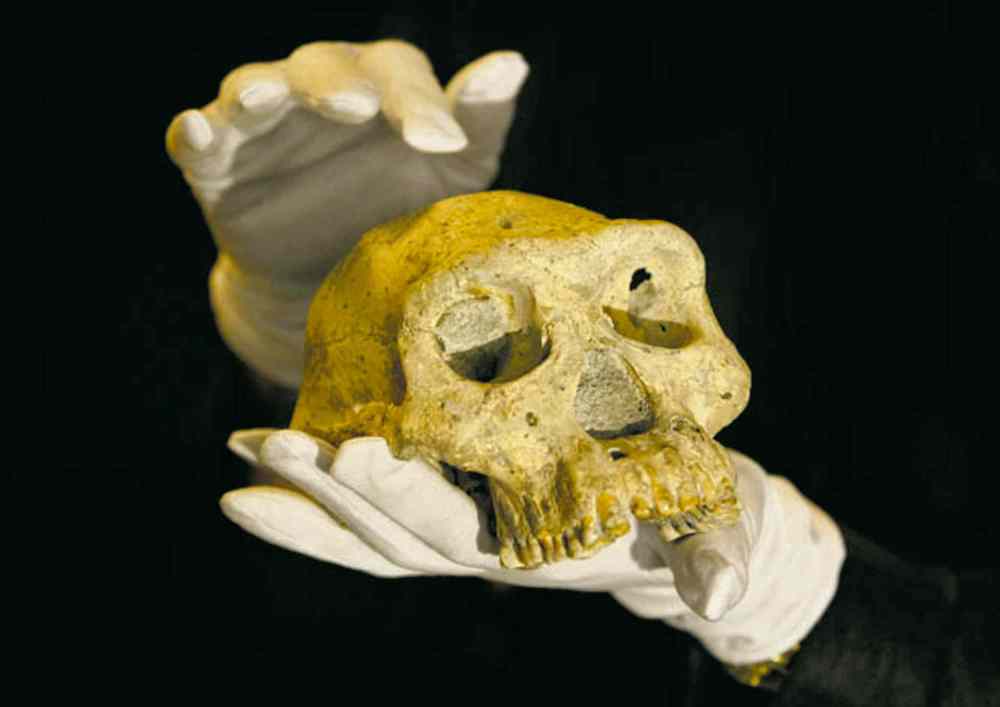
Nearly all of the previous pre-human discoveries have been fragmented bones, scattered over time and locations — like a smattering of random tweets of our evolutionary history. The findings at Dmanisi are more complete, weaving more of a short story. Before the site was found, the movement from Africa was put at about 1 million years ago.
When examined with the earlier Georgian finds, the skull “shows that this special immigration out of Africa happened much earlier than we thought and a much more primitive group did it,” said study lead author David Lordkipanidze, director of the Georgia National Museum. “This is important to understanding human evolution.”
For years, some scientists have said humans evolved from only one or two species, much like a tree branches out from a trunk, while others say the process was more like a bush with several offshoots that went nowhere.
Even bush-favouring scientists say these findings show one single species nearly two million years ago at the former Soviet republic site. But they disagree the same conclusion can be said for bones found elsewhere, such as Africa. However, Lordkipanidze and colleagues point out the skulls found in Georgia are different sizes but are considered to be the same species. So, they reason, it’s likely the various skulls found in different places and times in Africa may not be different species, but variations in one species.
To see how a species can vary, just look in the mirror, they said.
“Danny DeVito, Michael Jordan and Shaquille O’Neal are the same species,” Lordkipanidze said.
— The Associated Press