

A hard habit to break
Chinese tobacco industry generates billions in profit, but millions will die from related illnesses
Advertisement
Read this article for free:
or
Already have an account? Log in here »
To continue reading, please subscribe:
Monthly Digital Subscription
$1 per week for 24 weeks*
- Enjoy unlimited reading on winnipegfreepress.com
- Read the E-Edition, our digital replica newspaper
- Access News Break, our award-winning app
- Play interactive puzzles
*Billed as $4.00 plus GST every four weeks. After 24 weeks, price increases to the regular rate of $19.95 plus GST every four weeks. Offer available to new and qualified returning subscribers only. Cancel any time.
Monthly Digital Subscription
$4.99/week*
- Enjoy unlimited reading on winnipegfreepress.com
- Read the E-Edition, our digital replica newspaper
- Access News Break, our award-winning app
- Play interactive puzzles
*Billed as $19.95 plus GST every four weeks. Cancel any time.
To continue reading, please subscribe:
Add Free Press access to your Brandon Sun subscription for only an additional
$1 for the first 4 weeks*
*Your next subscription payment will increase by $1.00 and you will be charged $16.99 plus GST for four weeks. After four weeks, your payment will increase to $23.99 plus GST every four weeks.
Read unlimited articles for free today:
or
Already have an account? Log in here »
Hey there, time traveller!
This article was published 08/03/2014 (4410 days ago), so information in it may no longer be current.
The air in China can be deadly, and not only because of the smog.
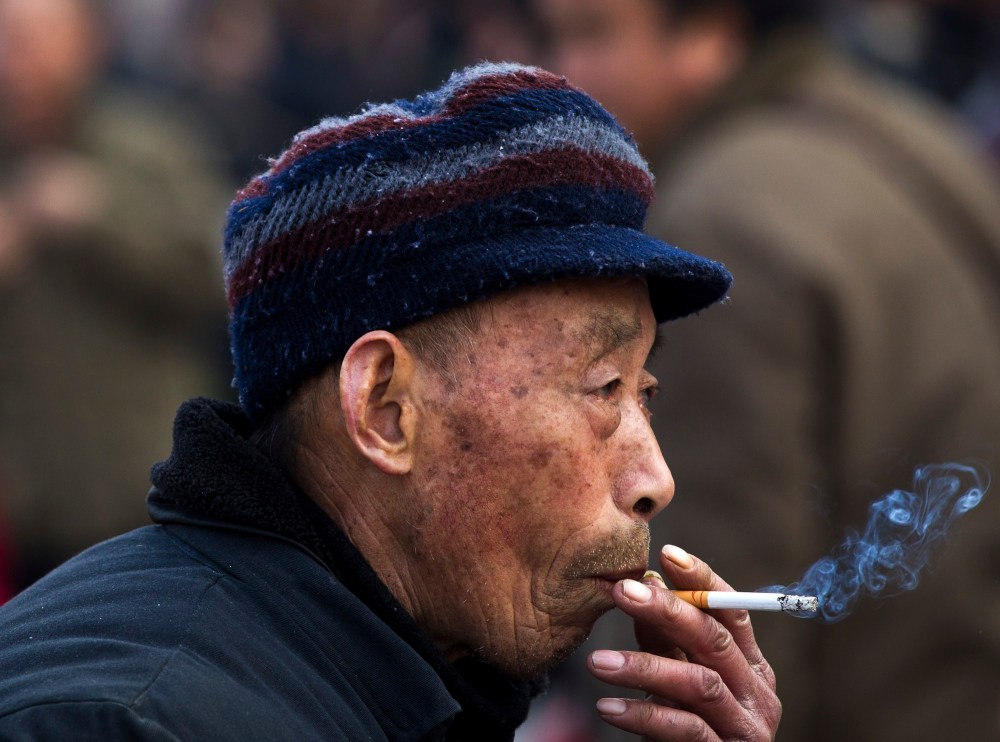
Some 300 million Chinese adults are smokers and, with more than 700 million people exposed to secondhand smoke, the country is paying a high price for its addiction. The prevalence of smoking is greater in countries such as Austria and Russia – more than half of Chinese men smoke, but barely two per cent of women do – but China is still the world’s largest cigarette market and, by present trends, 100 million people stand to die from tobacco-related illnesses this century. The resultant economic burden, estimated in the tens of billions of dollars, will soar as the economy and the cost of health care grow.
China is starting to take notice of the problem. Mao Zedong smoked like a chimney, but it is rare to see a senior leader smoking in public now. Peng Liyuan, China’s first lady, is even an official anti-smoking ambassador.
China also has taken a number of policy measures. It ratified the World Health Organization’s Framework Convention on Tobacco Control in 2005. The central government has promoted a partial ban on smoking in public places at health-care facilities and in schools, and some large cities have announced restrictions on smoking in indoor public places.
Although these proclamations look impressive on paper, however, they have not amounted to much in practice. Smoking is less common than it was in urban offices and restaurants, but China has hardly kicked the habit. The revenues of the Chinese cigarette-manufacturing industry shot up to $123 billion in 2012 from $47 billion in 2005, when the convention was ratified.
Medical studies add to the sense the damage done by tobacco is set to rise. Hence talk of beefing up efforts to curb smoking. At the end of 2013 the State Council, China’s cabinet, banned officials from smoking in hospitals, schools and on public transportation. The National Health and Family Planning Commission says it is working with the State Council on a nationwide ban on smoking in indoor public places.
Even then, though, the effect may be limited, for two reasons. The bans are half-measures that fall far short of the proven mix of policies advocated by experts, and the tobacco business is so entwined with government it is likely to thwart any effective anti-smoking effort.
WHO studies of what has worked around the world show anti-tobacco campaigns need six planks. The first is reliable data on tobacco use and prevention, which is lacking in China. The second is the sweeping imposition of smoking bans, not the partial bans still being promulgated in Beijing. Third, countries must help smokers quit with well-funded, accessible programs.
Another plank is to educate smokers on the harms of tobacco. A 2010 study published in the journal Tobacco Control suggested only two-fifths of Chinese believed smoking causes coronary heart disease and only a fifth knew it leads to strokes. The WHO also advocates a complete ban on marketing. China’s cigarette brands have found many ways to circumvent official prohibitions, however, for example by setting up charities that fund schools and sporting events in their name — though officials now say they will crack down on this practice.
The final prescription from the WHO is also the most important: heavy taxation. Many studies suggest tobacco taxes are highly effective in reducing consumption. This approach has worked in poor countries such as South Africa, as well as in rich ones such as France. However, Chinese cigarettes are taxed so lightly by international standards that the cheapest packs in rural areas sell for only 35 cents, and in cities a cheap pack costs only 85 cents.
A study published on Feb. 18 in the British Medical Journal uses a computer model to calculate what would happen if China properly implemented the WHO’s policy recommendations. By 2050, the computer suggested, nearly 13 million smoking-related deaths would be averted, and more than 154 million “life years” regained. It also predicts a 40 per cent reduction in the prevalence of smoking.
Will China listen to the experts?
Perhaps, but the second great obstacle is the influence of the tobacco lobby. China National Tobacco Corporation has a near-monopoly on tobacco sales in China. It is overseen by the State Tobacco Monopoly Administration — supposedly an independent entity, but the two share managers and a website and have intertwined organizational structures. Li Keming, brother of Prime Minister Li Keqiang, holds a senior post in both.
Cheng Li of the Brookings Institution, an American think-tank, calls this the “last bastion of China’s planned economy.”
Planners have consolidated the once-fragmented industry. In the decade prior to 2010, 185 cigarette firms and 1,800 brands have shrunk to only 30 firms and 133 brands. Foreign brands are relegated to a niche market in China, but the Chinese tobacco bigwigs now have their eyes on global expansion. They want to create major brands to go up against the Marlboro man overseas.
China’s government is hooked on cigarette revenue. In 2012, the tobacco industry turned over $117 billion in profits and taxes to government coffers, which made up six per cent of official revenue. Not surprisingly, tobacco is as big in Beijing politics as petroleum and property. In provinces such as Yunnan, where they grow tobacco, that influence is even greater.
In theory, the central government could drive up the cost of smoking without losing income. Since it controls the monopoly, any lost profits can be made up as tax revenue. Costlier cigarettes would not be popular on the street, however, and leaders may not want to risk it. And, since the industry regulates itself, it is unlikely to suppress the source of such handsome profits.